Snapfit, a welcome newcomer to the challenge this year, from Da Green Horde
And a definite maybe (not sure if he’s committed yet): the only one on this list with the same accent as me: Mark A. Morin, from the eponymous markamorin.com.
Also, a few of my Instagram friends are joining in:
Don’t see your name here and want to? Drop me a line with your info and you’re in! There’s still time to join the fun!
For my own sanity, I will post Monster May(hem) updates once a week rather than try to keep up with every submission…but the blogroll is here for a reason! Drop by the sites and accounts listed here and have a look for yourself! Support our fellow hobbyists!
There has been much speculation ’round the blogosphere (ok, it’s just been Dave) as to whether or not I plan on hosting my annual painting challenge this May, Monster May(hem), considering I have been scarcely seen around these parts lately and that my recent posting history has been somewhat erratic. The answer is yes.
As in yes, I am hosting Monster May(hem) for the fifth year in a row, and you are all most welcome to participate. How do you do that? Sound off in the comments on this post, or drop me an email at angrypiper@angrypiper.com, and tell me you’re in. And just like that, you’re in.
THE “RULES”: What is Monster May(hem)? Why, it’s the month you paint monsters, of course. Any monster will do, although it should be a proper MONSTER; no skeletons or orcs. I mean something truly beastly; like a wyvern or a shoggoth or an owlbear. Your monster(s) doesn’t have to be strictly a fantasy miniature, and it may be any scale and from any manufacturer. I will link to your stuff throughout the month, and (if it’s not there already) add your blog/website/social media to the blogroll on the side! If you don’t have a site of your own and still want to participate, I’ll happily host your pictures here and ensure you get proper attribution!
How many monsters you paint is up to you. The minimum is one, of course; but feel free to do as many as you like. The only caveat is that they get painted sometime in May. I usually average around five or so over the course of the month, but guys like Azazel and Matt regularly do more than everyone else combined, and Roger and Dave have even been known to sculpt their own monsters prior to painting! Talk about a bunch of overachievers!
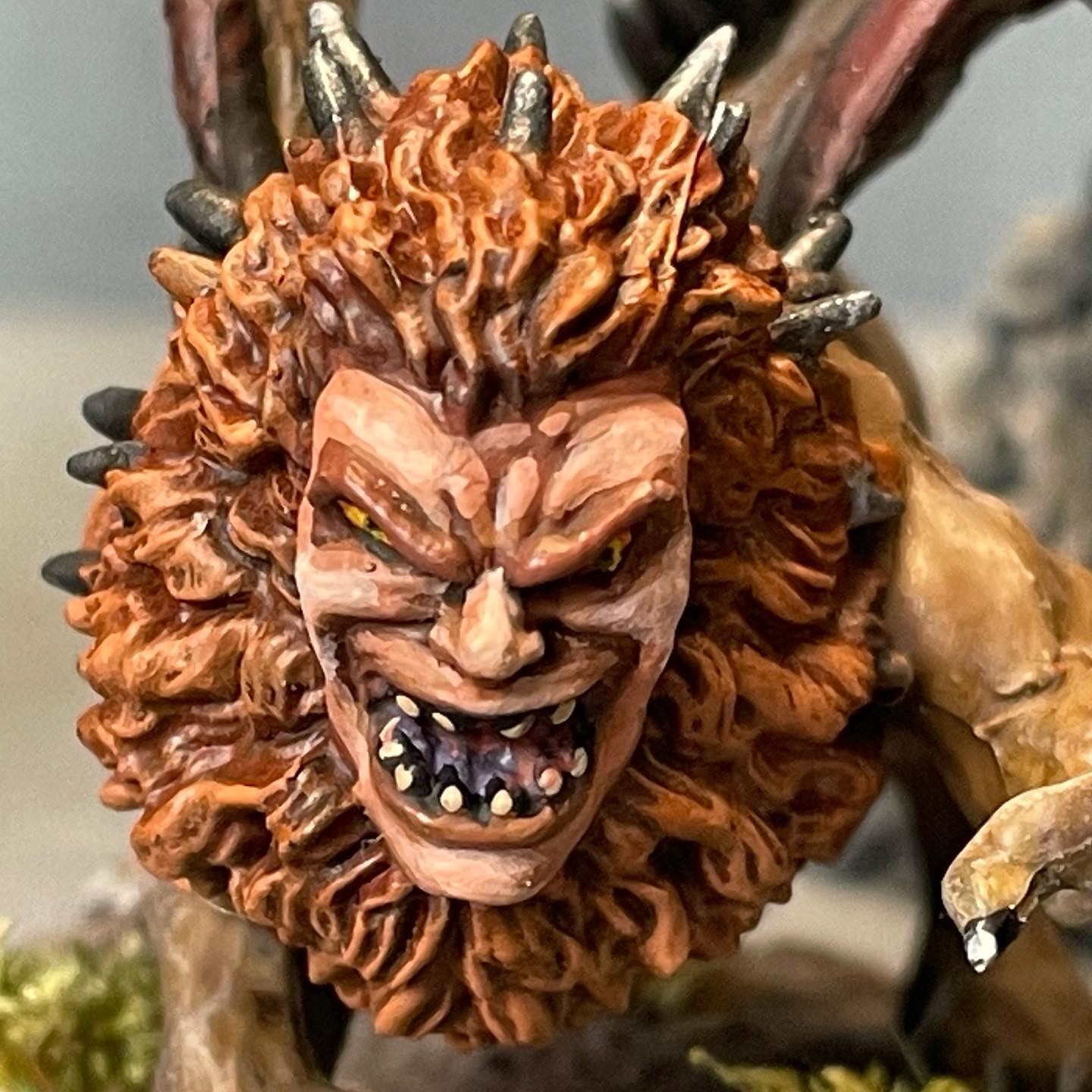
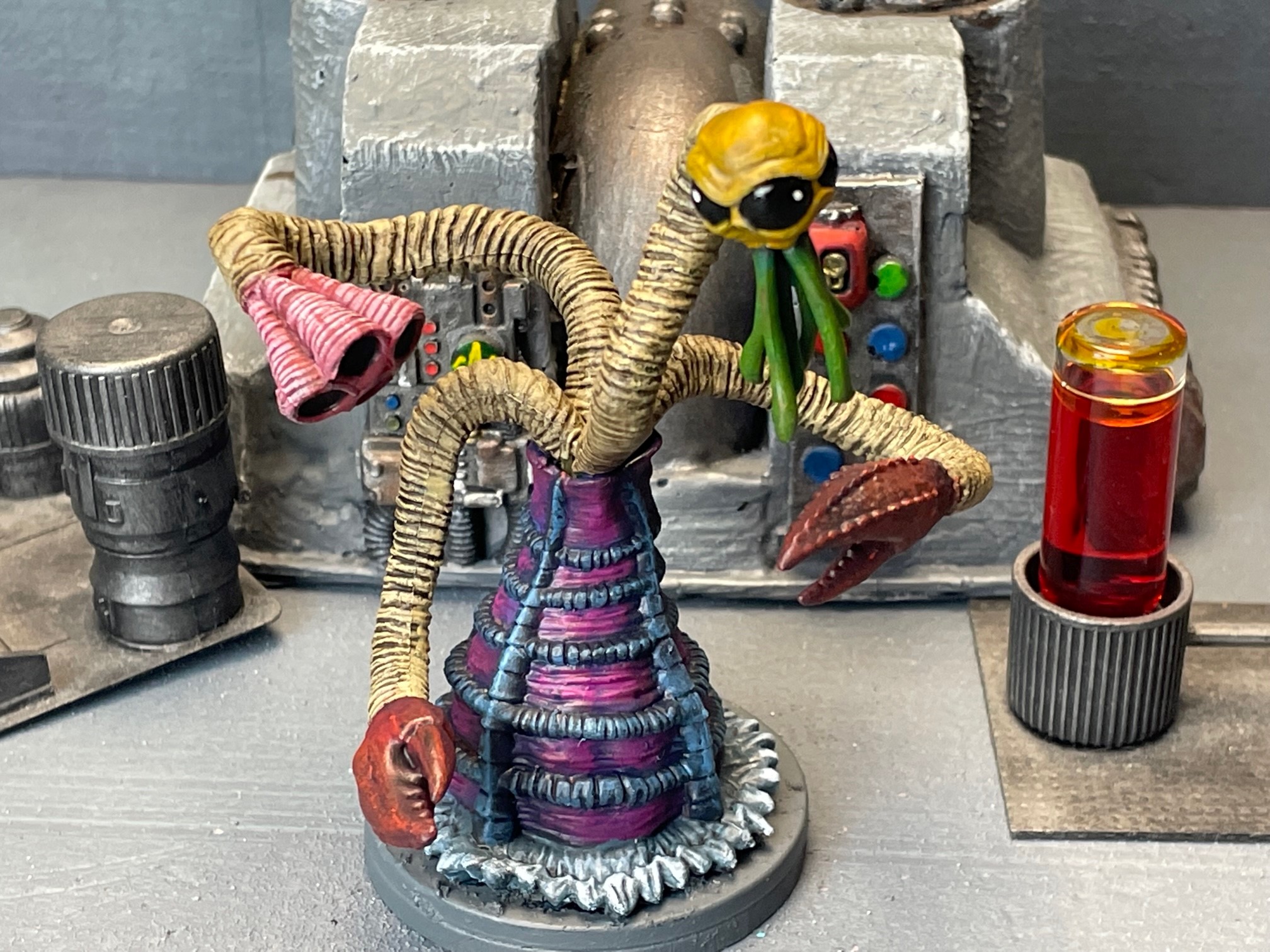
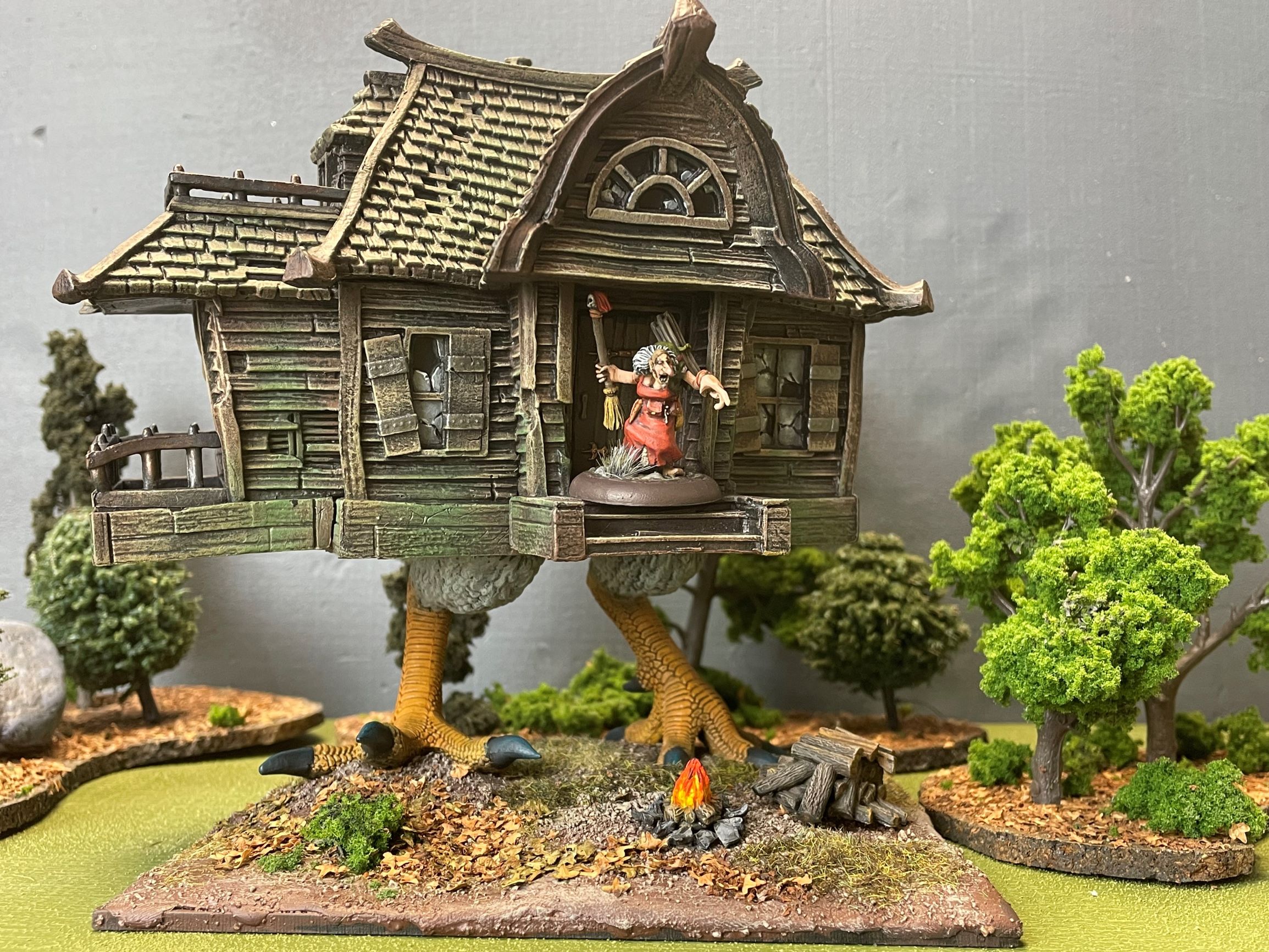
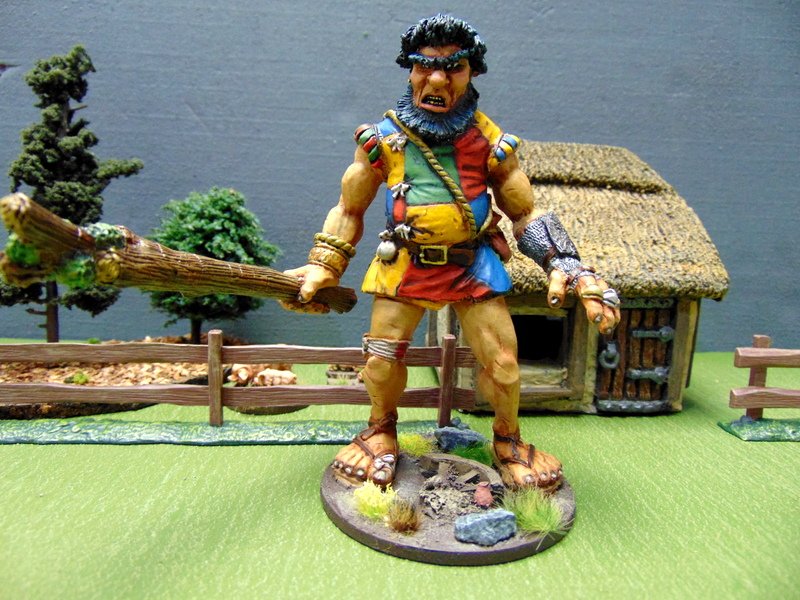
Here are some of my monsters from past challenges.
Great race of Yith, 2022Baba Yaga and her Hut, 2021Marauder Giant, 2020
Last year I opened this up to folks on Instagram, and I will do so again. But fear not: this challenge began here at Dead Dick’s Tavern, and here is where it will always be hosted.
So, who’s in? Let’s make it formal so I can start May off with a blogroll of participants!
Finally, to wrap up my three-part Star Frontiers posts, an actual post about miniatures! (Yes, I still do that here.)
Back in the mid-80s, TSR released a couple of boxed sets and blisters of Star Frontiers miniatures, both for the Alpha Dawn game and the Knight Hawks spaceship expansion. Let me skip to the end, here: like most TSR miniatures, they suck.
I have vented my spleen about the TSR line of miniatures before. In addition to Star Frontiers, TSR released miniature sets for Marvel Super Heroes, Indiana Jones and Advanced Dungeons & Dragons. They all suck. Awkward poses, poor sculpts, no sense of scale…all made out of what has to be the shittiest white metal alloy ever produced. It’s too soft, holds paint like shit, and is prone to metal rot. This was not a good era.
The best Star Frontiers miniatures by far are the spaceships for Knight Hawks. Although also prone to metal rot, these are in scale with each other (mostly). Spaceships in Star Frontiers don’t have artificial gravity, rather, gravity is achieved from the centrifugal force generated by the spinning of the ship on its axis. All the interior decks of the ship are perpendicular to the ship’s body. The miniatures look pretty good, but then again the sculpts should be hard to fuck up, considering they’re mostly cylindrical as a result of this gravitational concept.
Which brings us to the modern era of miniatures. Star Frontiers definitely has a retro vibe to it. Although there are several companies that make terrific retro sci-fi models (like Hydra Miniatures, Killer B Games, and Black Cat Bases; not to mention our own friend Roger from the now-sadly-closed Wargames Supply Dump), none of these really capture the feel of Star Frontiers, which has a retro vibe firmly rooted in the 1980’s. It seems like there just weren’t any good options, until now.
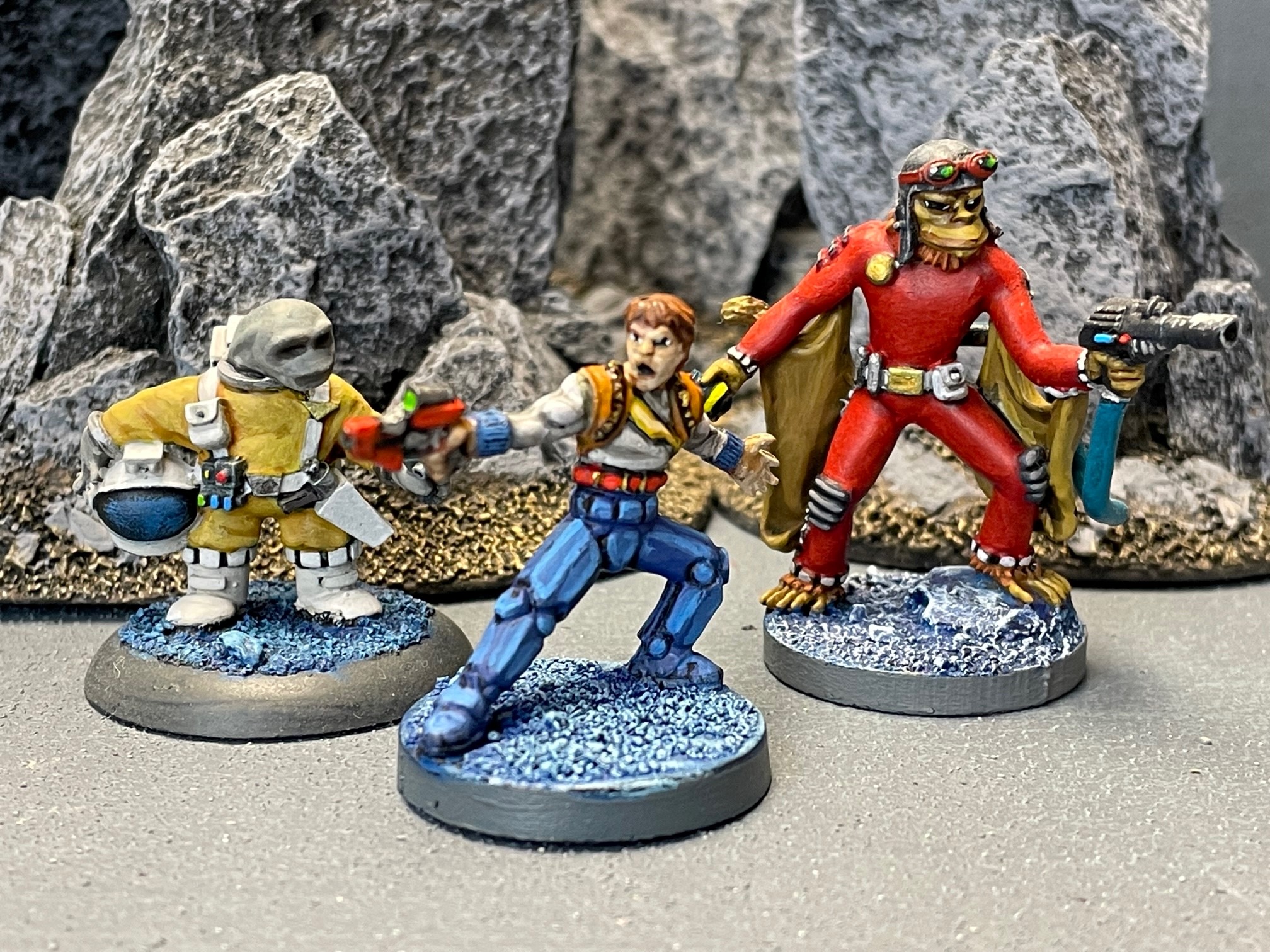
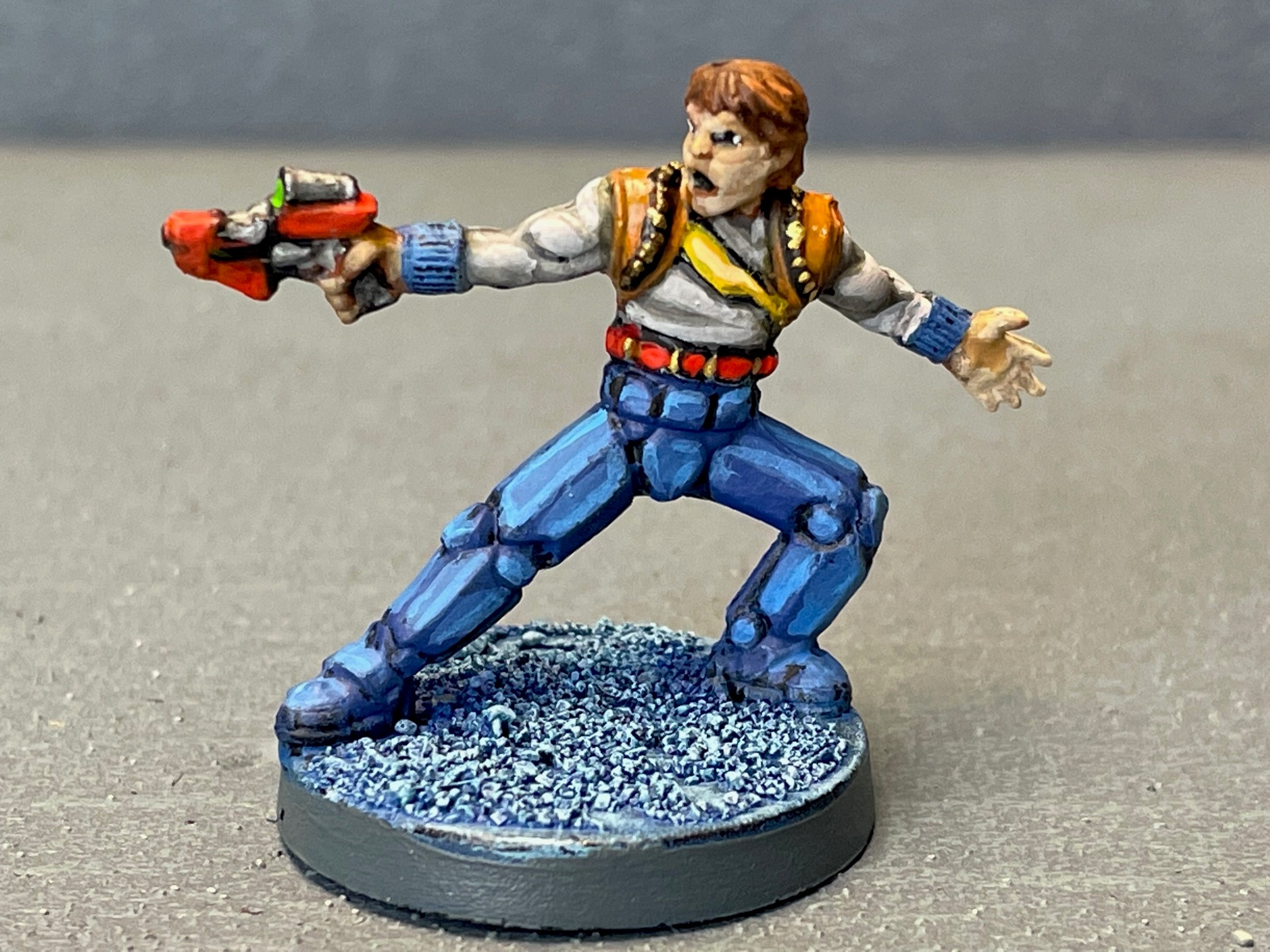
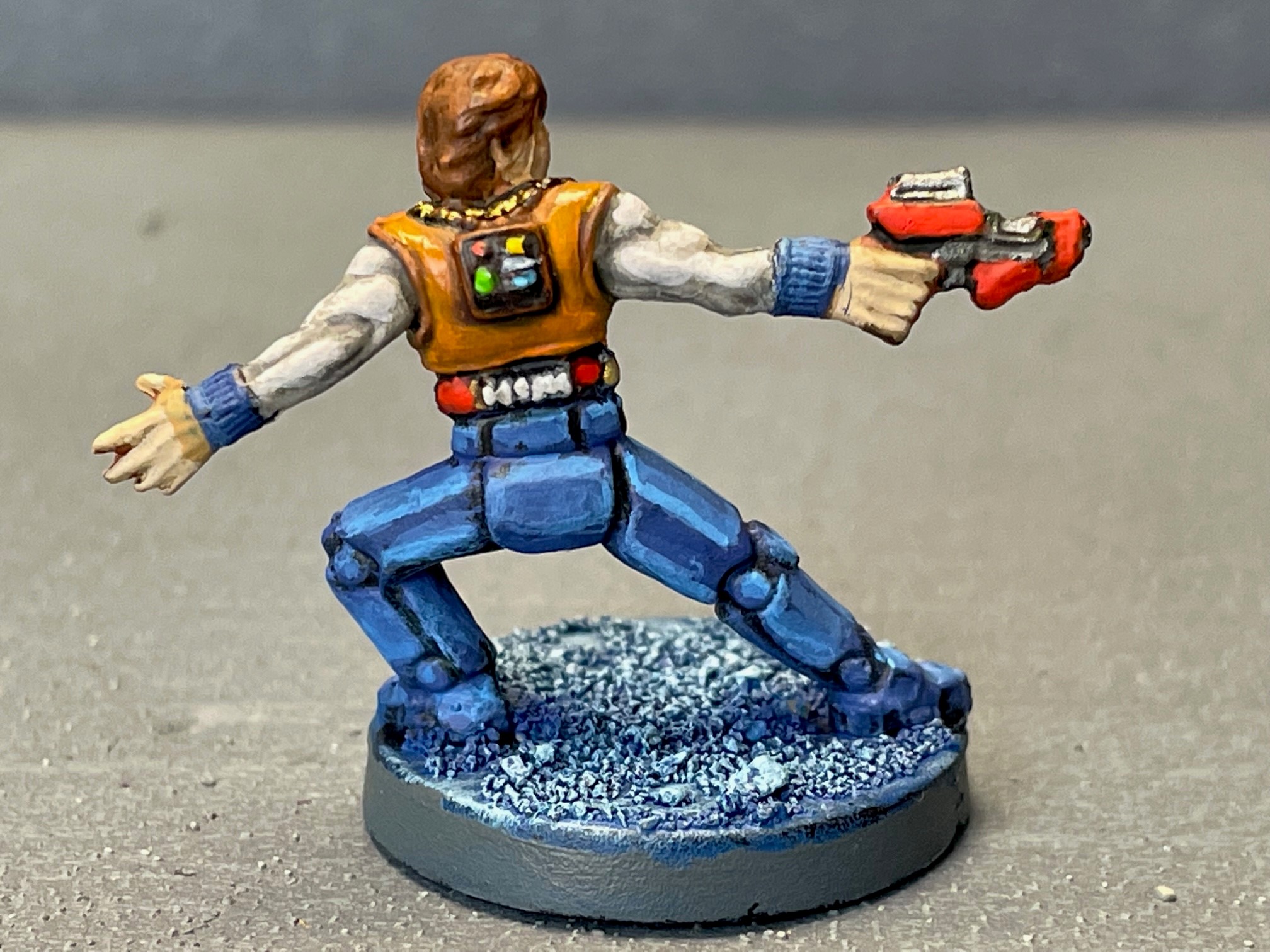
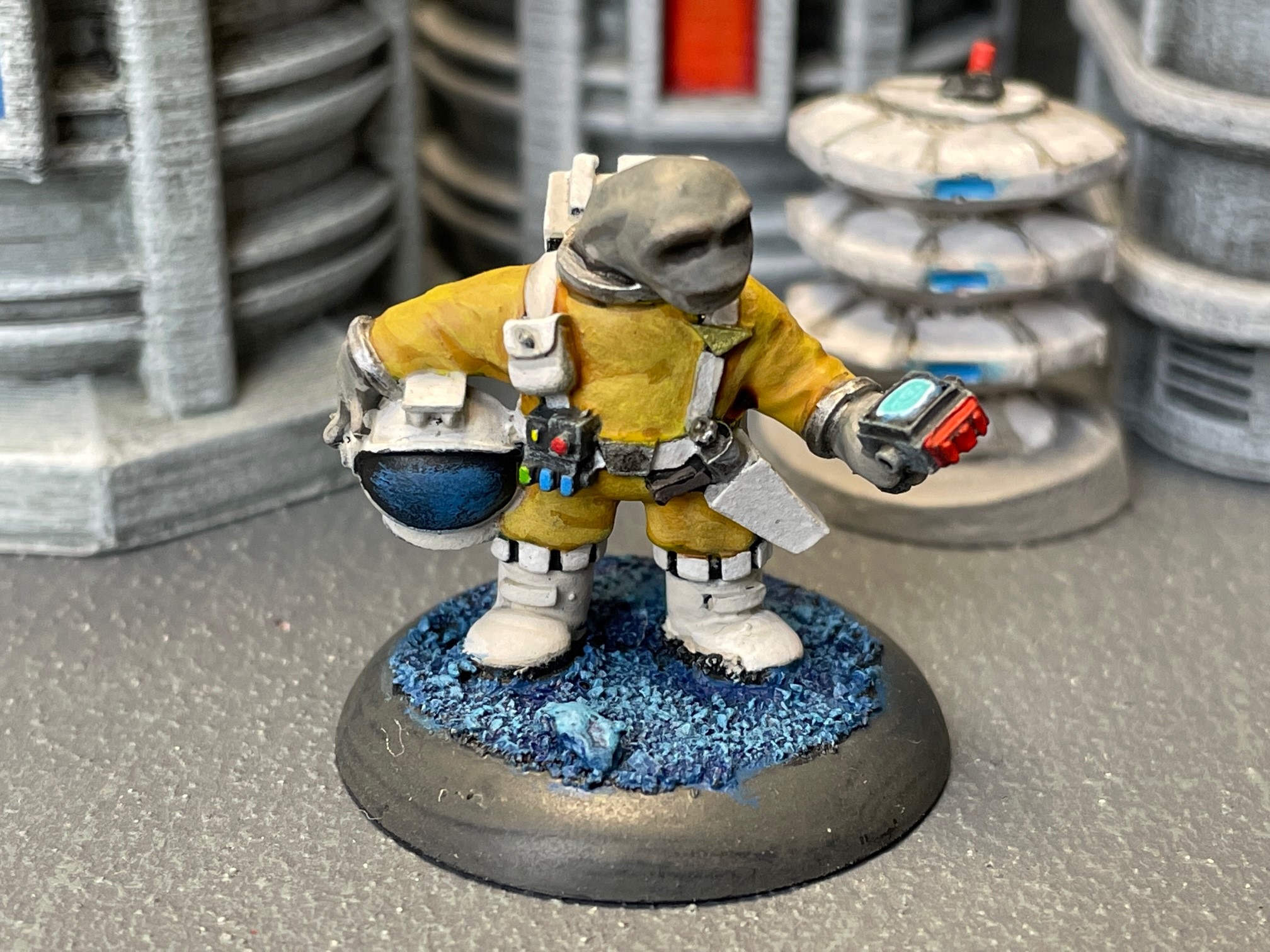
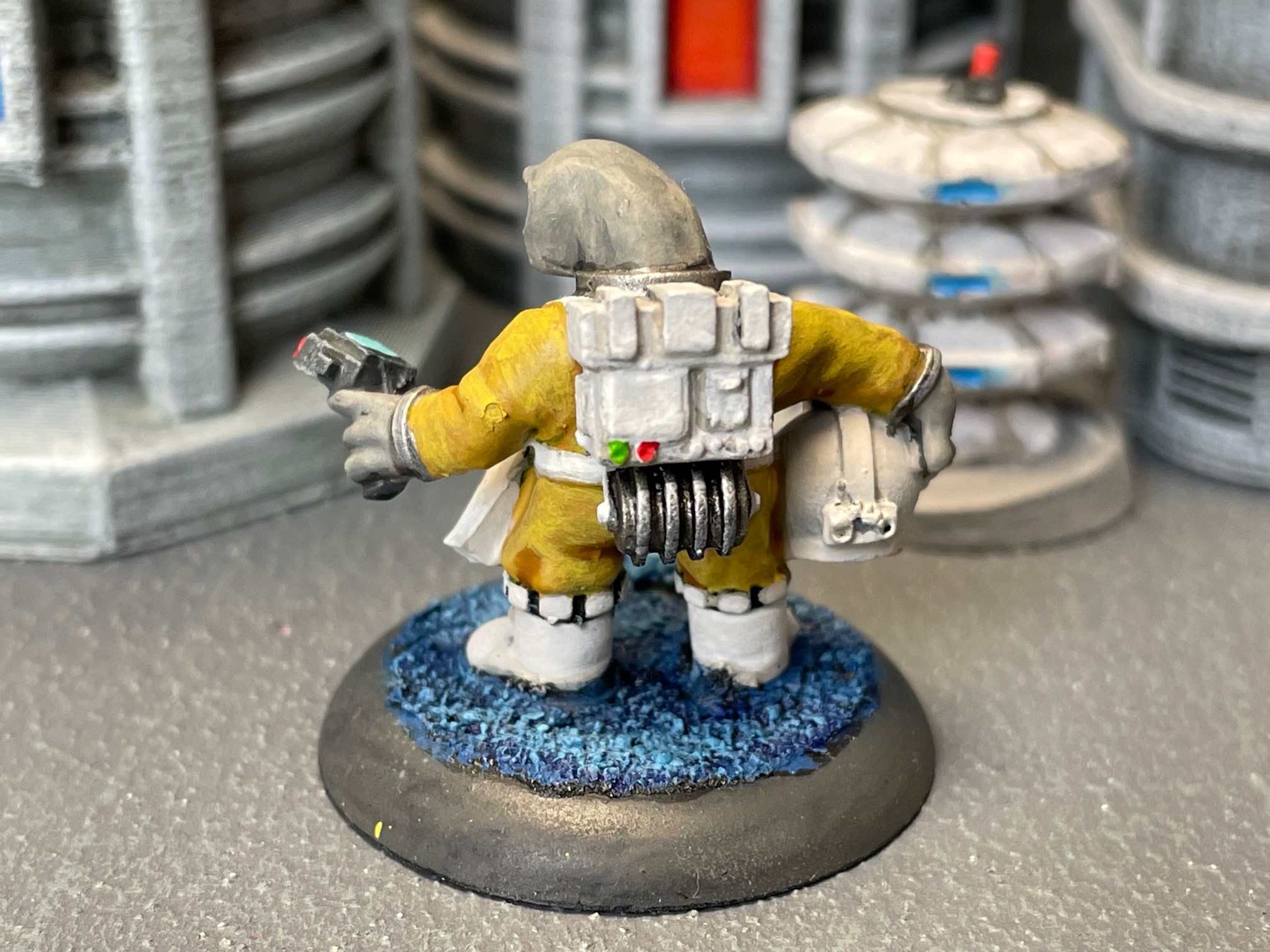
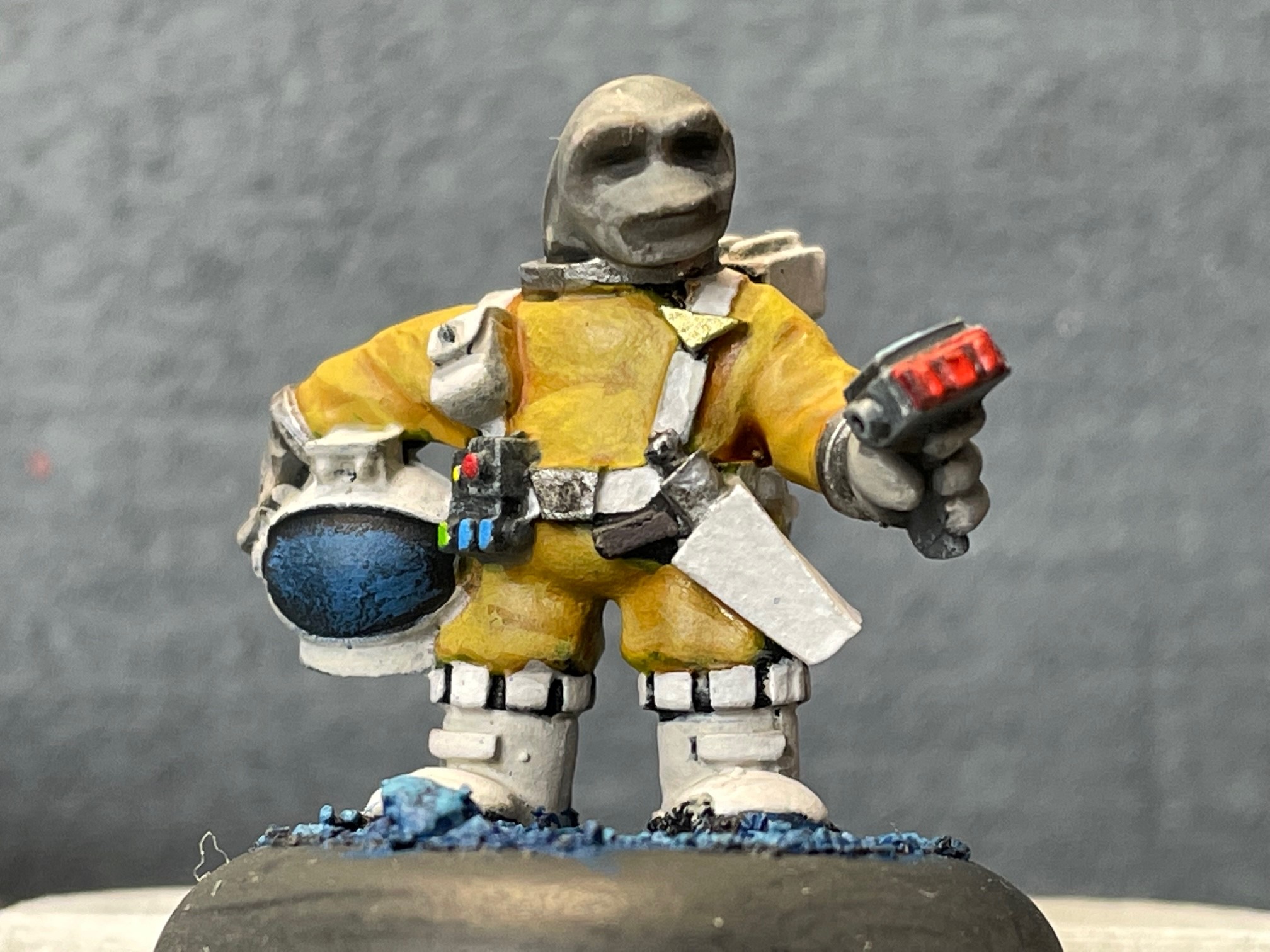
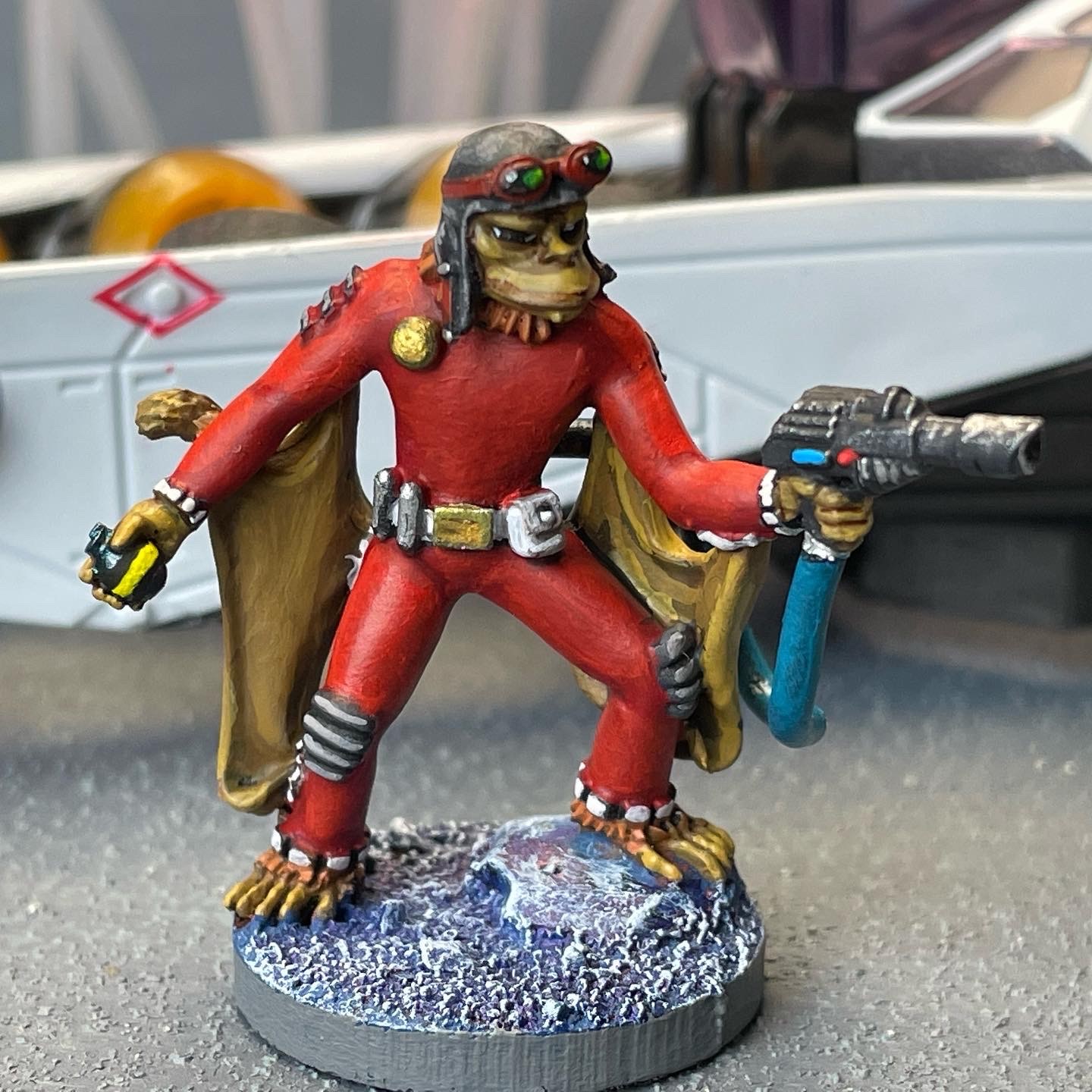
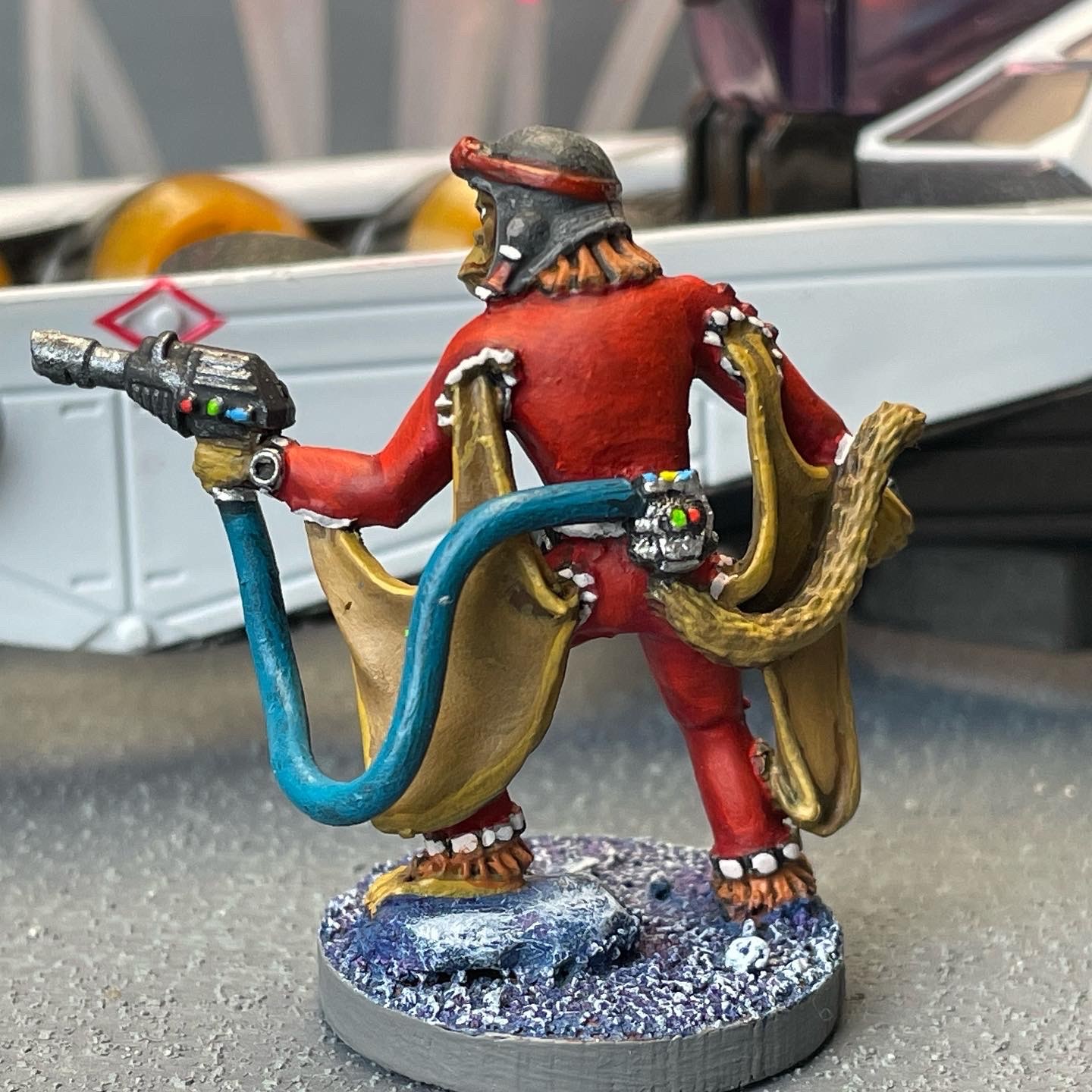
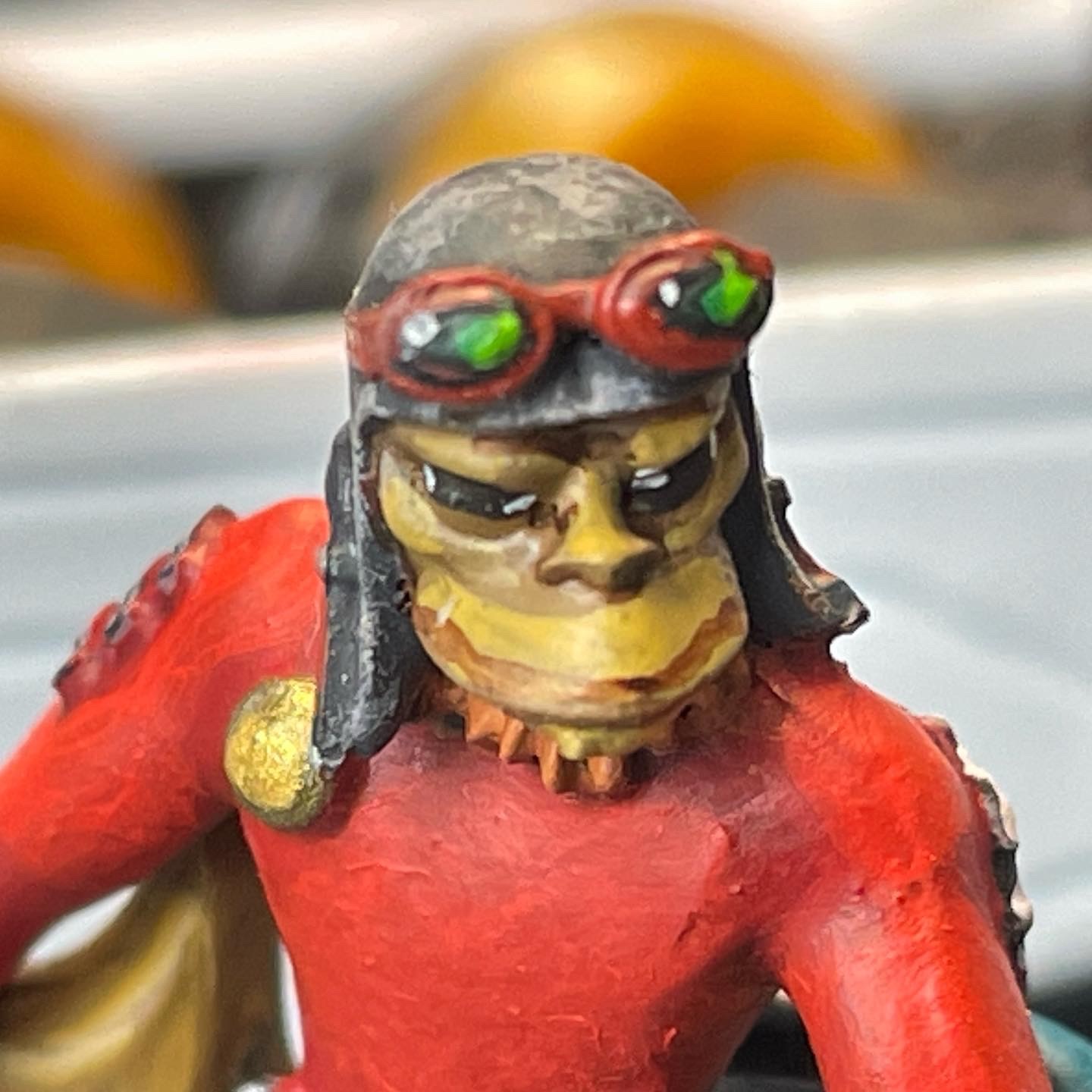
Behold! Reaper’s Chronoscope line has done it again, coming out with a Korkosan Explorer (a not-Yazirian if ever there was one) and an Argamite Explorer (a not-Dralasite). Together with their “Rand Daingerfield, Smuggler” this trio could have walked off the pages of any Star Frontiers book published back in the 80’s.
Check out that vest and those metal pants on Rand! Sadly, there’s no “not-Vrusk” miniature yet; but I’m holding out hope, as Vrusk are by far my favorite species in Star Frontiers.
I painted the Argamite and the Korkosan last year with the intent of doing a Star Frontiers post for the Year of Pop Culture; but since I didn’t have Rand painted yet I put it off. I only just got around to painting him last month.
I converted the Korkosan by removing his pistol and giving him a GW laspistol, then adding some wire as a power cord connected to a beltpack. (Everyone knows beltpacks are the way to go. They hold five times as many SEUs as a clip.)
This brings me to the end of my Star Frontiers retrospective. Maybe I’ll get around to running that game this year. Best way to find out is to join my Discord server and keep your eyes peeled in the announcements channel!
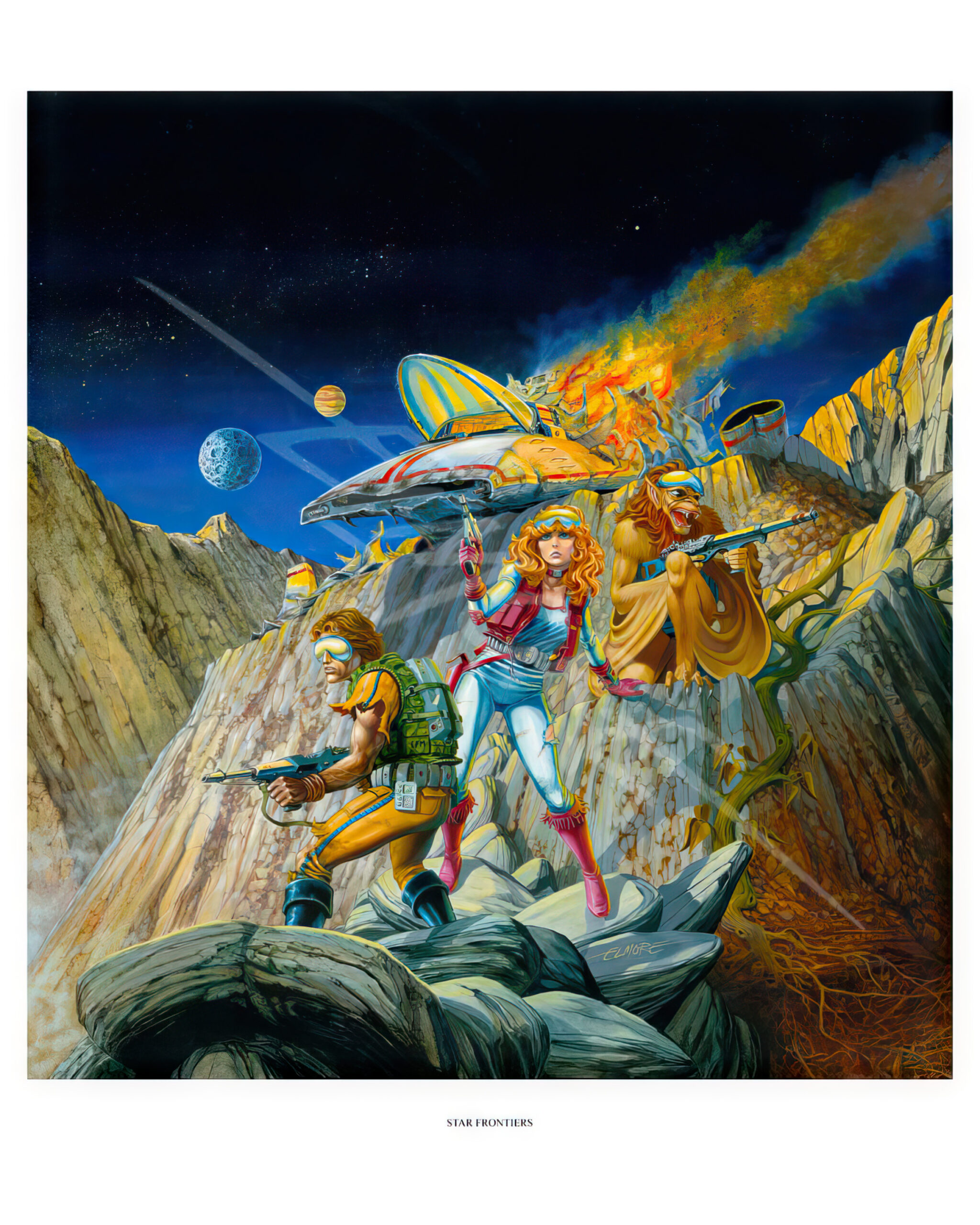
I love this picture, painted by the great Larry Elmore. I was fortunate enough to meet him at Gen Con in 2012, and I bought this signed print from him. It was the cover art for the second edition of the Star Frontiers RPG, renamed Star Frontiers: Alpha Dawn. Until then, the only sci-fi RPG of note was Traveller, which many people found somewhat inaccessible. This game was marketed to a younger crowd, and the system was much less complicated than Traveller (which isn’t really saying much).
A separate, compatible game, Star Frontiers: Knight Hawks, was released a year later in its own box, and dealt specifically with spaceships and space combat. Although it also had roleplaying elements, it was a spaceship combat wargame that used cardboard counters on a hex mat. I played a lot of Alpha Dawn but only dabbled in Knight Hawks. (We really just used the rules for ship design.) Both games enjoyed a decent amount of product support in the form of adventure modules and articles and scenarios published in Dragon Magazine.
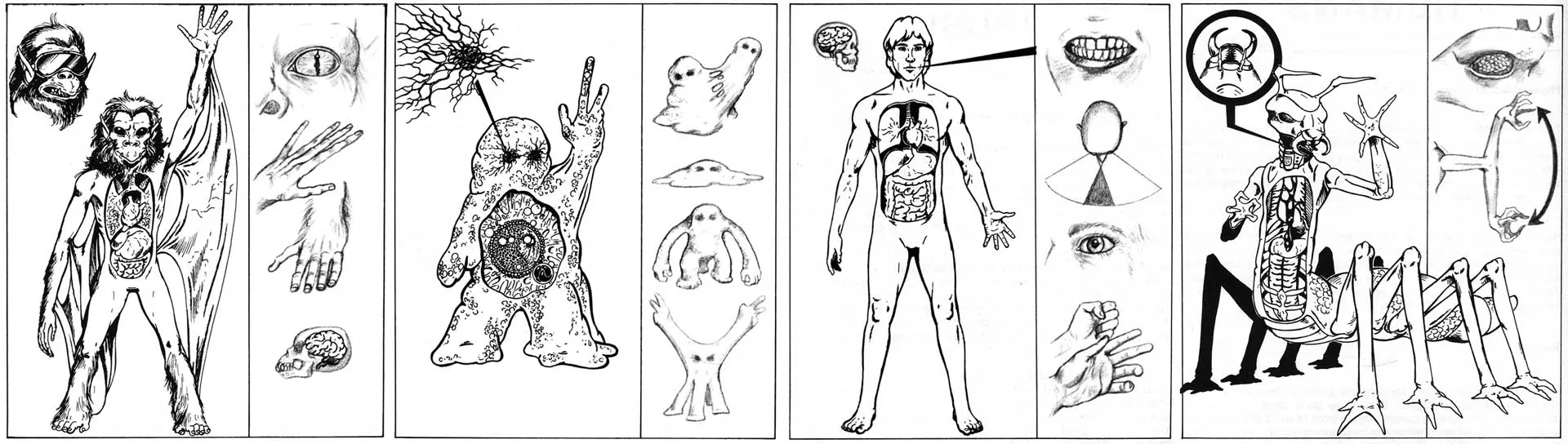
The real draw of Star Frontiers, at least for me, is the setting. It takes place in a region of space known as The Frontier, where the boundary of known space meets whatever else is “out there”. Players create characters from four playable races: Humans, who are pretty much like us, but live longer; Vrusk, a race of insectoid beings that resemble mantids, only without the big claws; Dralasites, an amoeba-like race that can change their physical form; and Yazirians, a race similar to flying monkeys, only with anger issues.
These races worked together almost immediately, freely exchanging information and technology, sharing scientific advancements and generally getting along. They formed the Pan-Galactic Corporation (PGC), a massive conglomerate that, like it’s name implies, spanned the galaxy. They even developed a language called Pan-Galactic (PanGal) that all four races could speak which allowed them to effectively communicate, given their differing anatomy and communication methods. It was a pretty good time.
Of course, good times don’t last forever, and another alien race, known as the Sathar, suddenly attacked the Frontier with what seemed like the intent to destroy everything the PGC had built. The Sathar are a wormlike race with strange telepathic powers who are aggressively xenophobic. No one knows much more about them, because any Sathar will kill itself rather than be taken captive, and they’re not much for chit-chat. To combat the Sathar threat, the PGC formed a combined military force called the United Planetary Federation, or UPF (not to be confused with the United Federation of Planets, which would have probably got TSR sued by the Star Trek guys over at Paramount). The UPF managed to drive the Sathar back to wherever they came from, but not for long.
Knowing that they can’t take the UPF in a fight, the Sathar have since turned to espionage and treachery to topple it from within. Sathar agents from all the frontier races actively work to undermine the UPF, so the UPF created another organization: Star Law. Star Law Rangers travel the galaxies looking for these agents in order to bring them to justice.
And that’s Star Frontiers in a nutshell. The published adventures assume your players will work for either the PGC or Star Law; but nothing says you have to stick to that. You can be pirates, privateers, salvage crews, planetary explorers or even military agents of the UPF. I’m pretty sure my group was a group of mercenaries, because it was the 80’s and I live in America and that was pretty much every movie of the Reagan era; but the game actively discourages this. The first adventure, Crash on Volturnus, effectively strips your characters of all their weapons and useful equipment right at the beginning, forcing them to survive on a hostile planet using their wits and diplomacy; a big departure for groups used to kicking in doors, killing everything in sight and looting the bodies.
There are a couple of big problems with the game. The system is a percentile-based system: roll under your attribute or skill and you’re successful; over and you fail. Pretty standard for TSR boxed games of the time, and still used by many games today. That being said, the system is sometimes a bit more complicated than it needs to be, especially where skills are concerned. Each character can picks a Primary Skill Area, such as Military or Science. Each one of these PSAs have a group of skills under their umbrella, each with a rating of 1-6. Each of these skills are improved individually and usually offer a 10% bonus per level of the skill. The problem is there are too many skills, so advancement takes a long time.
Combat is another matter. It takes forever because of clunky design, and if there’s one thing I can’t stand in games, both as a player and GM, it’s combat that drags on forever (J’accuse, 5E!). There are a ton of different weapons in Star Frontiers, each of which does a different type of damage (electrical, energy, sonic, projectile, etc.) There are an equal amount of defensive suits and screens, all of which are usually effective against only one type of damage. Having the right defense for the right attack is tedious and pretty much down to luck; but equipped properly, your characters can trade shots all day with little danger of dying. Even if not properly equipped, your characters can take a few shots before they have to worry, because most weapons that aren’t energy weapons do shitty damage.
Energy weapons and defensive screens use power tracked by Standard Energy Units (SEU). Tracking SEU use is a bit of a chore. In the case of weapons, the damage you inflict is directly proportionate to how many SEU you expend. For example, a standard laser pistol has a damage rating of 1d10 per SEU (max 10 SEU), and a standard ammo clip contains 20 SEU. That means you could get twenty 1d10 shots out of a clip, or you could burn the entire clip in two 10d10 shots before you’d need to reload.
Either way, you’re unlikely to kill your target. Most characters have an average of 60 hp (their Stamina score). The average d10 roll is a 5.5, rounded up to 6. I suppose it’s possible that a character could burn 10 SEU (10d10 damage) and get a result over 60, which would kill someone with 60 hp (assuming you hit), but it’s unlikely. It becomes even more unlikely when you factor in defensive screens and suits, which will reduce the damage even further. Why anyone would bother shooting a 1d10 shot is beyond me. Even at maximum damage (10) that’s not enough to be more than an irritation. If the target is wearing any kind of defense whatsoever, forget it. You’re just wasting ammo.
Both these issues are easily fixable with some house rules which I use. First, I cut down the number of skills. The military PSA as written, for example, contains a separate skill for each type of weapon, which is ridiculous. Is it safe to assume that military-trained characters know how to shoot all kinds of guns? Yeah. I’d say so. So let’s just group all those separate skills together and call it “firearms” skill. For combat, no more adjustable shots based on SEU use. Laser pistols, for example, do 5d10 damage and a clip contains 10 shots. That makes them more dangerous and more effective then they are in the rules. I use two types of defensive screens: energy and inertia, not an individual one for every conceivable type of attack. Inertia protects against projectiles and explosives, energy protects against electricity, energy and sonic attacks. Two screens, no more. Same with suits. One for energy, one for inertia. Mix and match as you like, but no more nonsense.
It should be noted that combat in Star Frontiers was probably not intended to be deadly. Like I said, it was marketed to a younger crowd. There are plenty of non-lethal weapons in the game: stunners, needler guns, and the iconic doze and tangler grenades, which render an opponent unconscious or immobile, respectively. The equipment lists are both futuristic and a bit dated…for example characters are often equipped with a chronocom, which is a wristwatch/ video communicator with a range of…wait for it…10 whole kilometers! It’s an amusing reminder of when the game was written, long before cell phones were commonplace or the internet even existed.
I’m not the only one who has a love of Star Frontiers, not by a long shot. There are two fanzines that are regularly published: The Star Frontiersman and Frontier Explorer, both of which have a ton of fan-generated content that’s worth looking at. Both of these zines used to be free, but now they’re available for sale at (sigh) DriveThru RPG. The original Star Frontiers rules are also available there in PDF and Print on Demand format.
Up next: a short coda to the Star Frontiers posts, as I discuss…the miniatures!!!!