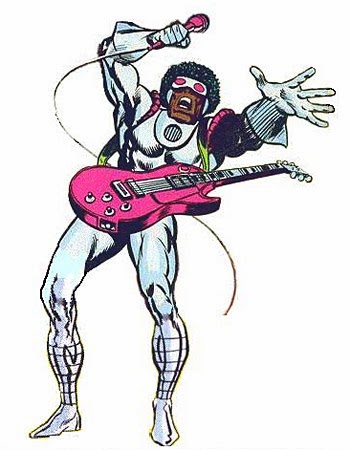
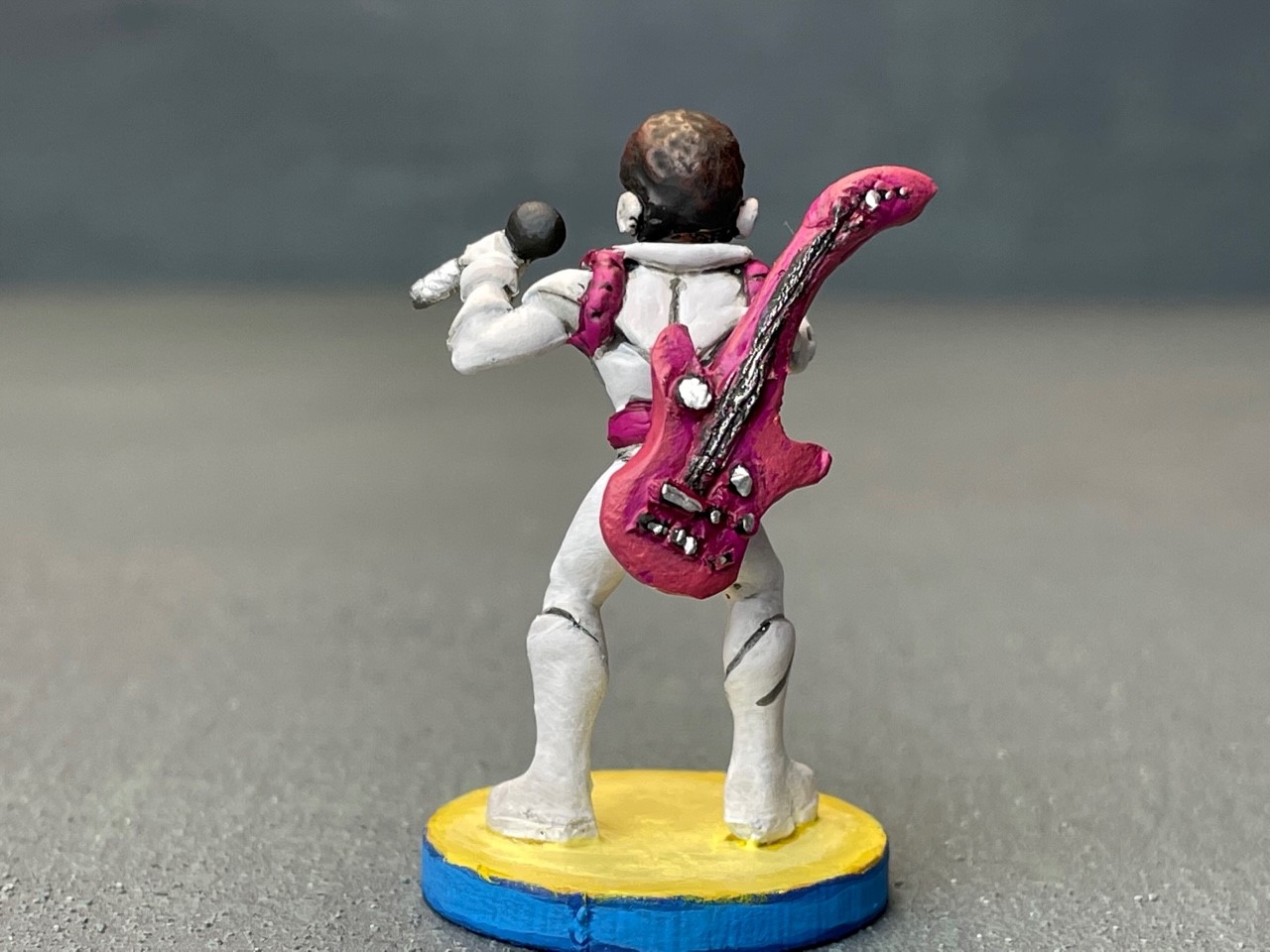
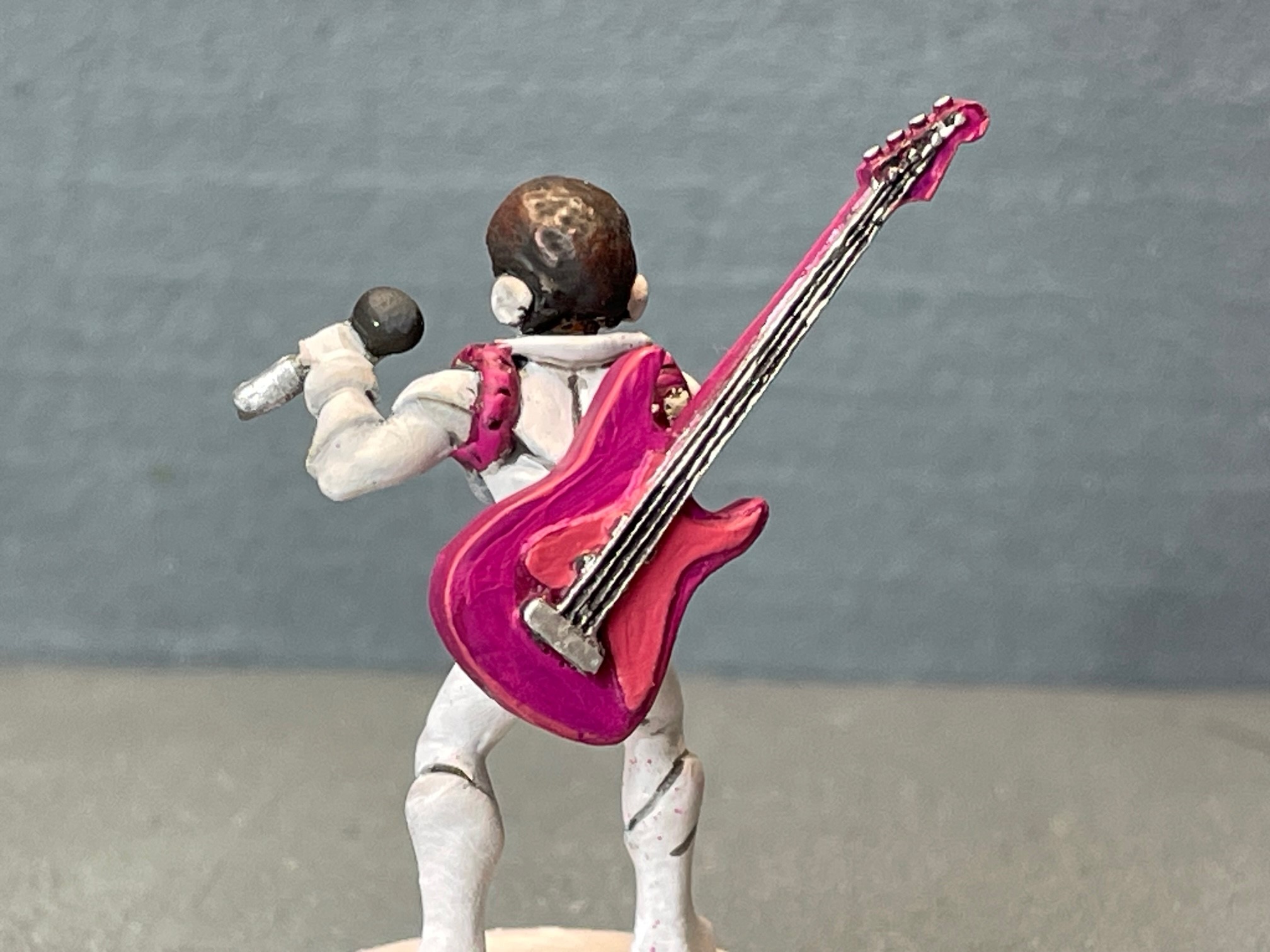
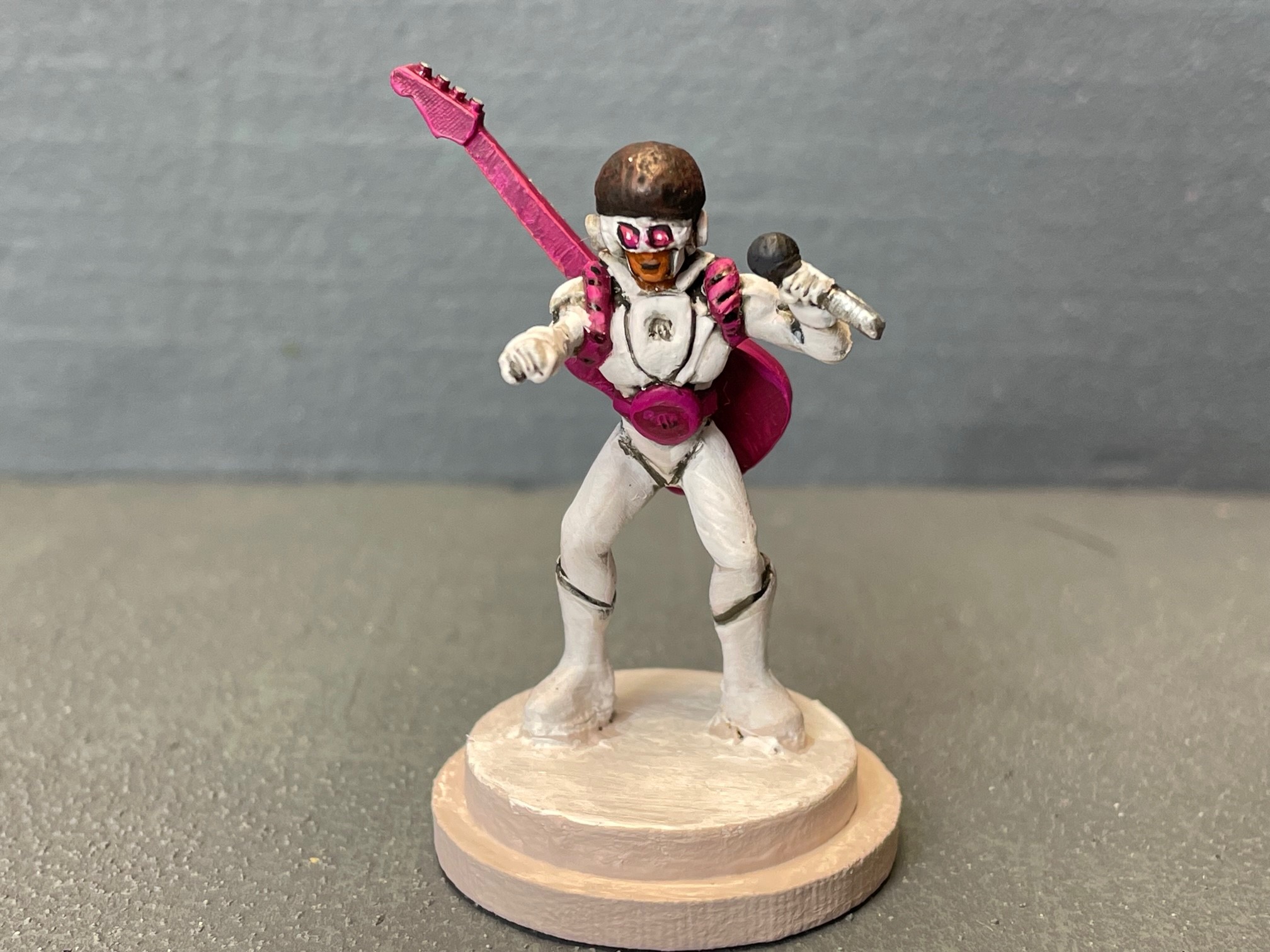
Last year, one of my submissions for Forgotten Heroes was the Disco Superfly himself, The Hypno-Hustler. He’s been sitting in my display case since last June, and every time I looked at him, I wasn’t happy. Although I think I did a pretty decent job of converting a Booster Gold miniature into the Hustler, two things in particular bothered me: his base and his bass.
I sculpted his bass guitar from green stuff, and like most things I sculpt, it looks mediocre at best. I searched for a suitable guitar bit first, but the best one I could find came from a British company called Zealot miniatures, and it didn’t make sense to buy it just to pay twice as much shipping it to me. Now, though, through my shadowy network of global operatives, I’ve been able to procure one at last! (OK, it was through the kindness of Dave Stone, a shadowy, international man of mystery if ever there was one.)
With that out of the way, I set about fixing the Hustler. The other thing that bothered me was his base. I wasn’t going to put the Hustler on regular ground, so I attempted to make it look like a spotlight on stage. It didn’t really do the trick. So, I added another base and repainted it a simple white, so he looks like he’s on a 1970’s disco round.
Because this base obviously looks like shit, I will remove the Hustler and use spray paint instead to cover up the brush strokes. Then I will re-mount him. I didn’t have time to do this before the end of the month, but rest assured, it will happen. And that’s about it. By giving him a new bass and a new base, I think he’s now done for real, and a fitting end to Forgotten Heroes this year.
I just listened to the latest episode of The MIskatonic University Podcast, wherein the hosts rank their top 10 RPGs. It’s due to be a two-part episode, and they are including games they may or may not have actually played. I thought I’d do my own RPG GOAT lists, also in two parts…but this first post will be solely games I’ve played, while the next one will be for games I have yet to play, or haven’t played enough. If RPGs aren’t your thing, feel free to come back and look at the pretty miniatures, which will return soon.
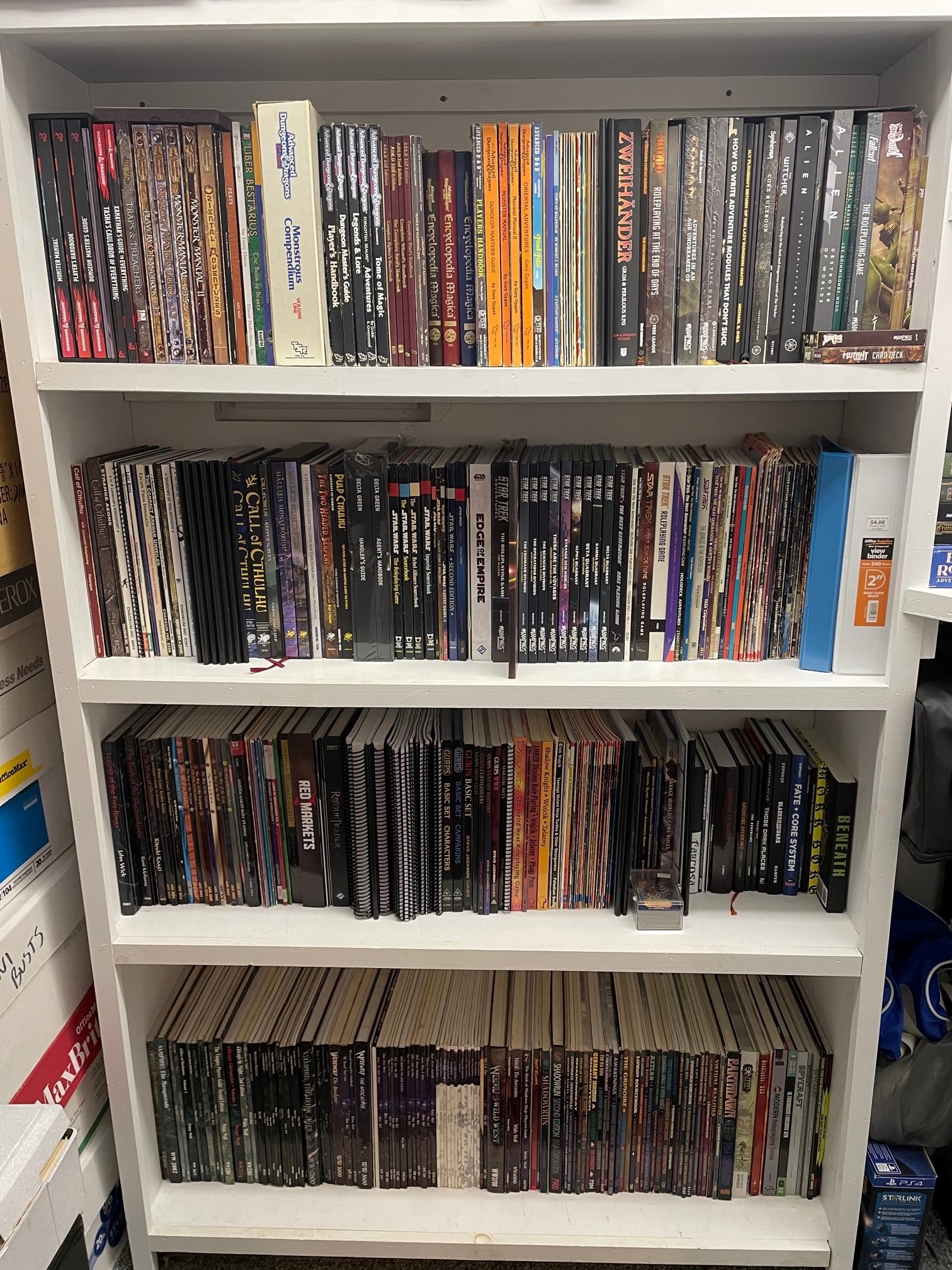
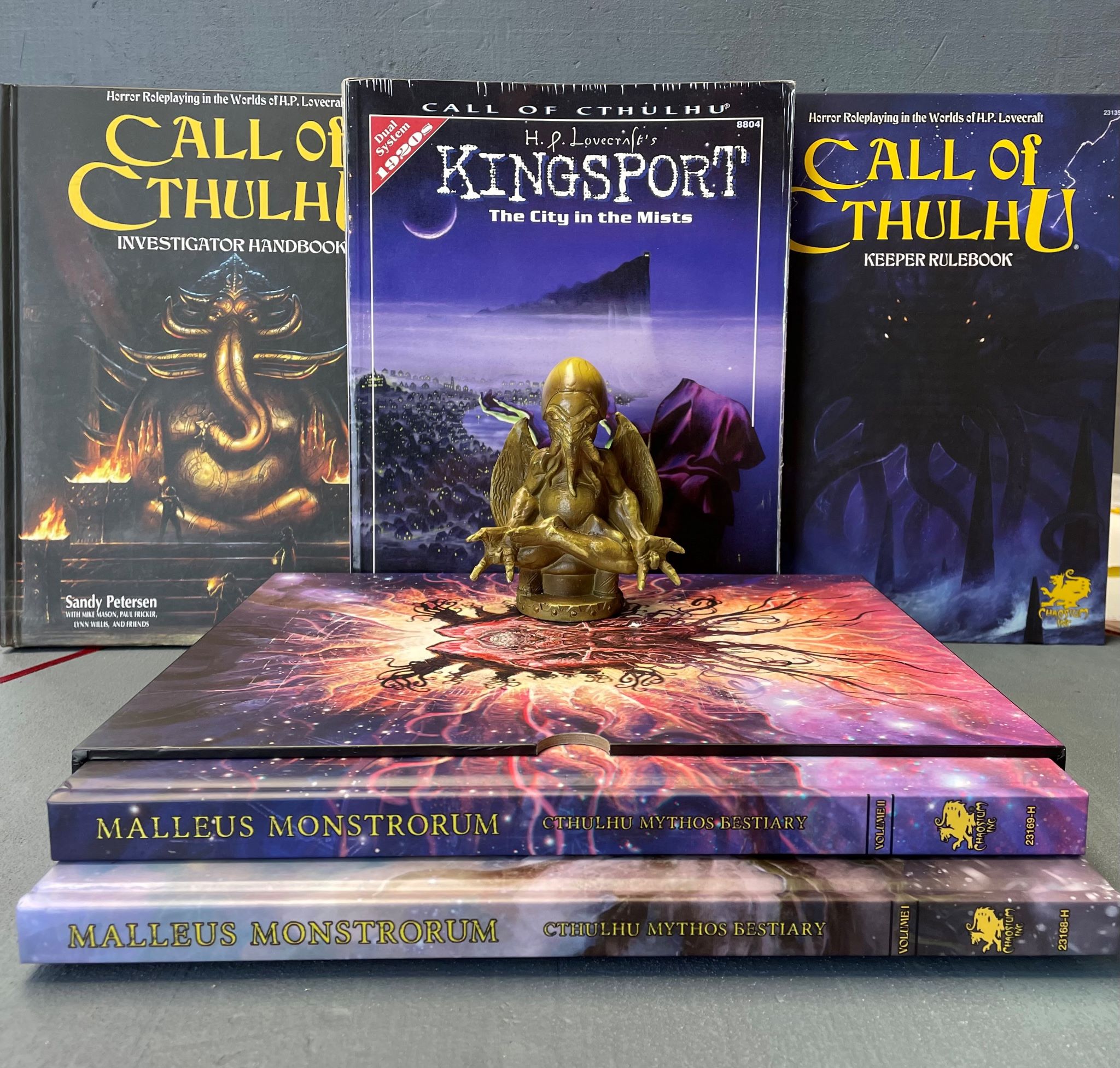
I own many roleplaying games and game supplements for dozens of systems. The above picture represents about half of my overall collection, and it was taken back in 2021. (This is the chain I have forged in life, and like Jacob Marley, I have labored on it since.) But which ones are my favorites? Without further preamble, I give you The Angry Piper’s Top 10 RPGs of All Time, ranked in descending order.
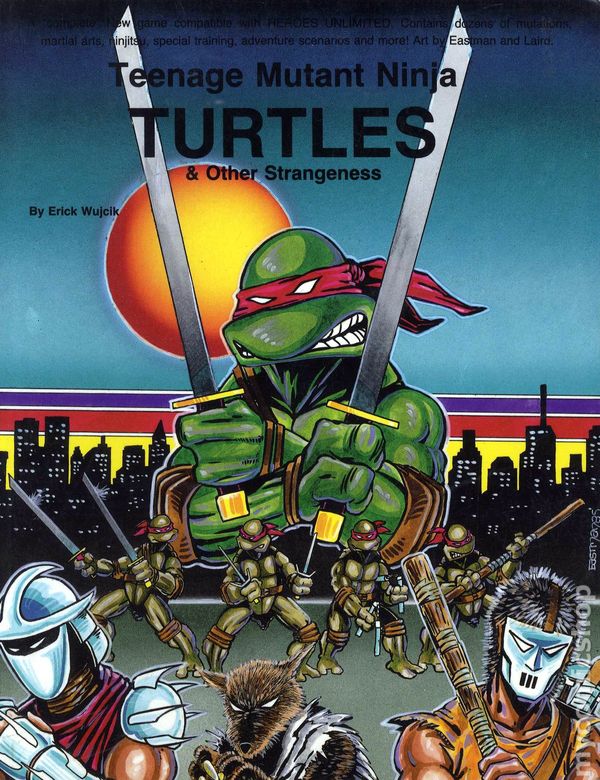
10. Teenage Mutant Ninja Turtles and Other Strangeness (Palladium, 1985) My freshman year in high school, I met two brothers who are still two of my best friends to this day. One of them introduced me to the TMNT comic. I collected Marvel and DC comics and had no idea about independent publishers like Mirage. I immediately was hooked on the black & white, irregularly-published TMNT comic. These turtles were still a long way from the pizza-loving pop culture juggernauts they would become. These turtles were badass.
It was TMNT and Other Strangeness that introduced us to the Palladium system. I have many fond memories of the games we played, most of which degenerated into complete silliness. The character creation system is point-buy: each animal type (and there are many included) has a certain amount of Bio(logical) -E(nergy) points to spend. These points determine things like overall size, stance (biped/qudruped), hand type (partial, like paws, or full), speech and special “Powers” based on the animal type (like the Turtles’ shell). It was a very well-constructed character generation system and we never tired of making up new mutated animal characters.
The system…well, let’s just say I’m not a fan of Palladium’s system for many reasons. We played RIFTS and Heroes Unlimited a few times, but our interest waned pretty quickly and we were on to other games within a couple of years. Still, this quirky game provided us with a lot of fun times, and for that alone, it makes it into the top 10.
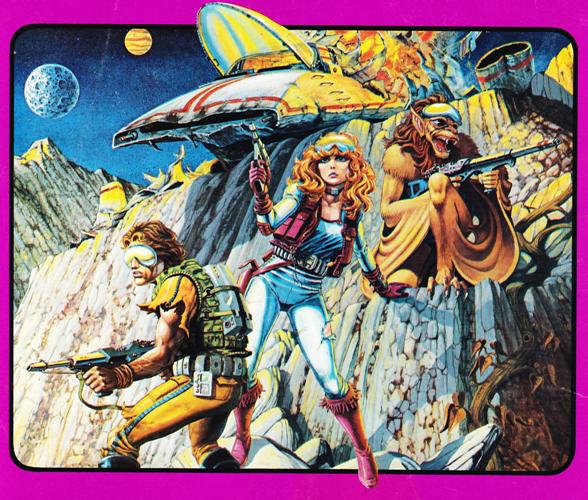
9. Star Frontiers: Alpha Dawn (TSR, 1983) I have spoken of my love for the classic Star Frontiers RPG in a series of recent posts. As I stated previously, for me, the real draw of this game is the setting. I cover that, as well as several “problems” with the game extensively here.
We played a lot of Star Frontiers in the 80’s and I’ve revisited the game a couple of times since then. One of my friends even converted it to GURPS, which made the game more complicated and challenging (in a good way). Sadly, I’m the only one among my friends who seems to miss this game nowadays, so if I ever get to play it again I will likely have to run it online.
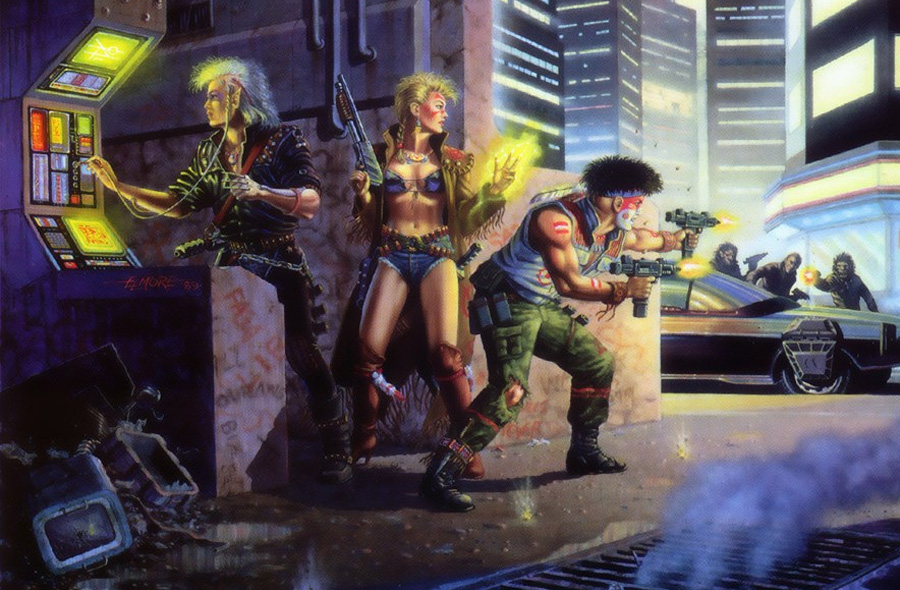
8. Shadowrun (FASA, 1989) Where man meets Magic and Machine. In 2050, the world is a Gibson-esque cyberpunk dystopia ruled by mega-corporations, connected in virtual reality through a worldwide computer network called the Matrix. In the midst of this futuristic, capitalist nightmare, magic returns to the world and metahumans and creatures from myth and folklore once again walk among us. You play a shadowrunner–someone with a unique set of skills (magic, thievery, computer hacking, combat) who lives on the fringes of regular society. Oh, and there are dragons, too; and one of them becomes President.
Shadowrun, like so many other games that came out last century, has gone through several revisions and updates. I’m only familiar with 1st and 2nd Edition. 2E was better, and we played it most. The game has a timeline and metaplot that has kept continuity throughout all its editions. When the game debuted in 1989, the year in-game was 2050. Now, the current 6th edition of the game is set in the 2080s.
Shadowrun is one of those RPGs that’s immensely fun to play, but just as much fun to read. The sourcebooks are annotated as if they were documents posted to online hacker forums, so there is tons of commentary from the shadow community regarding the veracity of some of the information presented in the supplement. I haven’t played Shadowrun since pre-2000, but I still sometimes break out my old Shadowrun supplements just to read them.
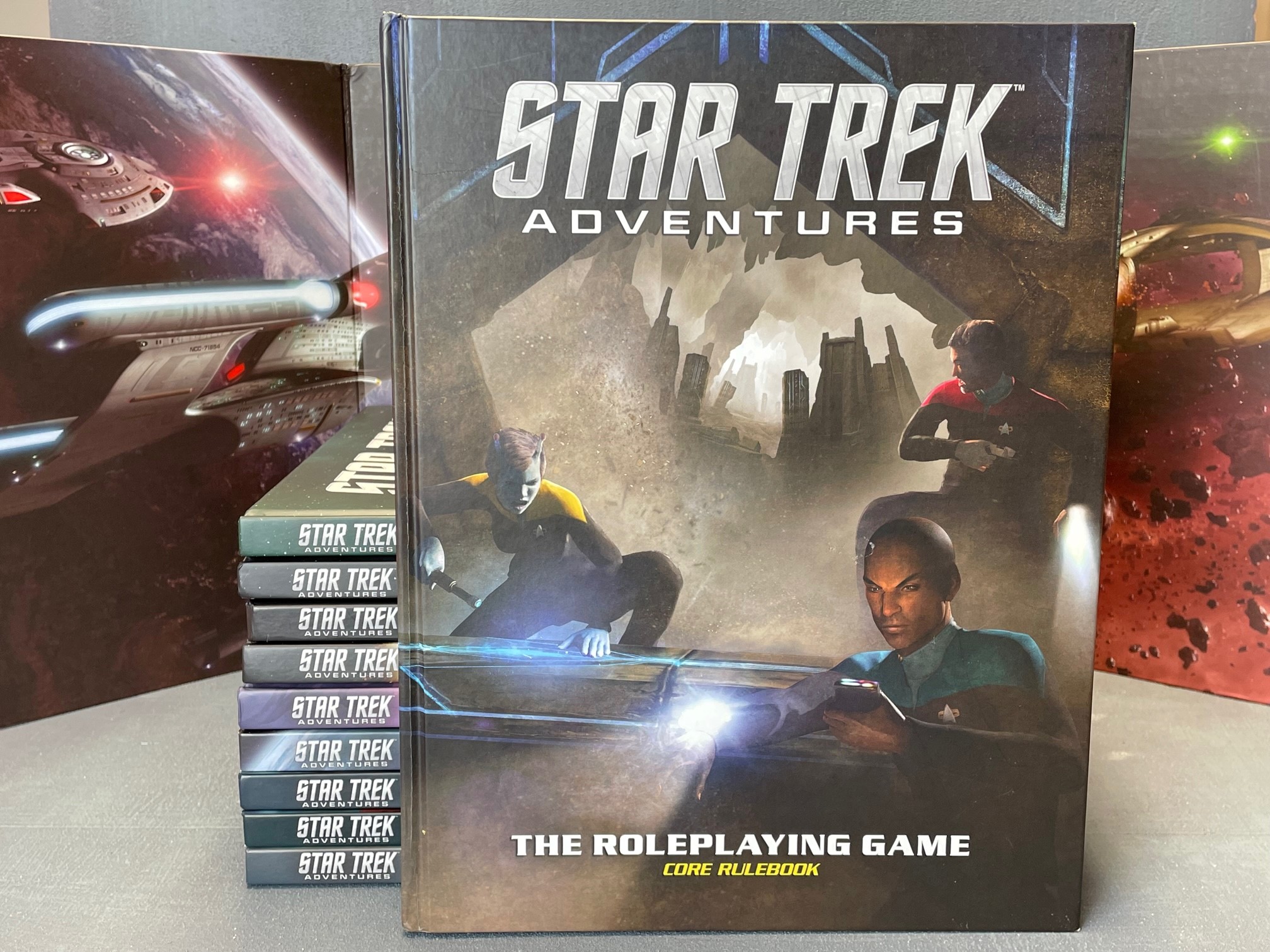
7. Star Trek Adventures (Modiphius, 2017) No big surprise to anyone who visits this blog: I’m a huge Star Trek fan, and I went all in on the Modiphius 2d20 system. It’s a bit more complicated than I like in a system nowadays, but once you get the hang of it it’s pretty awesome. There’s a lot you can do and a lot of different ways to do it. It really captures the feel of the Star Trek Universe better than any previous Star Trek RPG, and it covers all eras of Trek from Enterprise through Discovery.
I first ran this game by converting an old FASA Star Trek module, The Vanished, to this version of the rules. Rather than make their own characters, my friends played Kirk, Spock and the bridge crew of the Enterprise. You can read about it here. Since then I’ve run several one-shots and even a brief campaign set in the Next Generation/DS9/Voyager era. You can find the first post of that campaign here. I’ve had a lot of fun every time, and I definitely will be running more Star Trek adventures in the future.
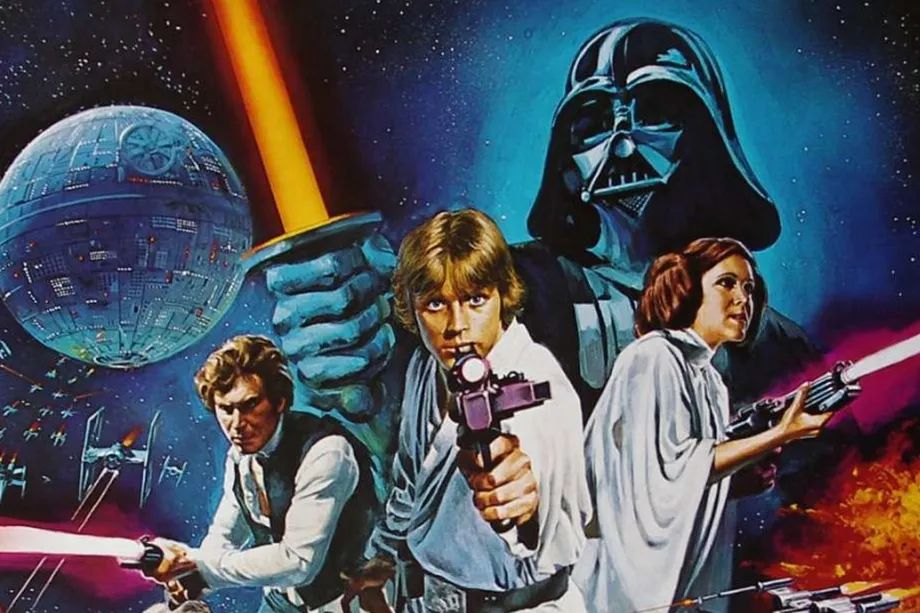
6. Star Wars (West End Games, 1987) With the ubiquity of everything Star Wars nowadays, it’s tough to remember that after Return of the Jedi was released in 1983, we didn’t have another Star Wars movie (for better or worse) until The Phantom Menace in 1999. Sure, there were novels and comics in between, but when Lucasfilm licensed Star Wars to West End Games to develop a roleplaying game, it was a license to print money, even if the game was shit, which this most definitely was not.
Arguably, the Star Wars RPG did more to keep Star Wars alive than anything else; but more than that, it built upon Lucas’s creation and added so much more to the lore and setting than anything we could ever see on film. Lucas approved all of it, and much of it became and remains canon. The system is D6-based and it works well. There aren’t too many rules to slog through and the action moves quickly. The D6 system is now open license for anyone to use.
I played a lot of this in the 80’s and a fair bit in the 90’s. About 10 years ago, I wrote a quick, one-shot with some pregenerated characters and ran a game for my friends. It was like riding a bike.
There have been 3 companies to publish Star Wars rpgs: West End Games, Wizards of the Coast and Fantasy Flight Games. The current FFG line is expansive (and expensive) and pulls from all eras of Star Wars, something the original WEG version couldn’t do, because none of it was written yet. It’s supposedly quite good; however it’s a testament to the popularity of the original game that Fantasy Flight Games published a 30th anniversary edition of the WEG Star Wars RPG in 2018. (No one talks about the WotC game nowadays.)
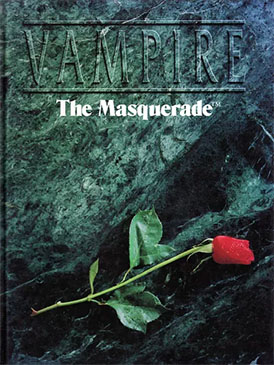
5. Vampire: The Masquerade (White Wolf, 1991) Ah, the angst-ridden, tragically hip 90’s, when you couldn’t swing a dead bat and not hit a Siouxsie Sioux, Peter Murphy or Robert Smith lookalike on any college campus in the country. Good times. I played a lot of the first and second editions of this game (as well as Werewolf: The Apocalypse and a little Mage: The Ascension) , and it’s one of the best, most memorable RPG campaigns I’ve ever been involved in. My interest in vampires has pretty much dwindled to nothing at this point in my life; but Vampire: The Masquerade is the game where I created one of my favorite RPG characters of all time: Lucas, a Nosferatu: a beast trying desperately to hold onto his humanity in the brutal and unforgiving Gothic-Punk Chicago of the 1990’s.
The World of Darkness Storyteller system is what really drives this game (aside from, you know, vampires), focusing primarily on roleplaying the trials and tribulations (or perhaps exultations) of being a monster. It’s billed as “a Storytelling game of personal horror,” and although pathos more than orror was the theme of the game in which I played, it is seen as a horror game. VtM has gone through several editions and publishers since the last time I played it, circa 1998 or so; and from what I can determine, it’s quite different nowadays. I’m not particularly interested in playing it again; but it’s definitely a game I played a lot of during my college years, and one I recall fondly.
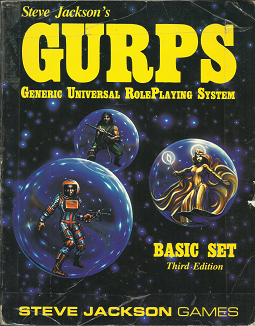
4. GURPS (Steve Jackson Games, 1986) My regular high school gaming group split up after graduation as we all went to different schools. I was invited to a game in college, and that game turned out to be run by a guy I still game with today. That game was GURPS (3rd edition) Fantasy.
The Generic Universal Roleplaying System is exactly that. Although it’s great for Fantasy gaming, I’ve played and run horror, sci-fi, superhero, kung-fu, espionage and pulp cliffhangers games using GURPS. One of my favorites is GURPS Old West, which is my favorite Western RPG. GURPS has licensed such RPG properties as Traveller, Vampire: the Masquerade, Deadlands and Discworld; and, over the years, has released some of the best, most informative supplements for roleplaying games ever written. The GURPS Vikings, Martial Arts, Japan and WWII supplements really stand out, but there are so many more. My friend converted Star Frontiers to GURPS, and I even once attempted to run a Chronicles of Amber game using GURPS (but that didn’t work).
There’s a reason it’s been around for so long. There are rules for everything, but you’re free to use whatever you want and make it as simple or complex as you desire. It’s still my go-to generic system for most things.
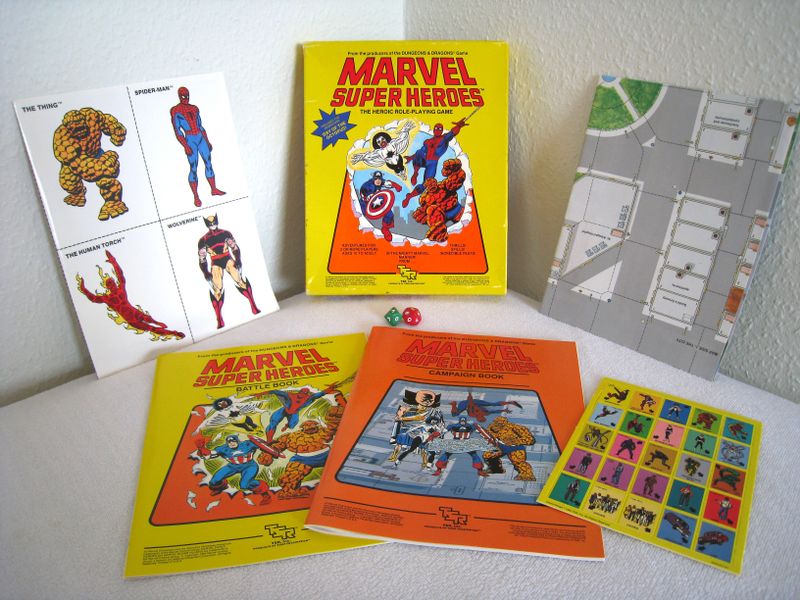
3. Marvel Super Heroes (TSR, 1984) One of my all-time favorite roleplaying games is free for all at Classic Marvel Forever. I’ve always loved this game. It’s simple and captures the feel of a comic book perfectly. We played a lot of MSH back in high school. It still has a devoted fanbase today, and the innovative FASERIP system has been updated and streamlined by various publishers. (My favorite is Astonishing Super Heroes, by Let’s Start Over, Shall We?-a MSH actual play podcast). I brought this game out of retirement a couple of years ago to run a one-shot for my friends. The first of that four-post writeup is here. Although most of us had fun, a couple of my friends think games of the past should stay there. Undeterred, I ran it again on Discord as recently as March for a group of Instagram friends, and everyone seemed to really like it.
The published adventures are particularly bad; but the rules are simple and easy to learn. This is the only game that I can think of where I never want to make my own character. Although there are detailed character creation rules, I’ve always preferred running games for established heroes like Spider-Man and The X-Men rather than having the players create their own characters, and likewise, I prefer playing as established heroes as well. Sadly, no one I know seems keen on running this game but me. I haven’t been a player in a game of MSH since the mid-90’s, but I remain hopeful.
2. Call of Cthulhu (Chaosium, 1981) I discovered H.P. Lovecraft in 1987 when I was 15 years old, and although I had previously seen ads for the Call of Cthulhu RPG in the pages of Dragon Magazine, I never made the connection until later. Once I did, I knew it was a game I needed to play. A horror roleplaying game? How cool!
My first edition of the game was the 4th Edition, published in 1989. I still remember the first adventure I ran for my friends. It was one of my own scenarios involving a vampire who made his lair in an abandoned watermill. Being a vampire, he had no need to breathe and so he hid from the sun and rested underwater during the day. The group of investigators finally tracked the vampire to the mill, but of course, by then it was night and it was dark. They entered the watermill and found the floor had collapsed, so they waded through the waist-deep water, shining their flashlights around. One of the investigators suddenly realized the vampire could be under the water, and so I called for a Sanity check. He failed. I can still see the look on my friend’s face when I told him he dropped his flashlight into the water.
Call of Cthulhu is now in its 7th and, in my opinion, best edition of the game. I’ve played and enjoyed other horror games (like GURPS), but this is the best fit, both for Lovecraftian horror and horror storytelling that has nothing to do with the Cthulhu Mythos. I love to play this game and I especially love to run it. I always have more ideas for Call of Cthulhu scenarios running around in my head than any other game.
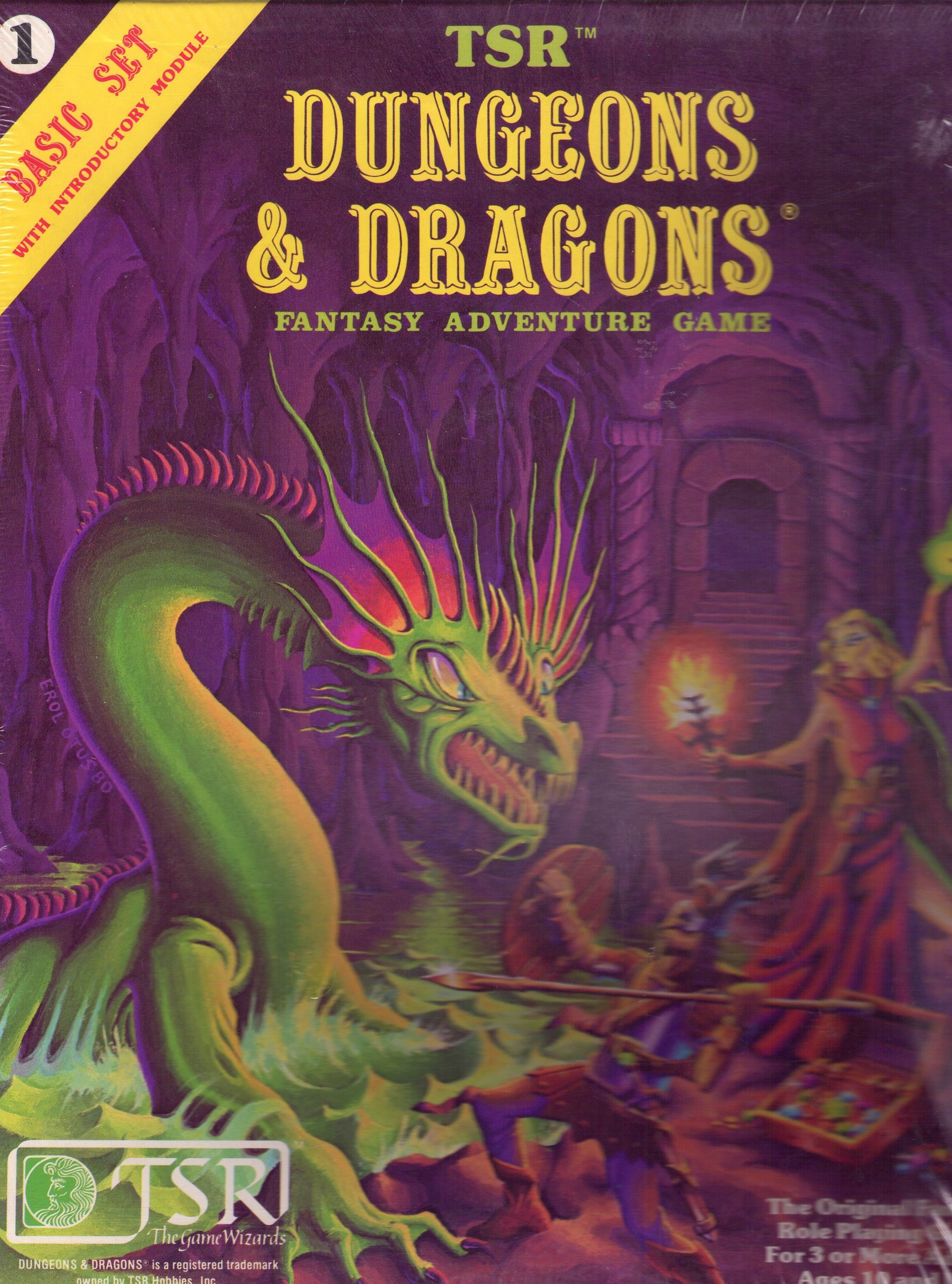
And finally, at #1: Dungeons & Dragons (TSR, 1974) Of course D&D will be my number one. Like so many people, it’s the first RPG I ever played, way back in 1983. It was the Tom Moldvay Red Box B/X system with the great Erol Otus cover art shown above. My aunt, who is only 9 years older than me, gifted me the game on my 10th birthday, pre-Satanic panic. I say this because she has since become an ultra-right wing conservative and staunch religious fanatic (yeah, we have lots in common nowadays), so I guess timing is everything. Anyway, thanks, Auntie Marie.
I’ve played almost every edition of D&D starting with the Moldvay B/X set. in high school, I played lots of AD&D before moving to AD&D 2E, which came out in 1989. I think I probably played 2E the most, though, being involved in several campaigns both as player and DM throughout the 90’s. I took a little break for a while, but came back to D&D with the 3rd edition. I ran a 3.5 campaign from 2011-2014 or so before it eventually broke down. You can read about that here. I skipped 4th Ed. entirely, which is by all reports what I should have done. No regrets.
Which brings us to 5th Edition, which is by far the biggest and most popular edition of the game to date, responsible for millions of dollars in sales and a huge influx of new blood to the roleplaying hobby. Thanks to Critical Role and Stranger Things, D&D is now super-cool; something I and most of my geek generation find amusing, as it certainly was not always so. I am all in favor of bringing new folks into the hobby, although I personally hate 5th edition because it is fundamentally different than the experience I know and love. I do not think the differences are beneficial to the game, but that is my opinion. I could write a whole blog post about why I hate it, but what’s the point? (I might do it anyway.) It’s not my game, but I certainly don’t begrudge others who love it (and they are many).
Dungeons & Dragons stirred my creativity, increased my vocabulary, raised my reading comprehension and fired my imagination. It made me a better speaker, a better writer and a voracious reader. It set me on the road to being the wise and erudite Renaissance man that I am today. It also taught me to be humble and not use words like erudite. But more than that, it gave me strong friendships that endure to this day.
I may play a thousand different games in my life, but I will always return to Dungeons & Dragons…just not any edition after 3.5.
Honorable Mentions
Picking a Top 10 was pretty hard, considering how many games I’ve played in my life. The following to games deserve special notice.
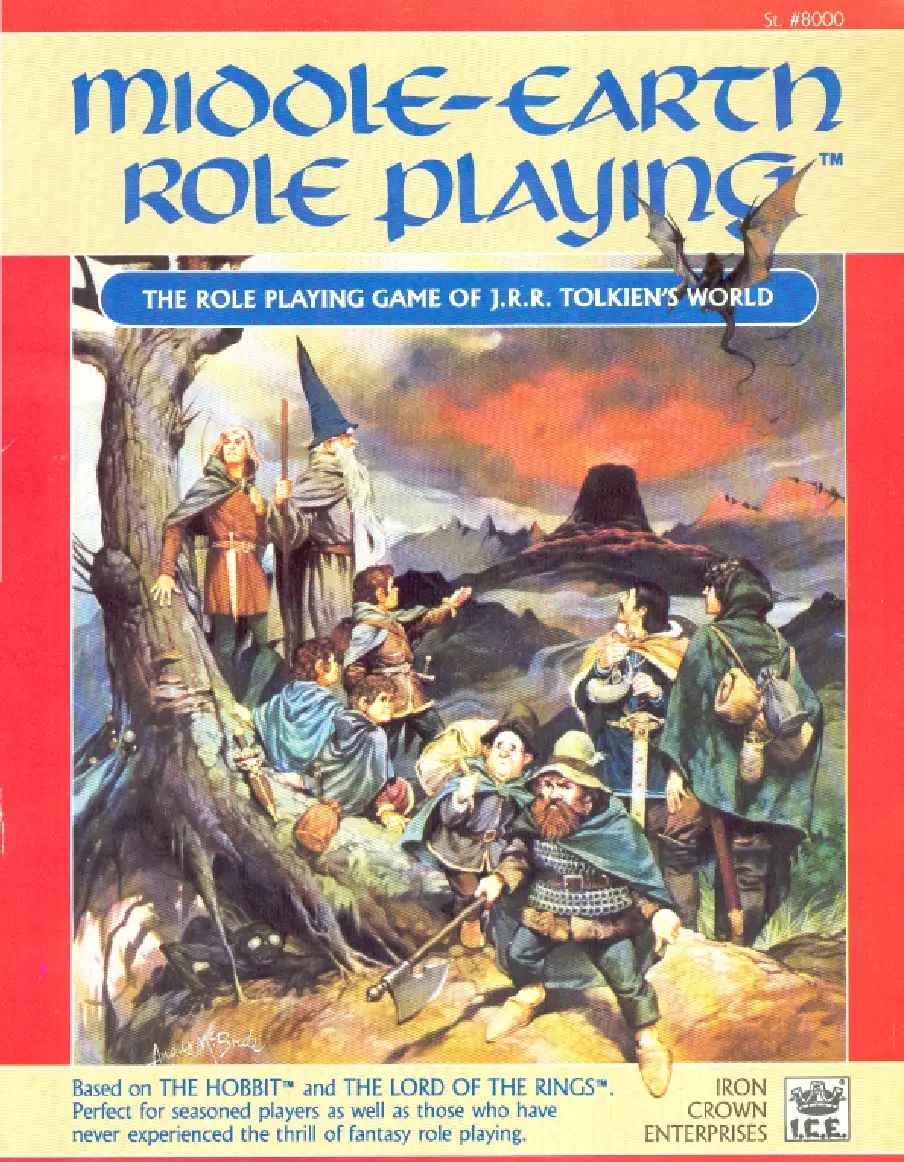
Middle-Earth Roleplaying (Iron Crown Enterprises, 1984) MERP has a special place in my heart, and always will. We played a fair amount of MERP in high school and college, and although I couldn’t tell you anything about the adventures and scenarios we played, I do know we had a lot of fun.
MERP is based on the Rolemaster system, which is not particularly suited for the setting, especially where magic is concerned. The spells and spell lists don’t really align with Tolkien’s portrayal of magic and wizards, for one thing; and the combat system is kind of clunky. MERP is justly famous, however, for the critical hit and critical fumble tables, which are absolutely hilarious and can instantly kill or maim anything, including the acting player character. It was worth it for that alone.
The supplements for MERP are exceptionally well-done, and like the WEG Star Wars RPG, much of the lore was created by the RPG company, not the original source. For example, prior to the release of the RPG, most of the Nazgul did not have names. In fact, Tolkien only named one of the Nazgul, Khamul the Easterling. Iron Crown named all Nine, and gave them backstories, too. They expanded and expounded upon Tolkien’s history and lore of Middle-Earth, and they did it with respect.
Bottom line: great setting and supplemental material. Not-so-great system for the game. Rolemaster may work well for fantasy RPGs, but it’s not a good fit for Middle Earth. Still, this was one we played often. Most MERP books fetch a hefty price on the secondary market nowadays, with good reason.
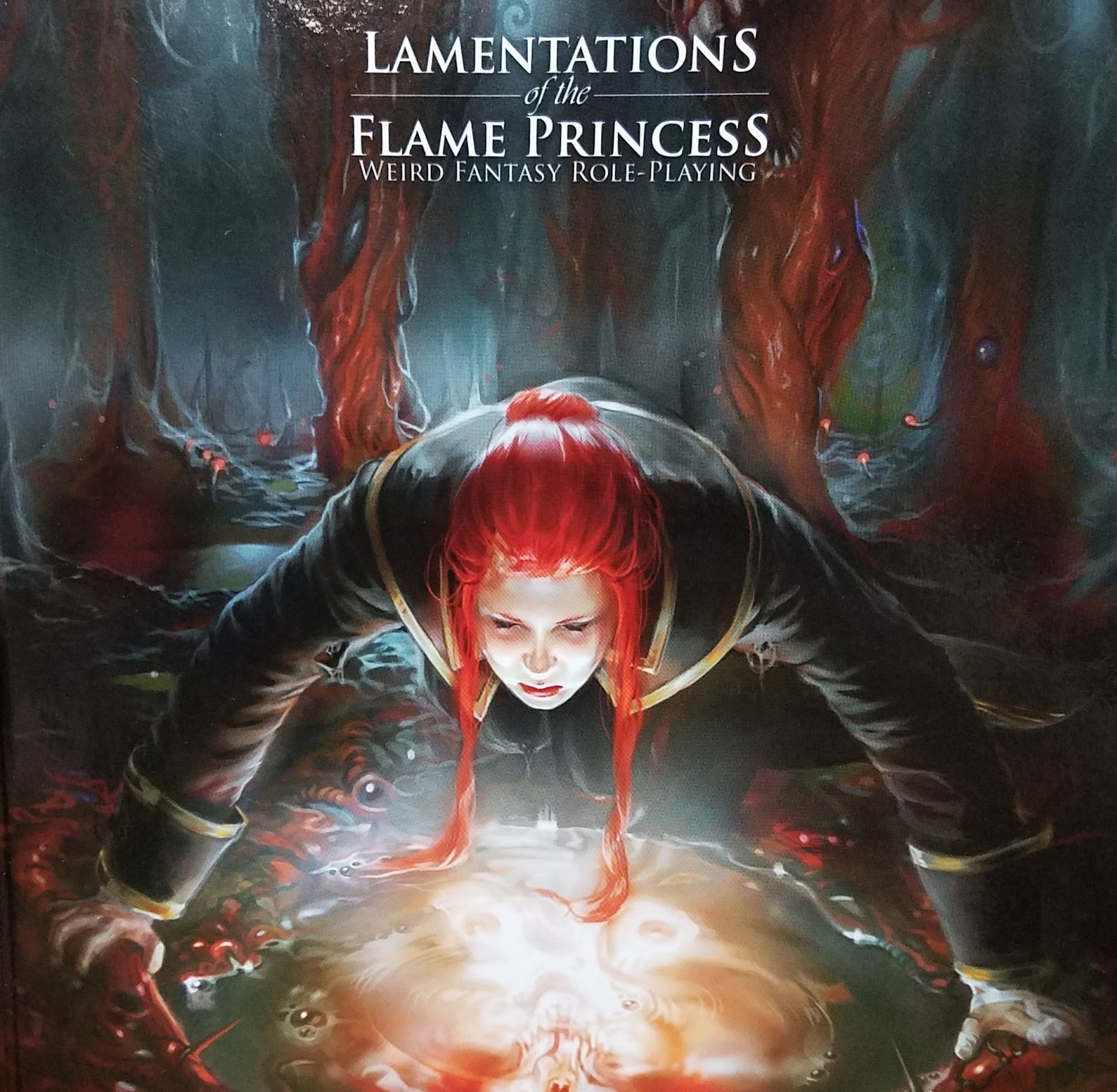
Lamentations of the Flame Princess (Lamentations of the Flame Princess, 2009) Lamentations of the Flame Princess is basically an OSR clone of Moldvay B/X D&D, although with a lot of updates (ascending Armor Class! Yaaay!) and changes that make the game much, much darker in tone. Whereas D&D is Tolkien-inspired high fantasy, LotFP is more grimdark and low-magic. It’s billed as Weird Fantasy, and it lives up to the name. There are no Fireballs or Lightning Bolts here; but Summoning is only a 1st-level spell, meaning it’s available to Magic-Users from the jump. Just because you can summon something, though, doesn’t mean you’ll summon what you want to, or that you can control it when it arrives, so beware.
Although LotFP has rules for demi-humans like Elves, Dwarves and Halflings (and, like B/X D&D, these races double as classes), much of the published material is designed without these fantasy races in mind, more of a late 16th/17th century European setting. In the words of James Edward Raggi IV, the game’s creator, this period of human civilization was hands-down the most miserable time to be alive in history. As a result, character survivability is low in LotFP. The published content is, without question, adult in nature; and has been the target of pearl-clutchers everywhere since the beginning. This only increased over the years when the cancel culture mob got the company in its sights. Sadly, that hasn’t gone away; but Raggi is well and truly done apologizing for anything at this point, and I, for one, am glad of that. Fuck that noise. Censorship is bullshit.
In March, I wrapped up a year-long Witch Hunter (i.e. Solomon Kane) campaign I ran for some folks on my Discord server. It was dark and grim and demonic, as it should be. We all had a great time, and I will likely use LotFP for my fantasy rules of choice going forward, unless of course I’m looking for something more forgiving and high fantasy.
That about does it for this post. Coming soon: my top 10 RPGS that I have yet to play (enough).
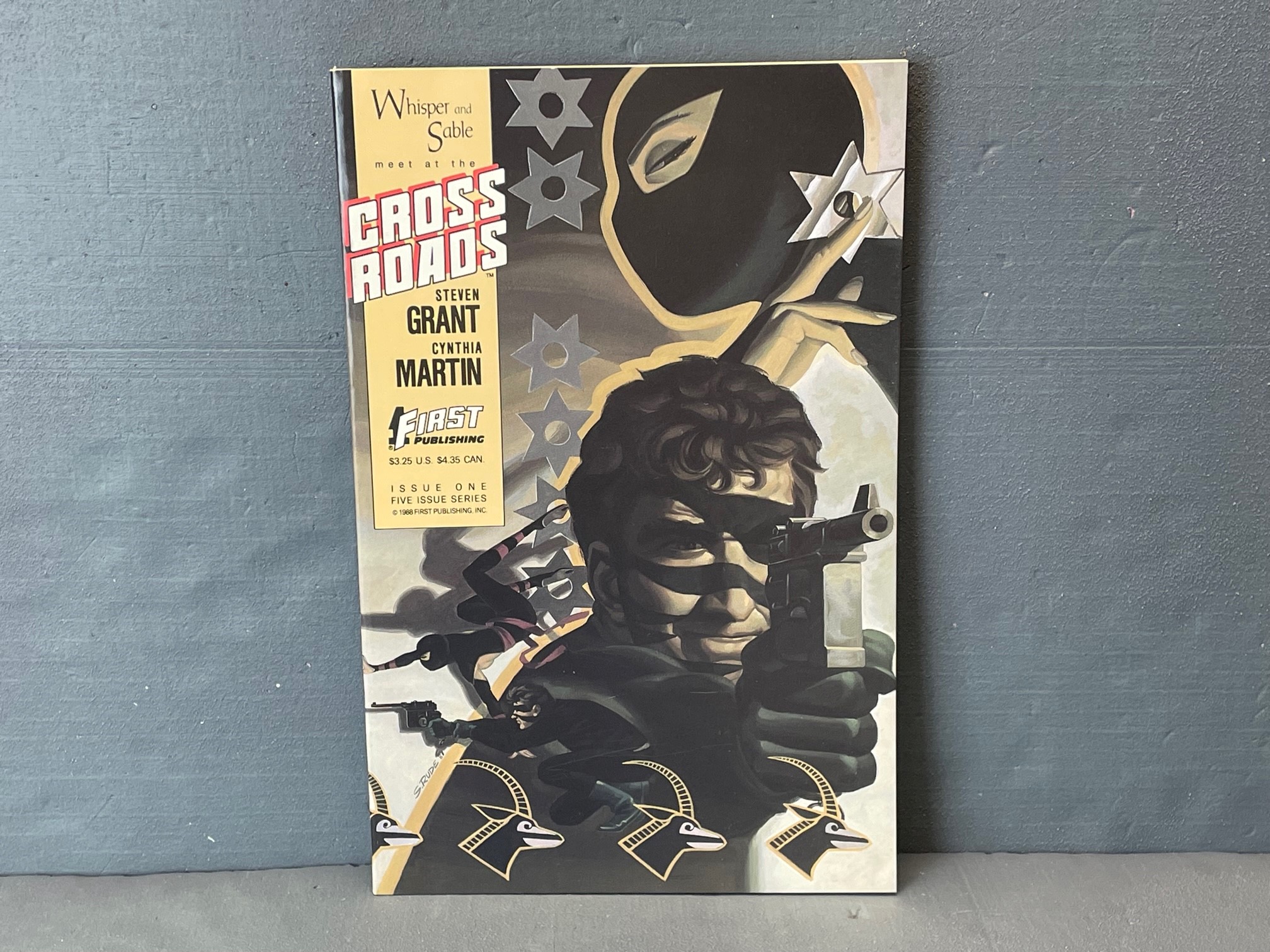
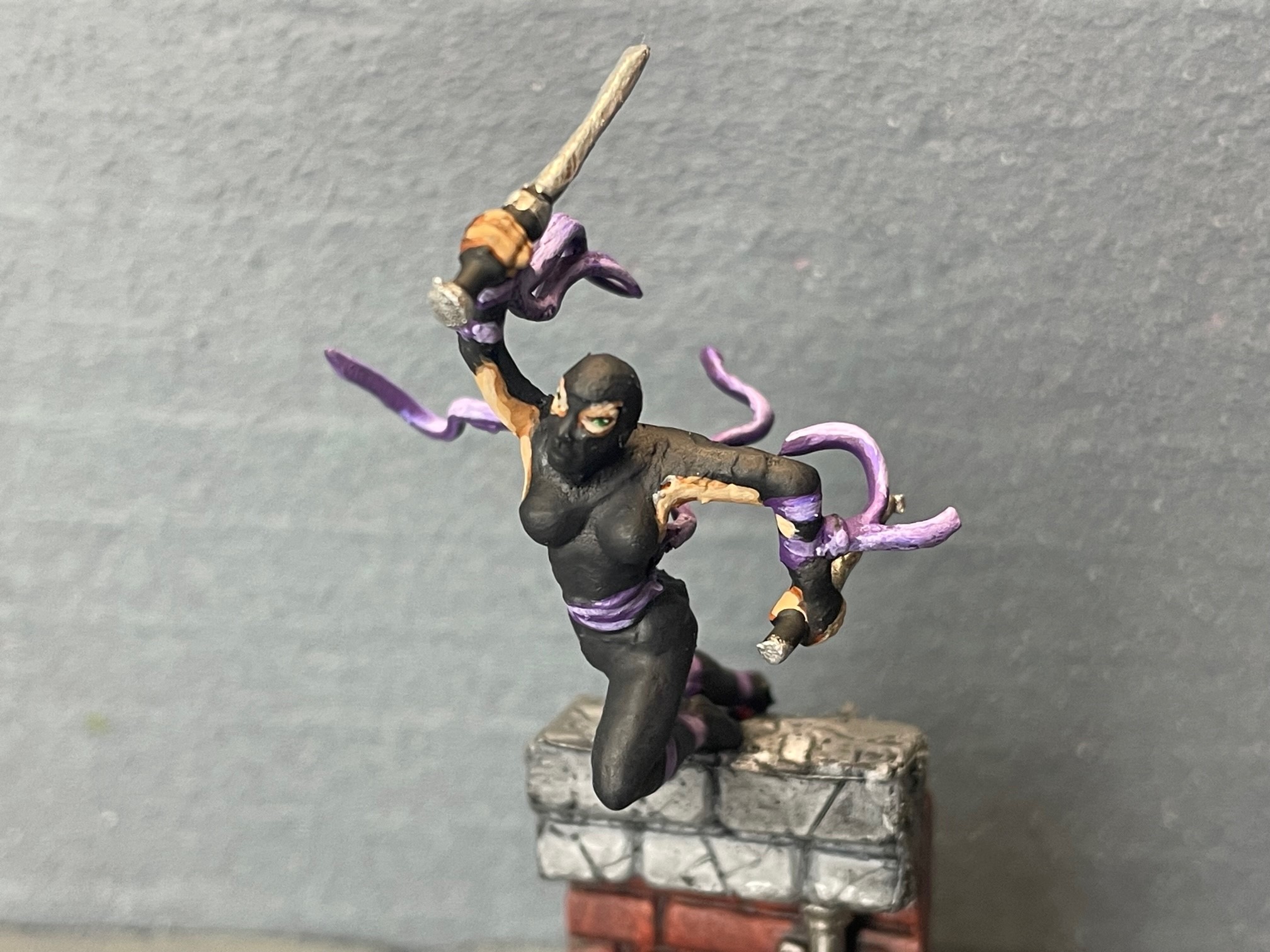
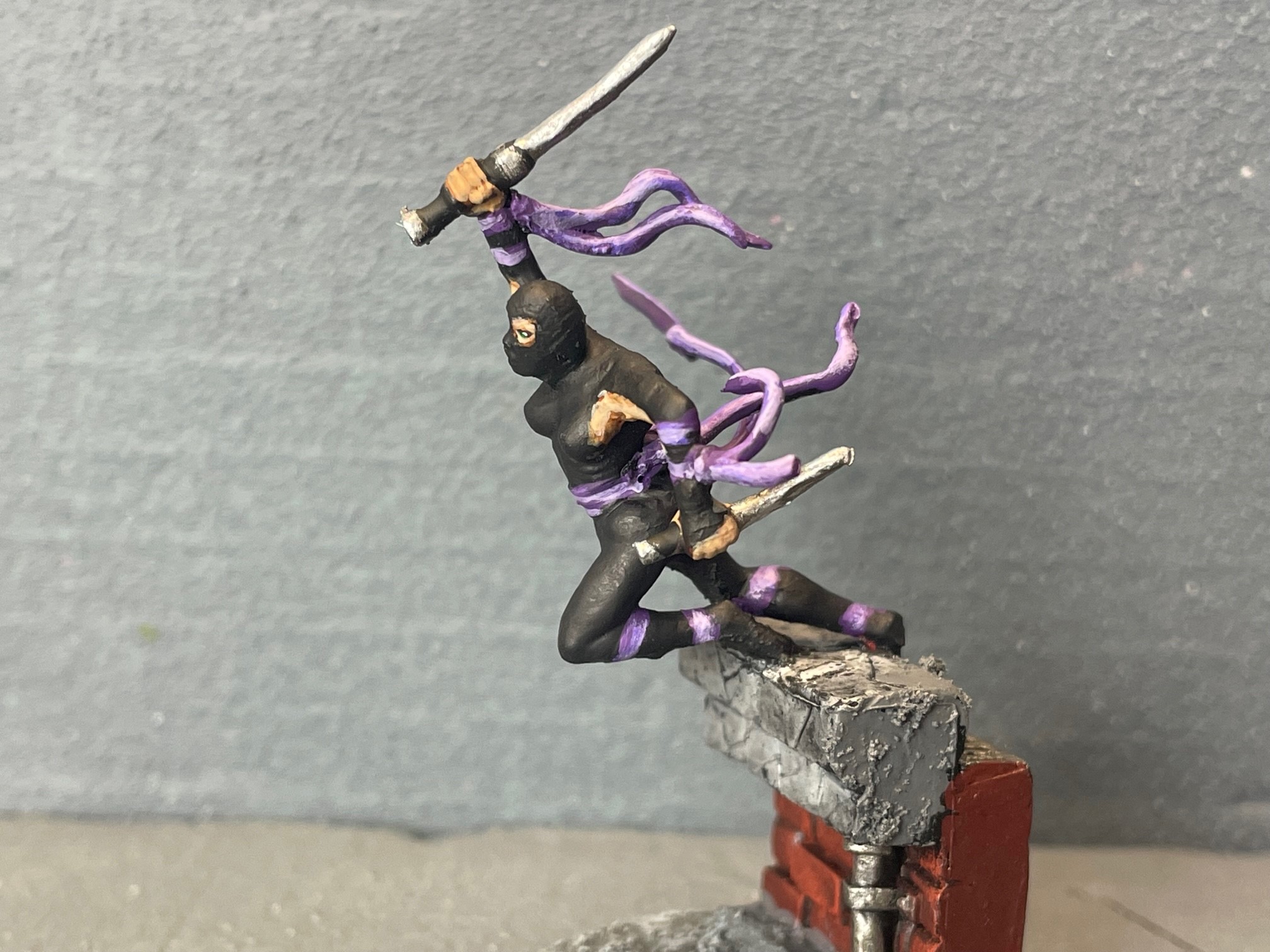
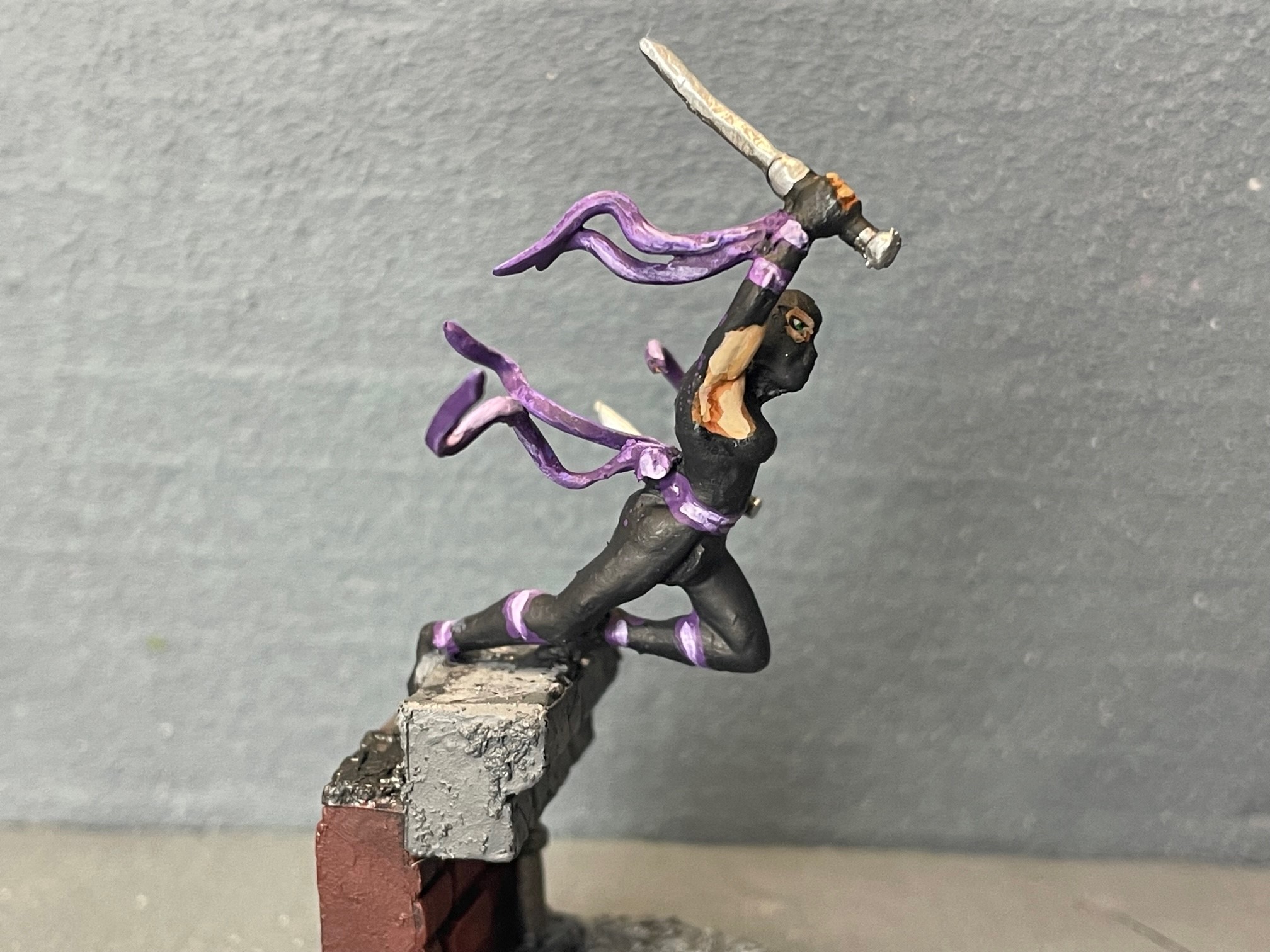
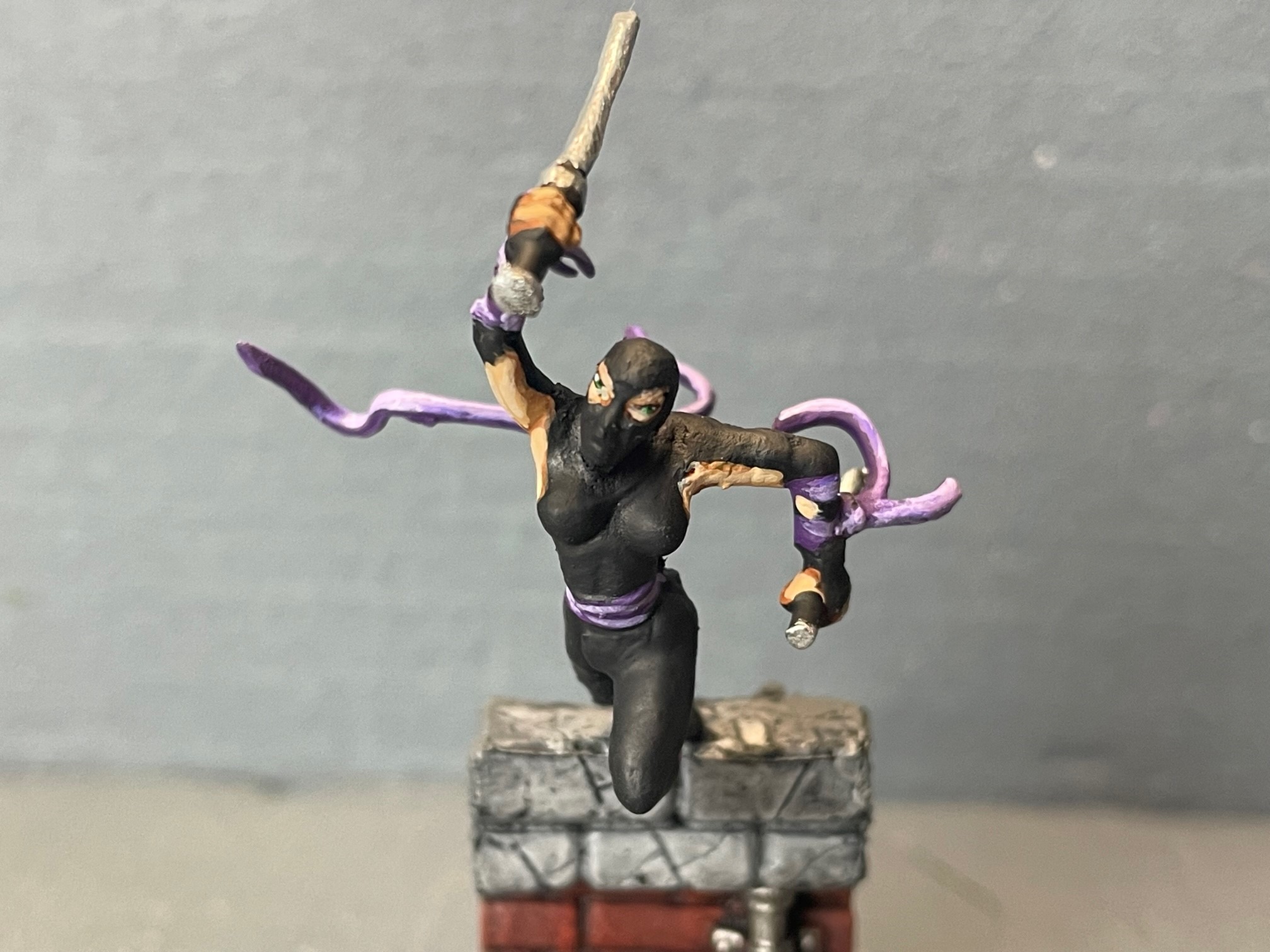
For my second Forgotten Hero of 2023, I present another First Comics character: Steven Grant’s Whisper. Along with Nexus and Badger, Whisper actually started out in Capital Comics before being published by First after Capital’s demise. Whisper last showed up in a one-shot in 2006. I own exactly one Whisper comic, and it’s not even an issue of her own series. It’s this Crossroads comic, featuring a team-up between Whisper and Jon Sable, Freelance. Despite having a cool cover, it’s bad.
As a result, I knew next to nothing about Whisper before I decided to make this conversion, so I looked up her story. She’s Alexis Devin, an American, but trained in ninjutsu by her Japanese Yakuza stepfather. As a child she had polio and this training helped her overcome it. Alexis was working as an architect and wanted nothing to do with ninjas when she was drawn back into the conflicts of the Yakuza against her will. I guess there’s more to the story, but that’s the gist of it. She’s a ninja, and it was the 80’s. The world was ninja crazy back then.
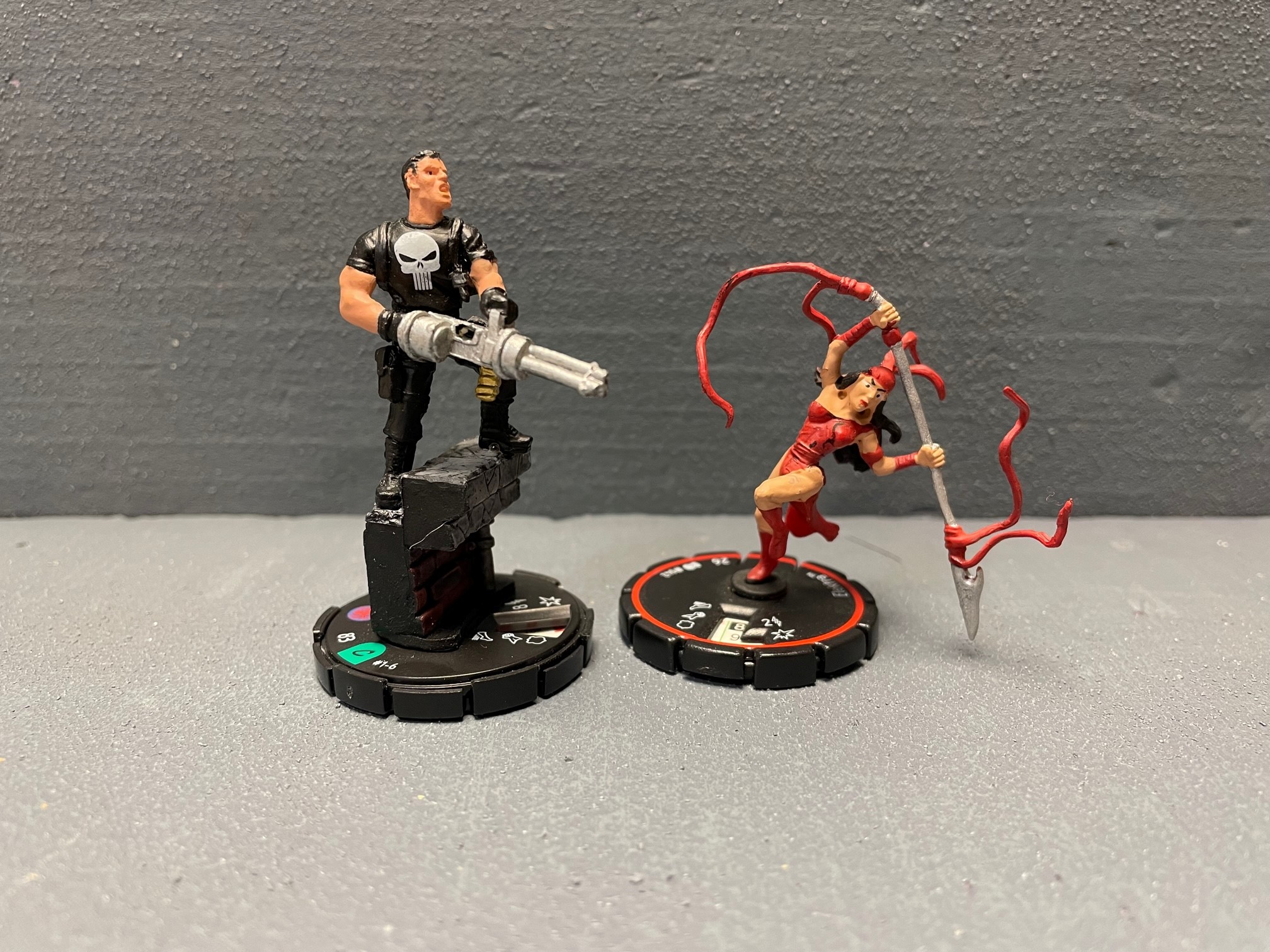
To make Whisper, I started with these two Heroclix miniatures: The Punisher and Elektra. I’ve always hated this Elektra miniature because it looks stupid, and like many Heroclix, the factory paint job is abysmal. The Punisher sculpt is pretty bad-ass. Unfortunately, I needed that wall he’s standing on, because I have no ability to sculpt one myself. (The Punisher plays no further role in this tale.)
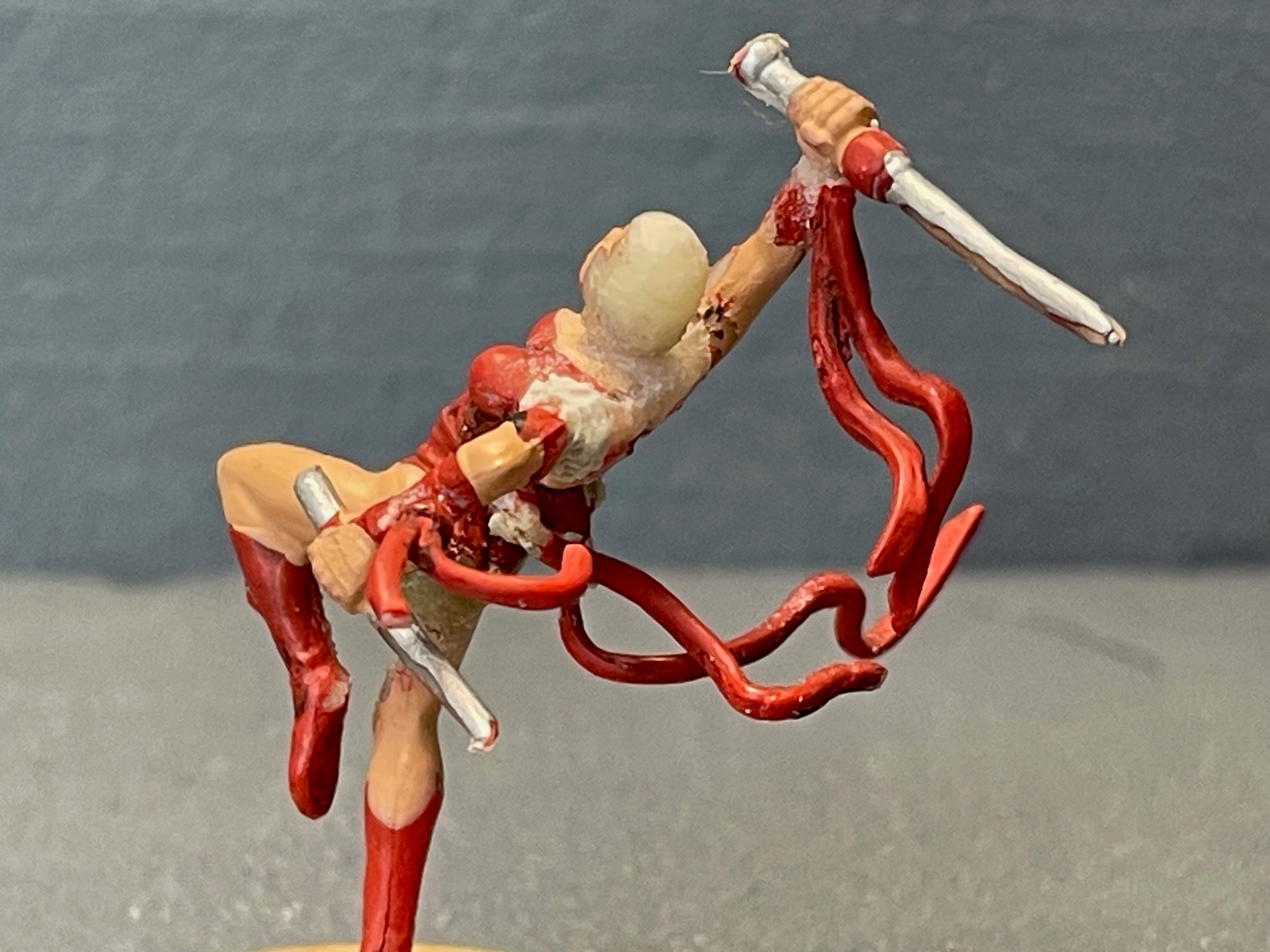
I started by cutting the spear apart and repositioning her arms. I removed the sashes from the spear, but kept some of the handle for each hand. Then I chopped off her hair and her skirt and filled the gaps left behind.
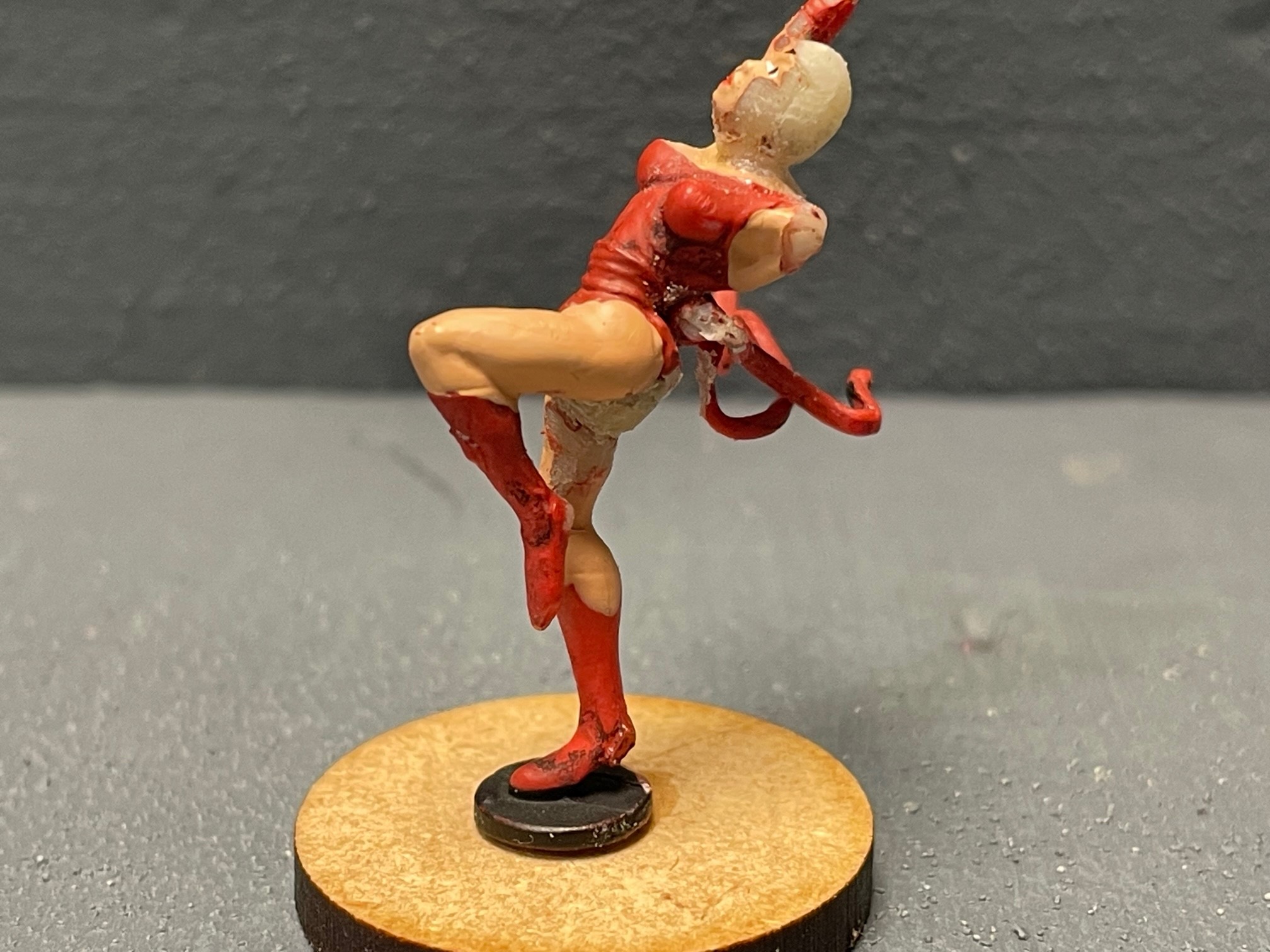
I spent a lot of time filing down her head. Like many conversions, this one looked horrible during the process. I couldn’t get the image of Elektra with a massive head bandage out of my mind. I reattached the sashes as a belt and some flowing wrist wraps. I shaved down the spear shafts to look more like swords.
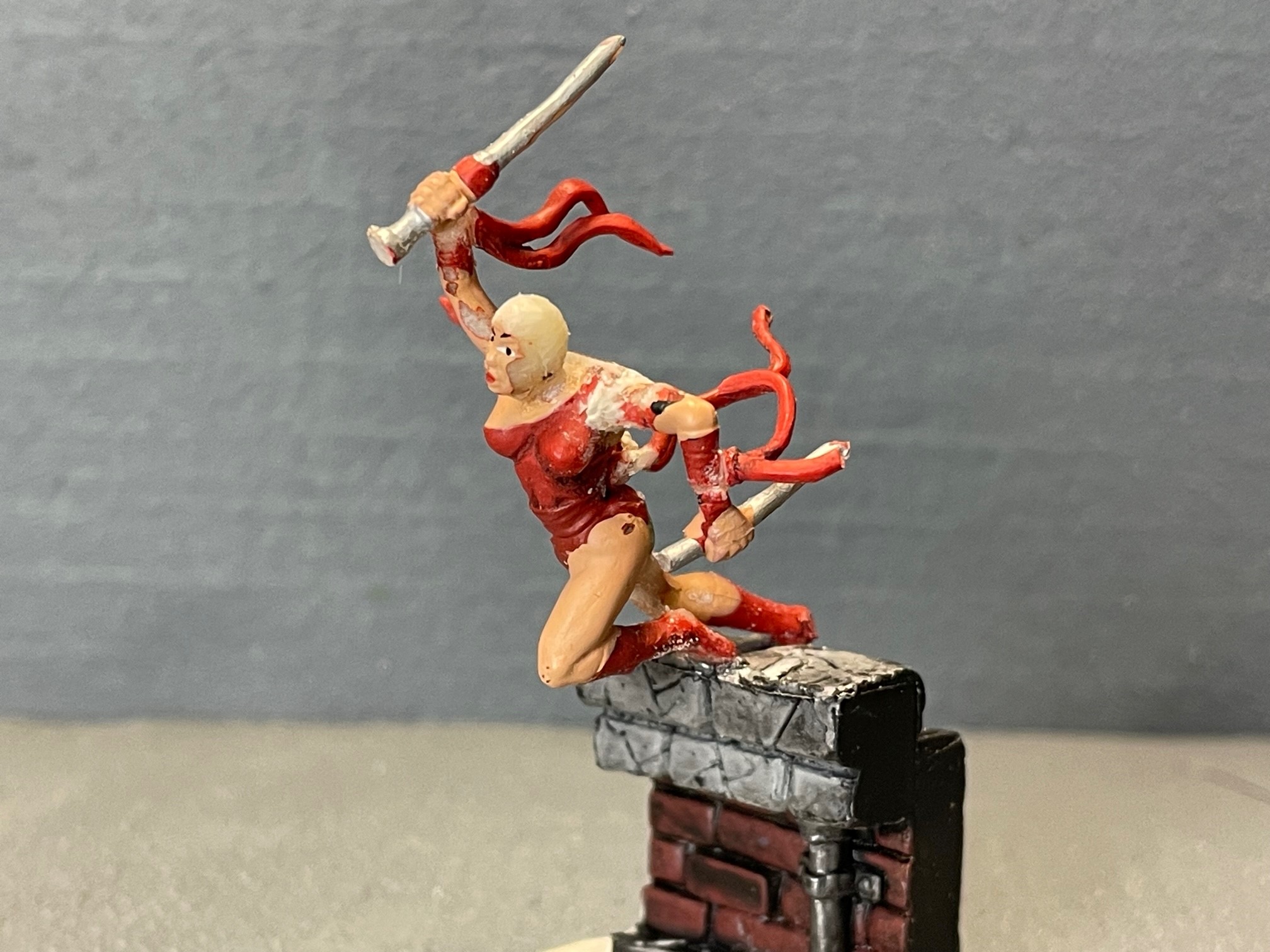
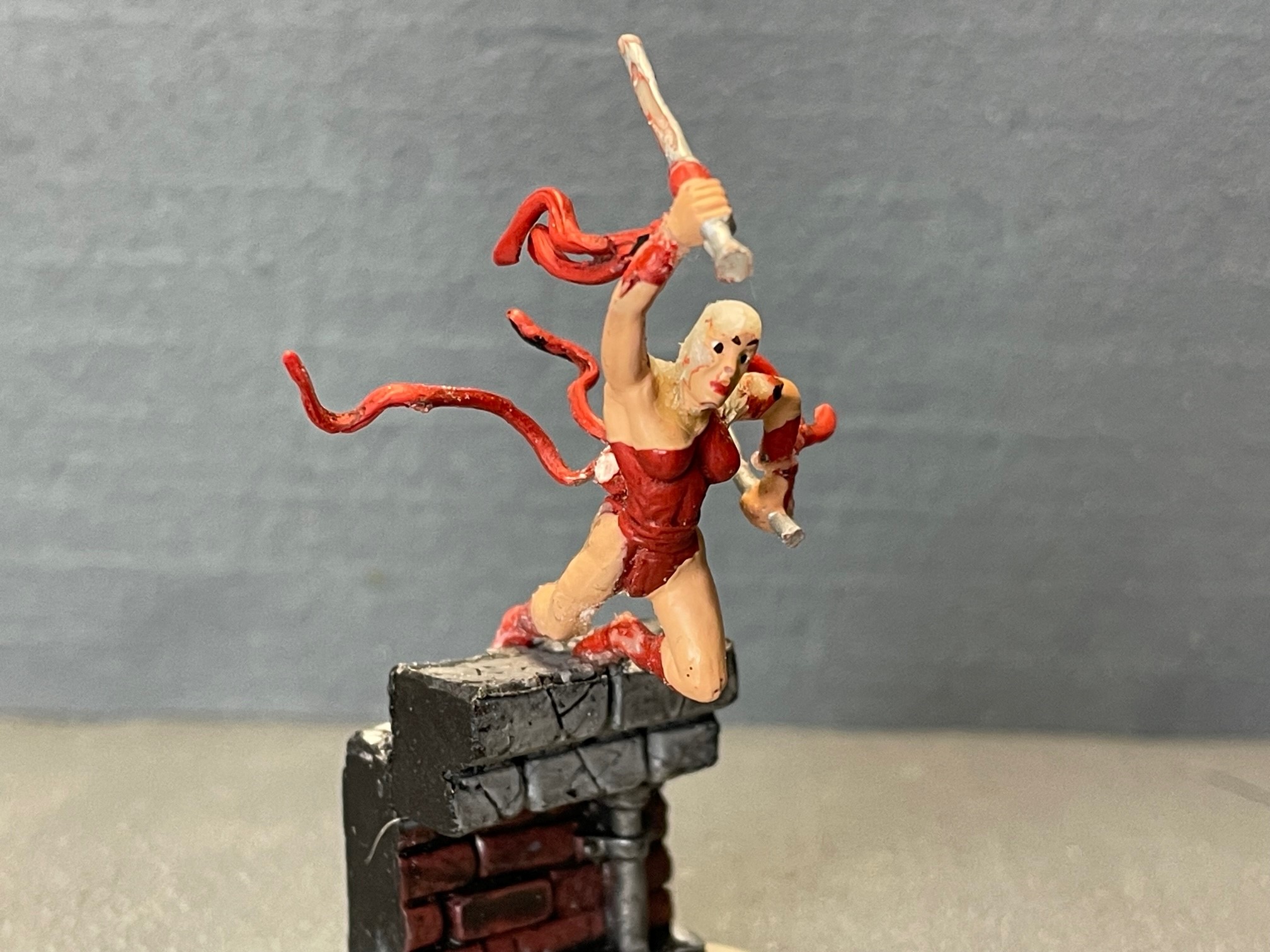
I wasn’t about to keep that stupid pose, so here’s where I used the wall. Now she’s leaping from a high ledge, ninja-style.
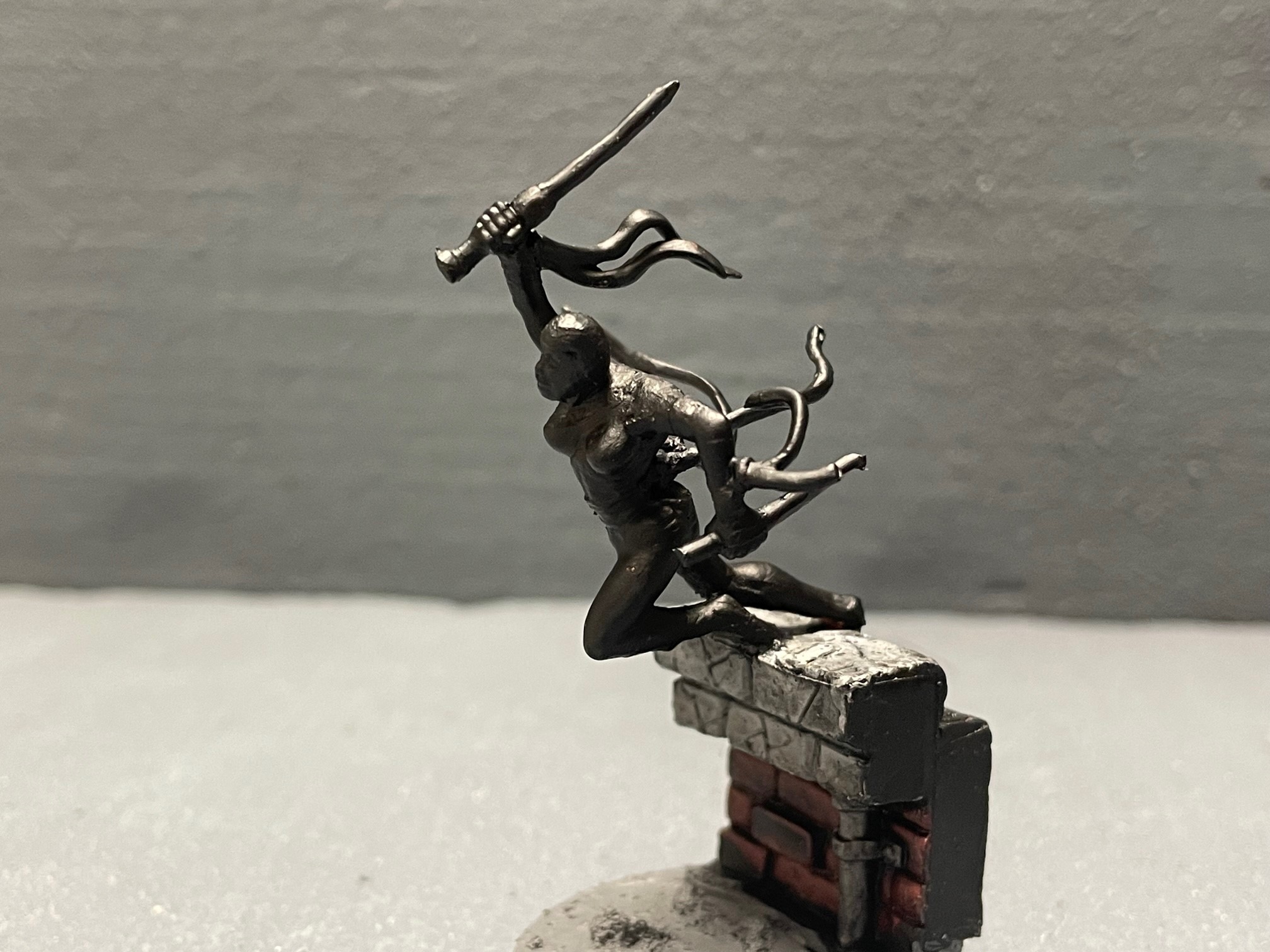
Once primed black, she immediately looked better.
Turns out Whisper doesn’t have flowing wrist wraps, but I like the look of it as it gives the character an illusion of motion. I didn’t do much to the wall other than weather it a little and give it a slight highlight.
And there she is: Whisper. Overall, I think she looks pretty good. She looks a lot better than that Elektra miniature, anyway…
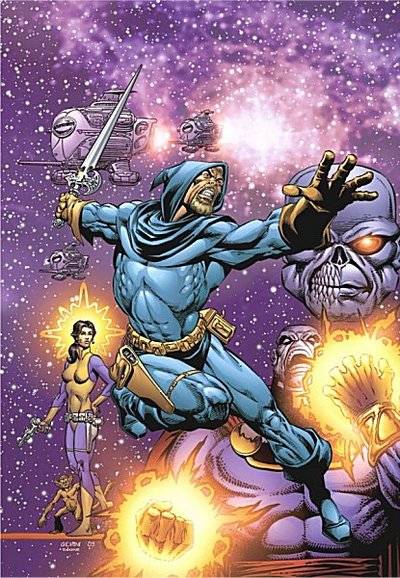
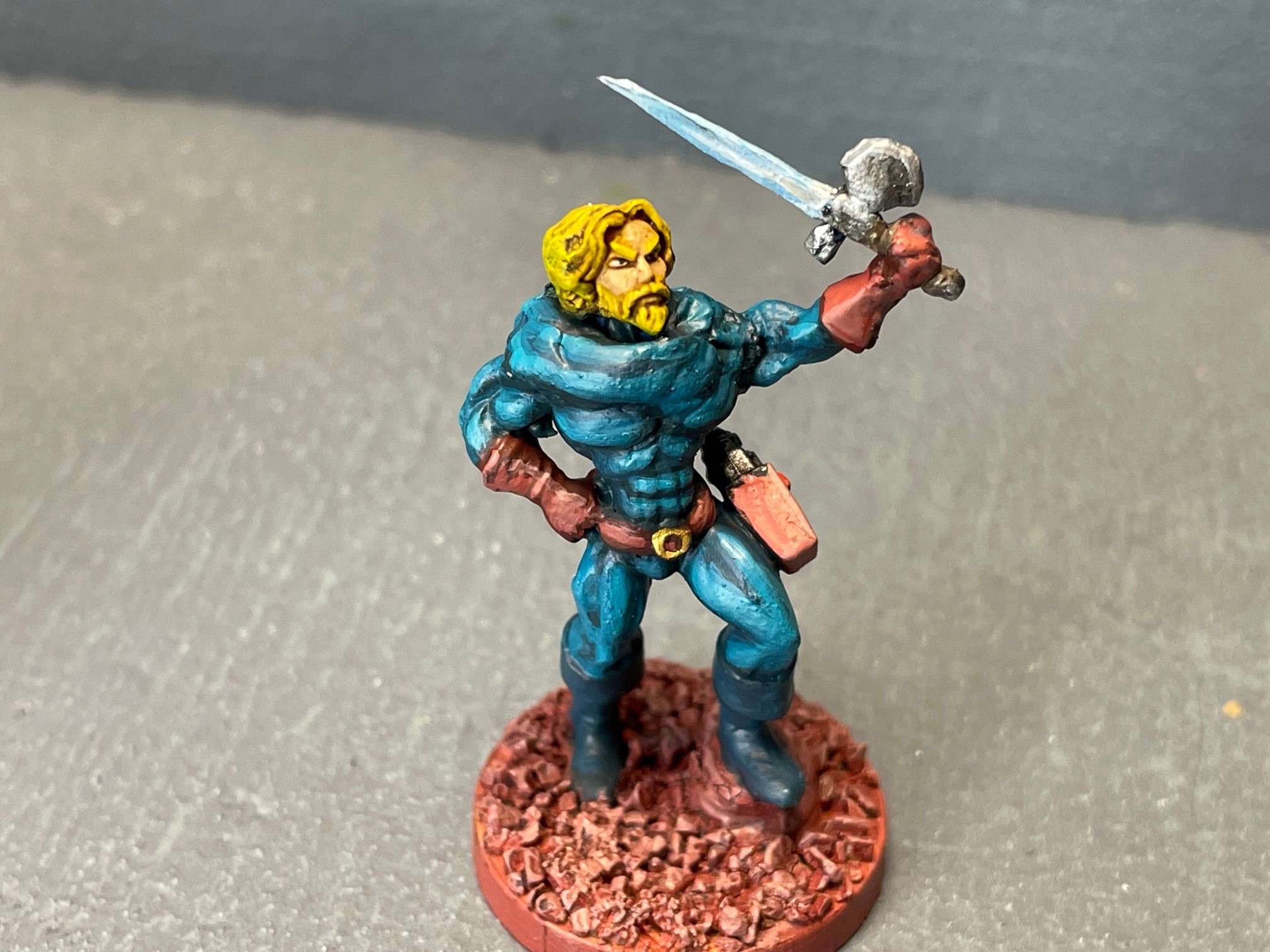
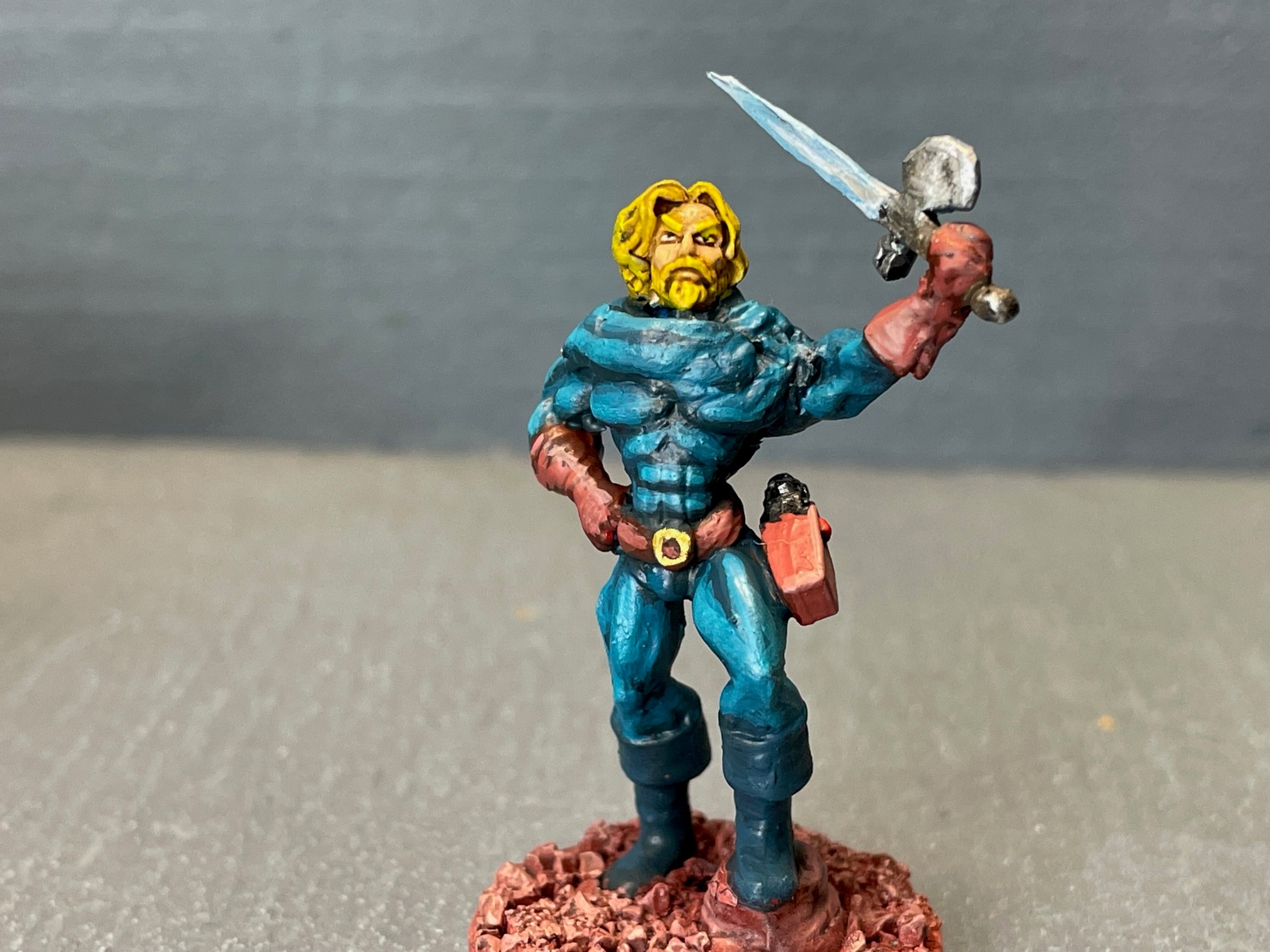
For my first Forgotten Heroes post of 2023, I decided to do Jim Starlin’s iconic hero: Vanth Dreadstar.
Dreadstar started out in Marvel’s Epic Illustrated, before getting his own Epic Comics series that lasted for 26 issues. Then Starlin took it to First Comics, where it was published until they went out of business in 1991. Dreadstar briefly returned for a limited series published by Malibu in 1995. As far as I know, that was the last appearance of Dreadstar in comics, although there is supposedly a TV series in the works. Guess time will tell.
I have a confession to make: despite having almost all the Dreadstar comics, I could never get into the character. Maybe I should try again. Still, I was a huge fan of First Comics, who published some really groundbreaking stuff back in the 80’s; including my favorite comic of all time, Grimjack. First Comics heroes have been my go-to for Forgotten Heroes challenges in the past. I’ve done Badger, Nexus and Jon Sable, Freelance in previous years, and if all goes well, I’l be doing another First Comics hero by the end of the month.
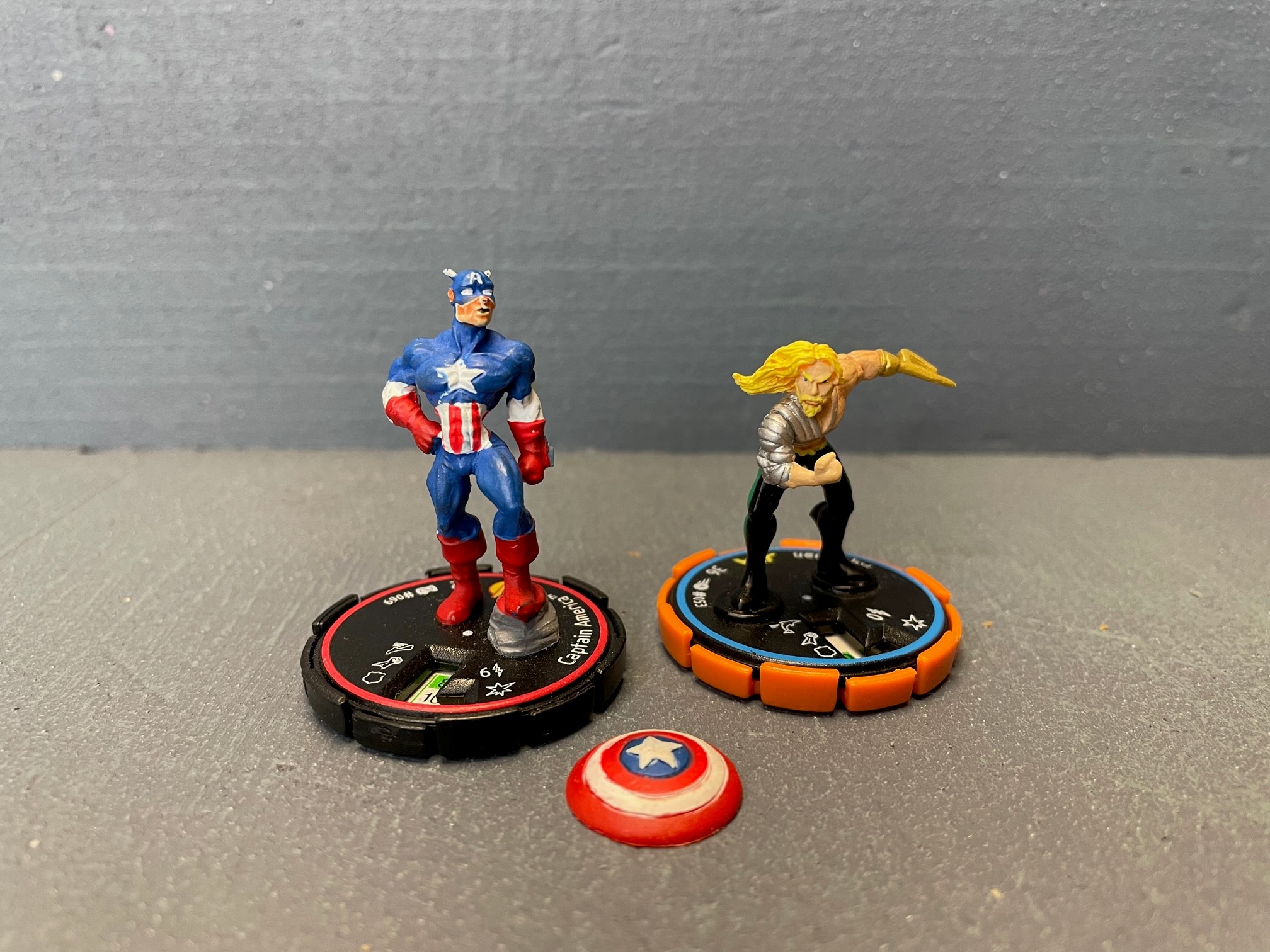
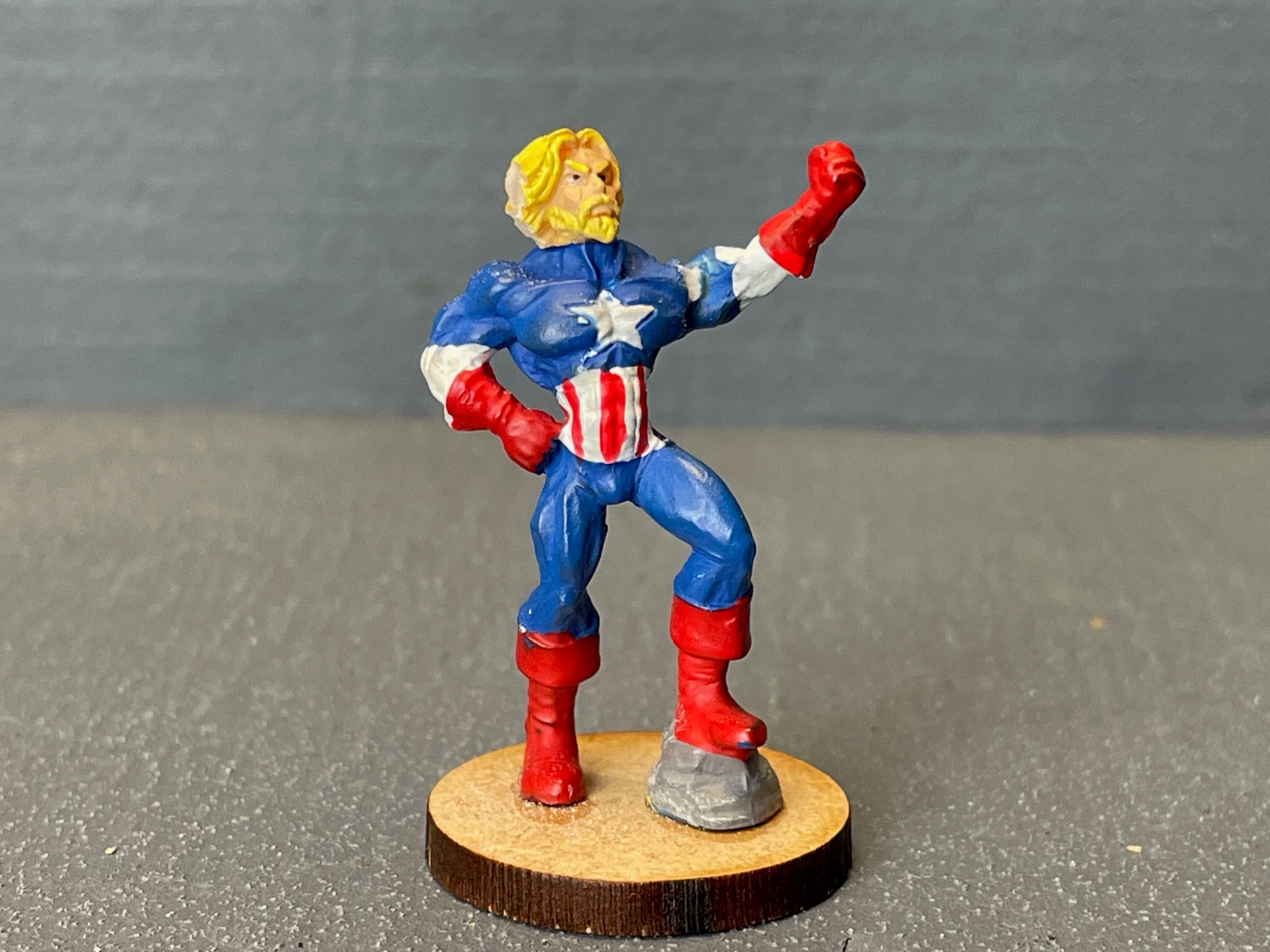
But on to Dreadstar. To make this miniature, I used two old Heroclix models: Captain America, from the original Marvel Infinity Challenge set, and Aquaman, from the original DC Hypertime set. I removed Cap’s shield (cool objective marker!) and his head, and also beheaded Aquaman. Then I chopped off some of Aquaman’s hair and swapped the heads. Finally, I repositioned Cap’s arm. The end result was this:
I’m saying something really important!
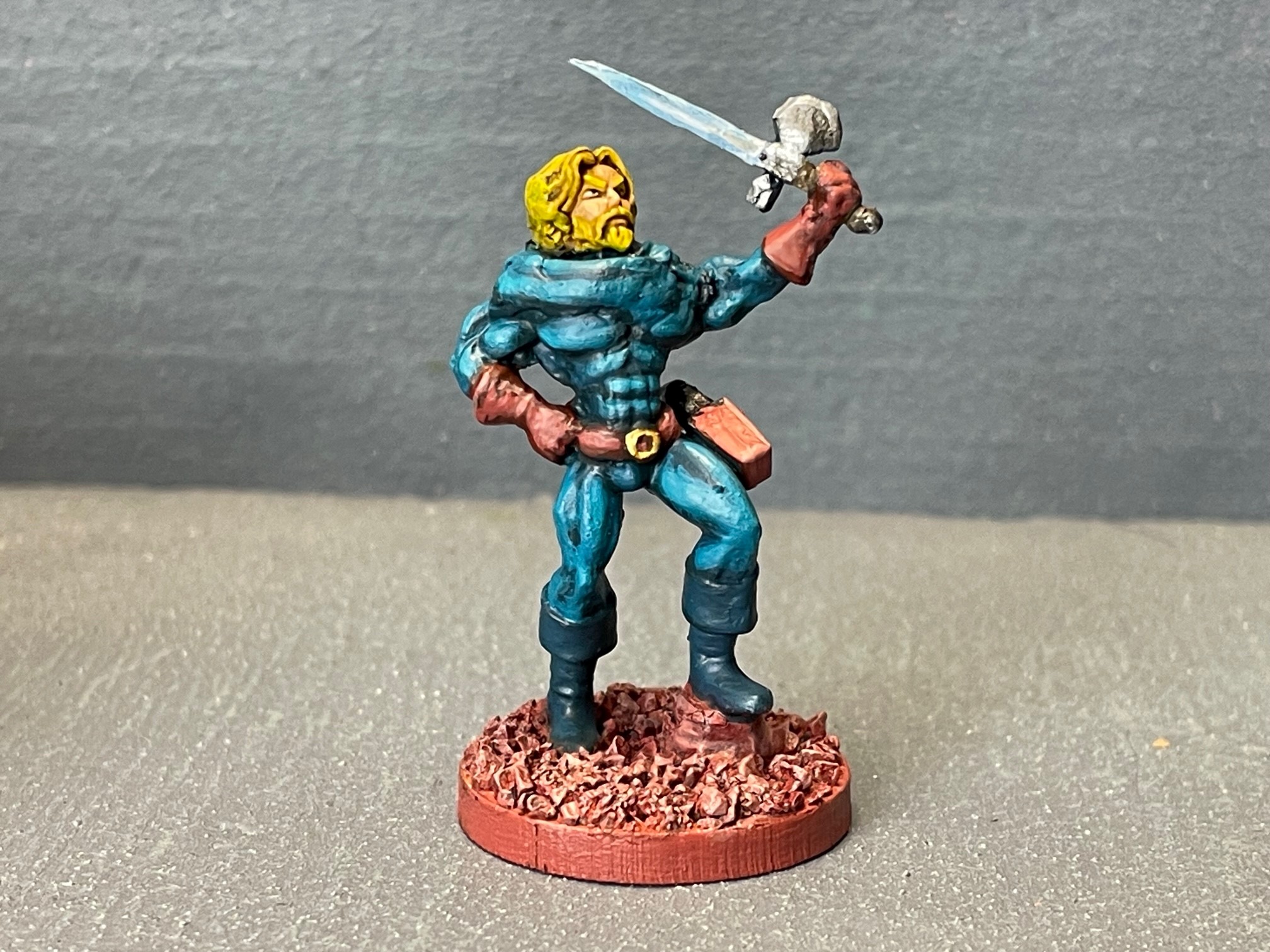
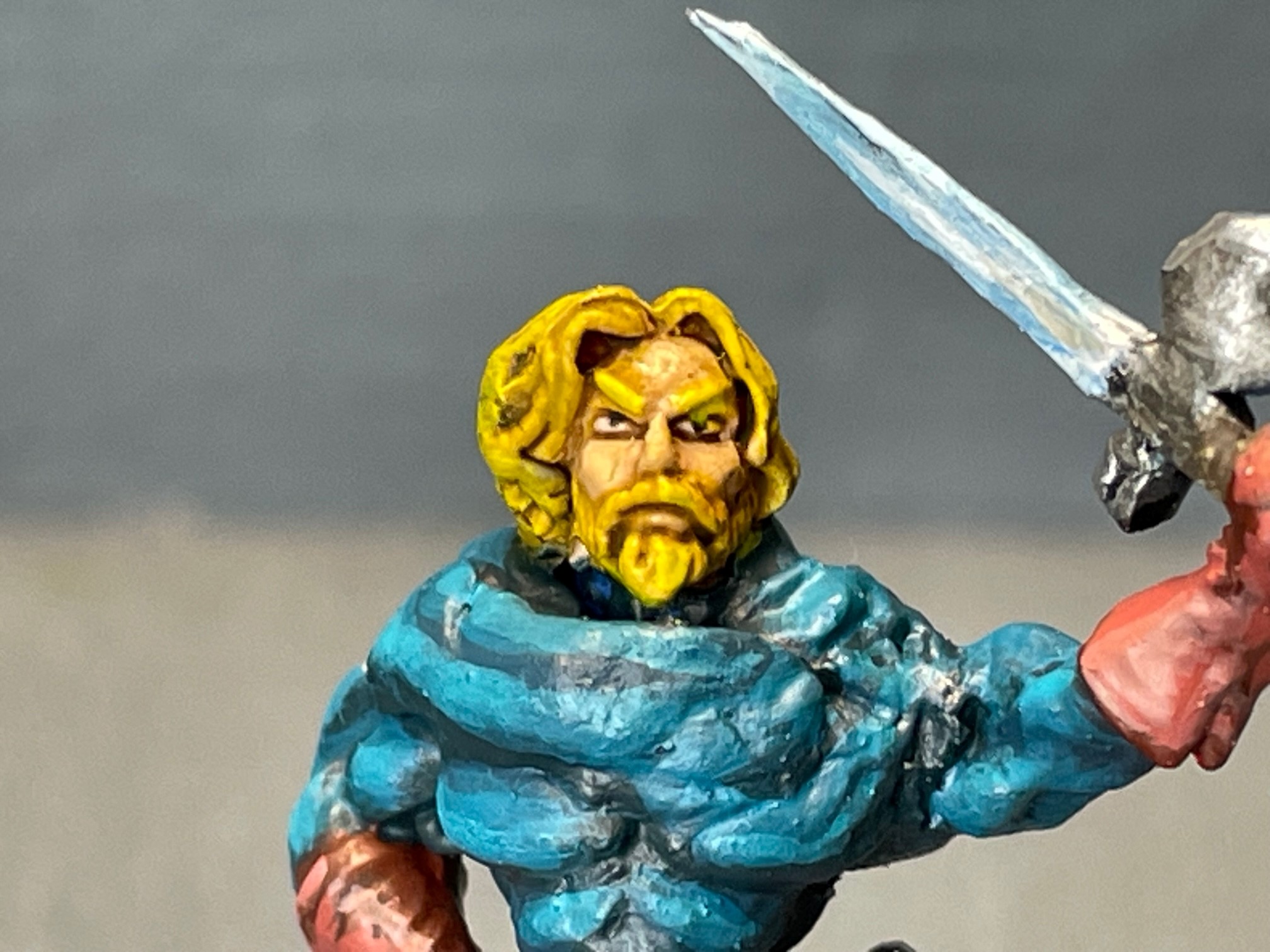
I made his sword from a toothpick and green stuff, and I sculpted his belt and hood. As anyone with eyes can see, I’m a shitty sculptor. Sadly, I forgot to take any pictures of this miniature covered in green stuff, It was too depressing. Anyway, here he is.
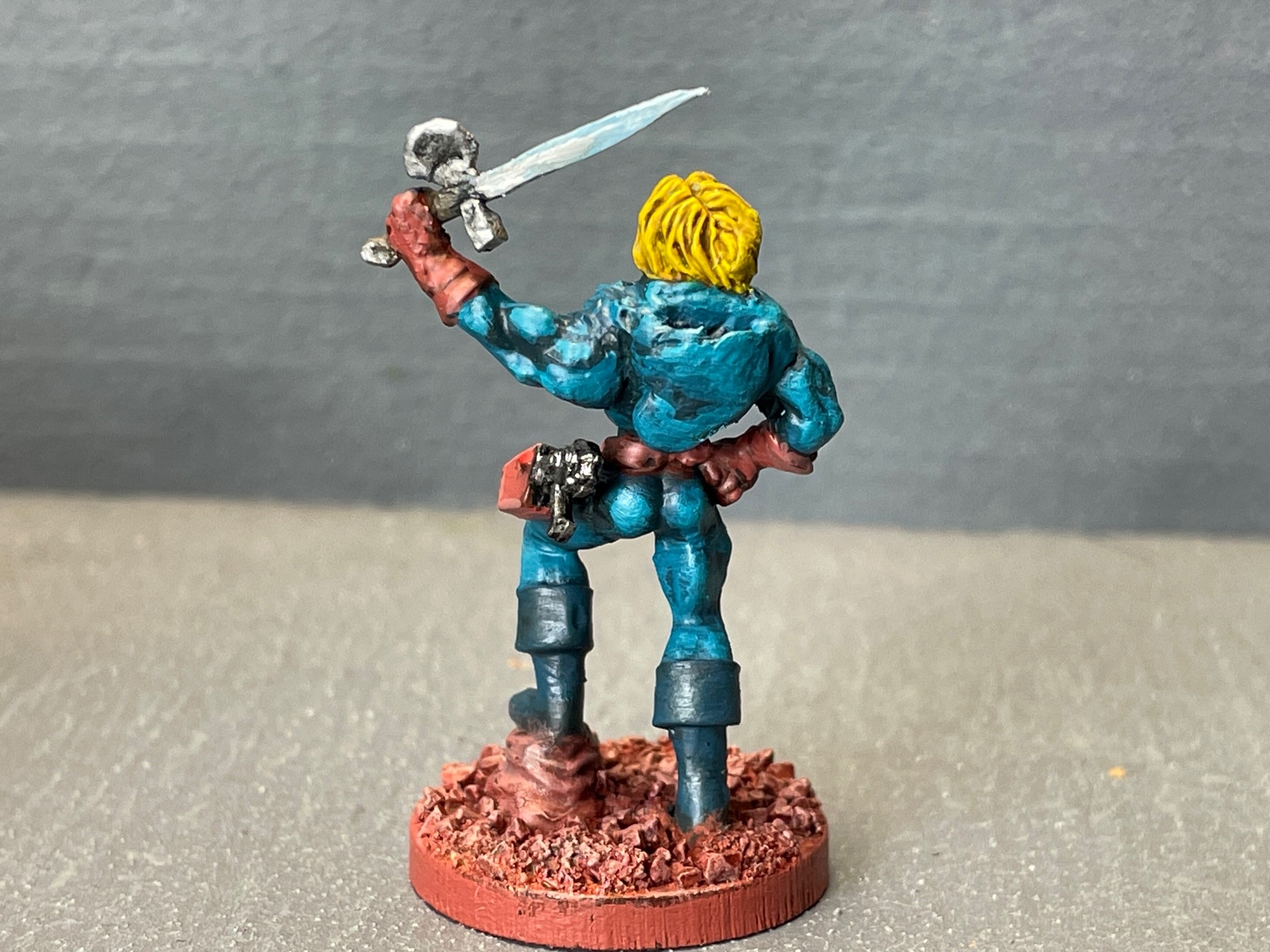
I added an old Space Marine bolt pistol to his hip.
Up close, you can see how shitty my sculpting is. Try as I might, I can’t make that green stuff behave.
Dreadstar’s history is long and convoluted, and like i said, I could never get into it. According to the Fandom page, most of his powers are derived from his sword. It can be absorbed and extruded from his body at will (gross), allows him to speak and understand any language, acts as a shield, and gives Dreadstar enhanced reflexes, rapid healing and the strength of twenty men. It’s also a sword, so I guess it can cut stuff, too.
Despite the sculpting flaws, I’m happy with how he turned out. Like I said, I’m hoping to get another First Comics character done by the end of the month. It’s a very obscure character. Want to know who it is? I’ll Whisper it to you….