Category Archives: Miniatures

Monster Month Holdouts: Displacer Beasts and Classic Balrog

There’s always a someone who’s late for the train. My orc warlord on wyvern took a bit longer than I anticipated, so these miniatures weren’t done in time to make it into Monster Month.

First up, some iconic AD&D monsters: Displacer Beasts!

(Every time I speak the name of this monster out loud, I say it as Sylvester the Cat would. It makes it much more fun. Don’t believe me? Give it a try.)


A Displacer Beast resembles a six-legged, emaciated puma with two toothy tentacles sprouting from its back. They are stealthy carnivores that often hunt in pairs, which is why I bought two. Displacer Beasts are surrounded by a light-bending camouflage effect, which makes it difficult to determine the monster’s exact location at any given time (like when you’re about to get eaten).  These Displacer Beasts are from Nolzur’s Marvelous Miniatures, and although they’re technically the same miniature, it’s easy to get some variation in the tentacles and tail simply by doing the old “hot water bath/reposition/cold water bath” method. (I’m not sure what’s up with the lighting in these pictures, but the focus is a tad blurry. Same thing happened last time. I need to investigate this further.)

In the video game Baldur’s Gate: Dark Alliance II, you get attacked by a ton of Displacer Beasts in an ice cave. I guess that’s why I based these on snowy bases. I used Citadel’s Mourn Mountain Snow, a texture paint kind of like Stirland Mud. I like Stirland Mud a lot, because it looks like mud. Unfortunately, Mourn Mountain Snow doesn’t look like snow, it looks like white mud; so I also added some snowy flock and tundra tufts to the bases.
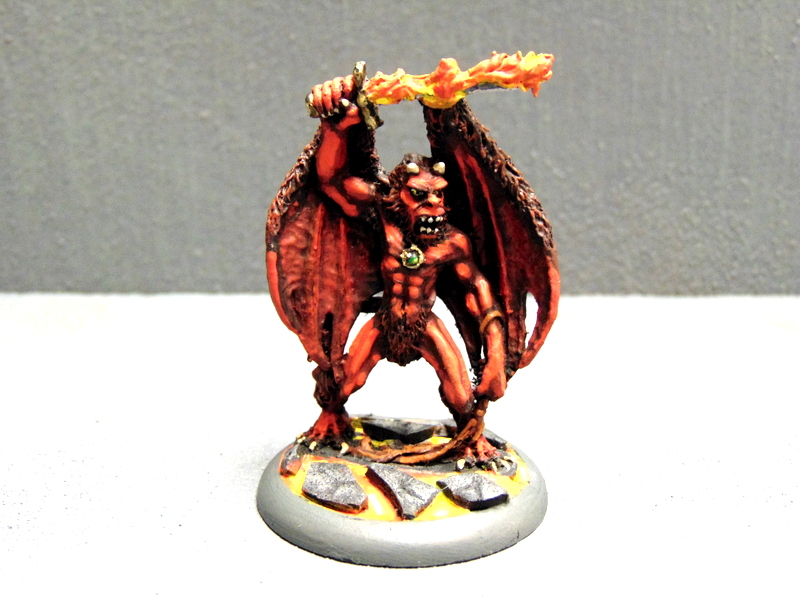
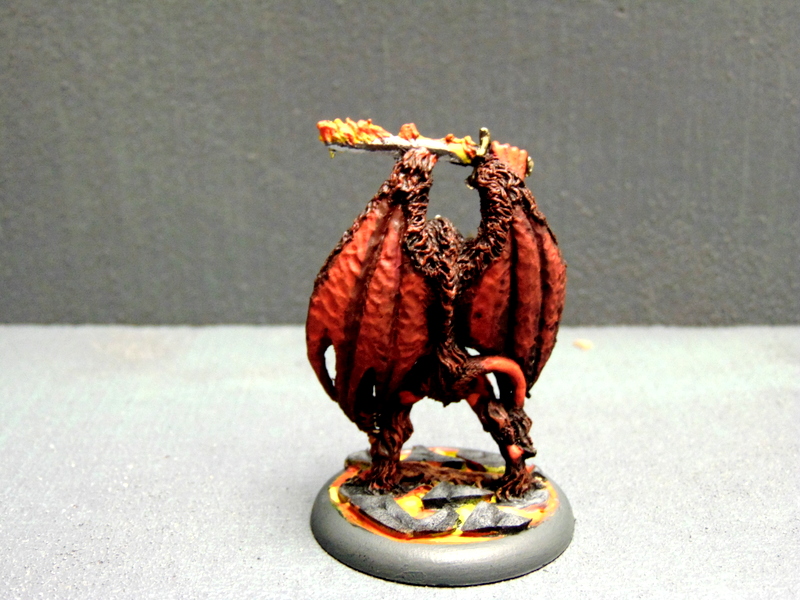
The other latecomer is a classic Grenadier Balrog. This miniature came out in the late 1970’s. I once painted him with the dreaded Testor’s gloss enamel, but I stripped the miniature years ago to repaint him. I finally did! There have been several variations of this figure over the years; one has a wavy sword rather than the flaming sword mine has. I think this miniature holds up quite well, considering its age.
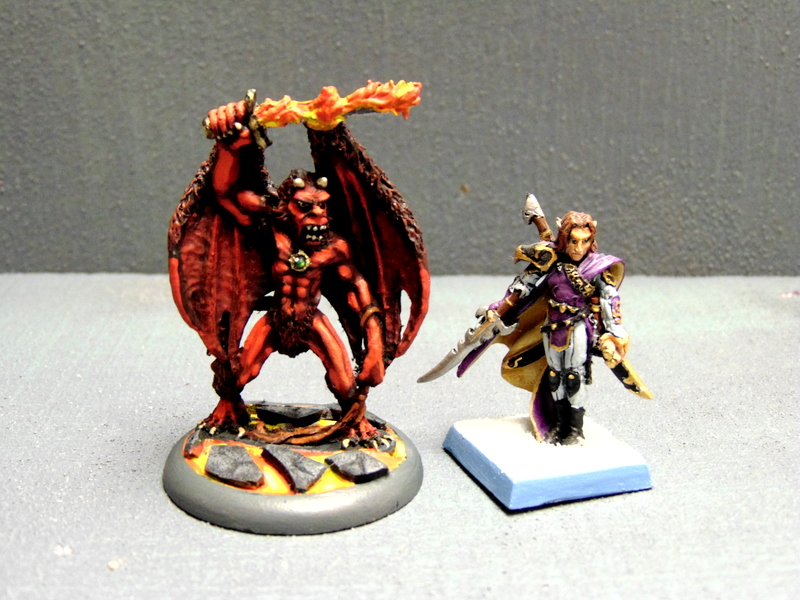
It does seem a bit small for a Balrog, as you can see from the picture above.  If you say the word “Balrog” most fantasy fans have an image in their heads that roughly corresponds to this one, i.e. the Balrog of Moria, “Durin’s Bane”. But Tolkien is often vague, even contradictory at times when describing what a Balrog actually looks like. At times he describes them as gigantic; other times he says they are twice the size of a man. Whether they have actual wings or not is apparently up for debate among Tolkien-philes. Whatever the case, looking at the mniature now, it’s a bit too red. I probably should have painted either his body or wings black for some variation. The hair on the Balrog’s body was drybrushed with a Vallejo Cavalry Brown, but it looks close enough to red so that the effect is somewhat lost.

It looks a hell of a lot better than it did when coated in Testor’s gloss enamel, and it can certainly do a fair job of representing a greater demon, nonetheless. I made the lava base out of pieces of irregular craft foam scraps I had from my Gaslands projects a few months back. I’m somewhat ambivalent about how it came out and I’ve since found a much better method for making lava bases that I’m keen to try soon.

That’s REALLY it for Monster Month. Up next: a return to Forgotten Heroes!

Insanity Pile Progress

Miniatures Painted Thus Far: 10

Miniatures Purchased: 0

Total: +10
 

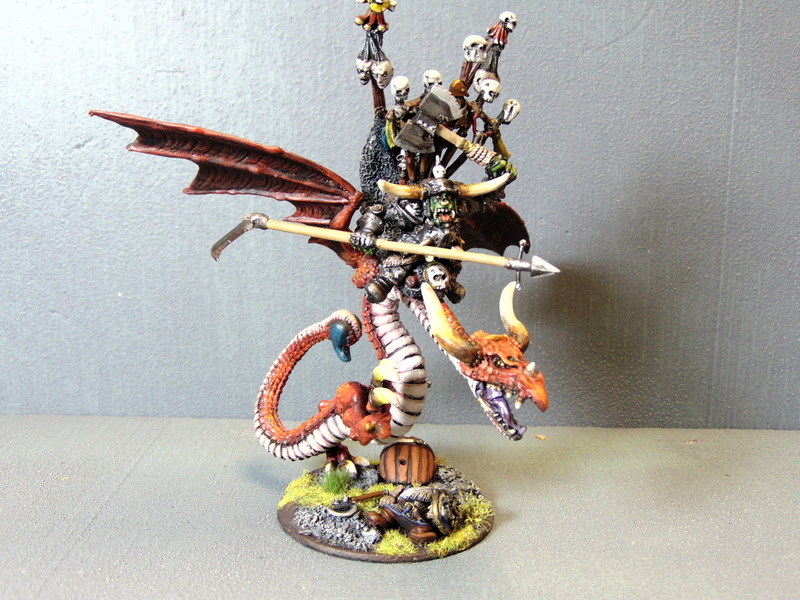
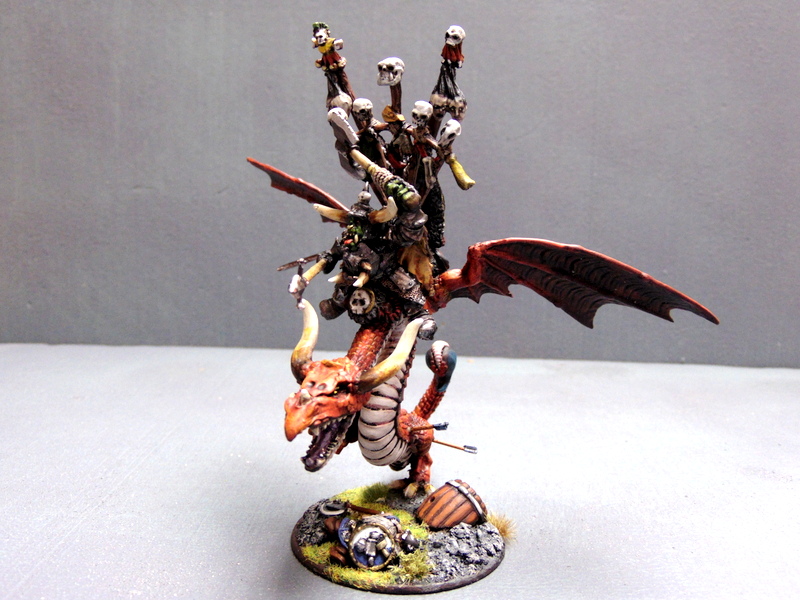
Varg Bonebreaka: Orc Warlord on War Wyvern

To finish off Monster Month, I present a  monster miniature that is finally seeing paint after almost THIRTY YEARS in my “to-do pile”!

It’s an old Warhammer Orc Shaman on War Wyvern, circa 1990 or thereabouts. I got him on the secondary market sometime in the mid-nineties. Originally, he was to be for use with my Warhammer Fantasy Orc & Goblin Army, but I wanted to use the wyvern as a mount for an army general, Varg Bonebreaka,  rather than a shaman (more on this later). Before I could do more than buy the bitz and start the conversion, though, several things happened.

  1. Mounting characters on monsters fell out of favor, if not with the entire WFB community, then certainly with my WFB gaming group. The focus of WFB became more about troops than super, unit-killing characters. A positive change, I would say.
  2. I stopped playing “special characters” in my army, for the same reason as above.
  3. I got distracted by something else. I don’t know what. It could have been a bright spot of reflected light shining onto the wall, for all I know. More likely it was my 40K Mordian Iron Guard.

Eventually, around 2003 or thereabouts, I ceased playing Warhammer and Warhammer 40K altogether. This miniature, along with all my others, languished in storage until around 2010 or so, when I started painting miniatures again.
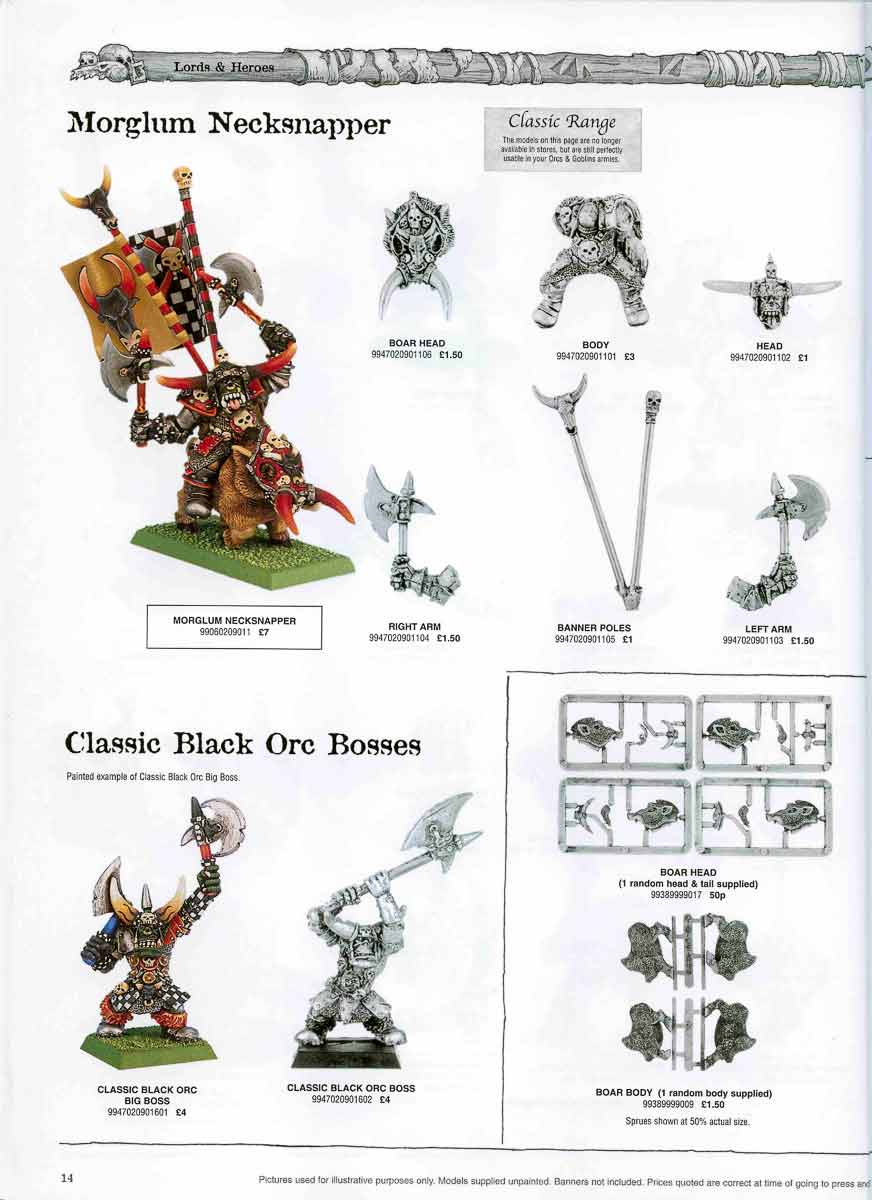
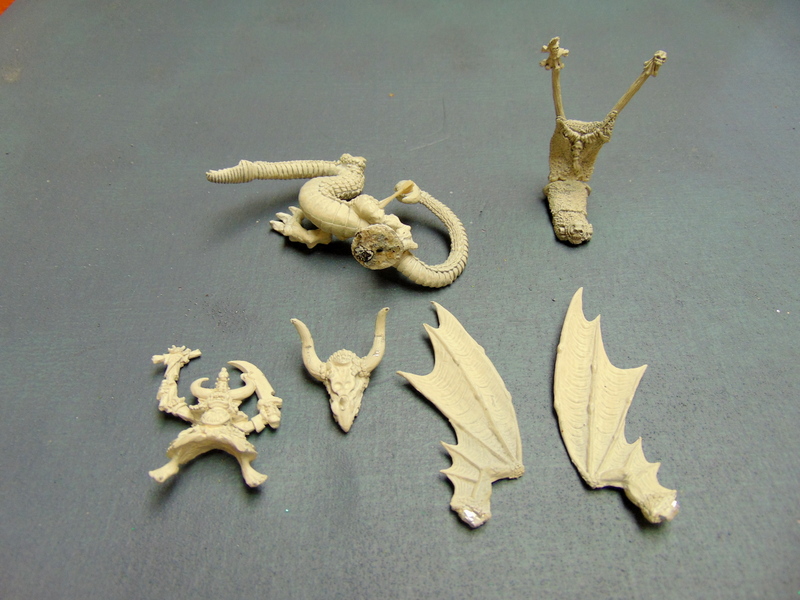
The mounted shaman miniature is perfectly acceptable, in a “I’m holding two weapons parallel to my body within my frontal plane” kind of way (typical of GW of the time). He just wasn’t all that exciting. For my general, Varg,  I decided to use the original Morglum Necksnapper model as the base of the conversion.  You can see in the picture below how the original model looked way back when. I intended to mount the shaman on Morglum’s boar, since he wouldn’t be using it. I still haven’t got around to that yet, either.

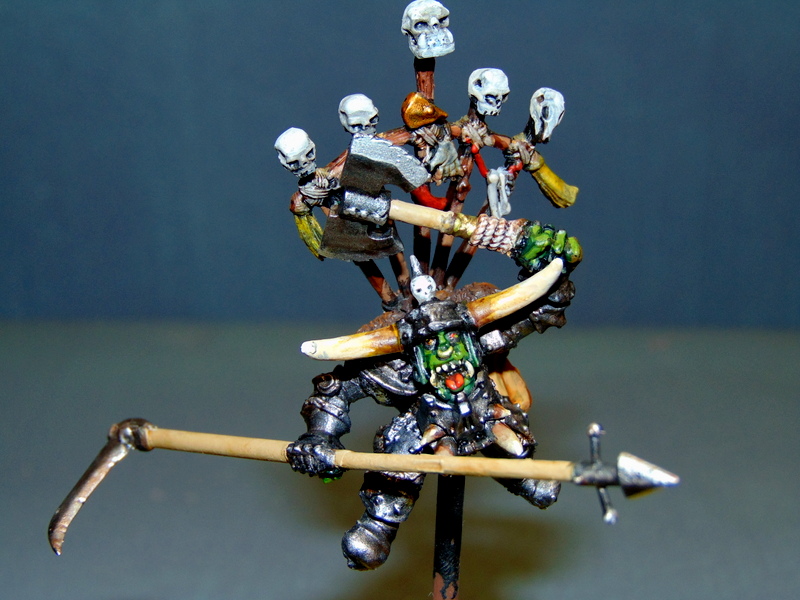
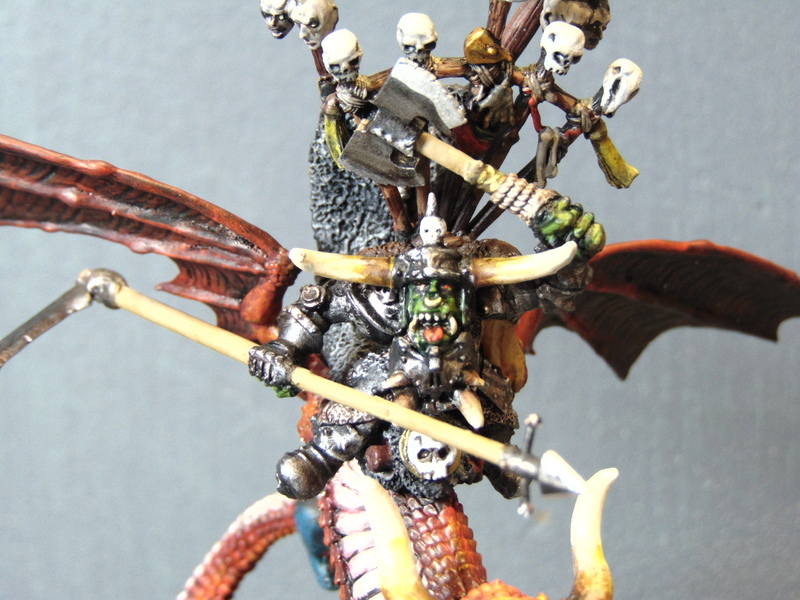
I purchased all the bitz I needed for the conversion from a GW rep who came by my FLGS in the “Bitz Wagon”. I bought a dwarf casualty for the base, as my Orcs & Goblins often faced off against my friend’s Dwarfs. (Yes, I wanted to irritate him.) I got rid of Morglum’s axes, as I hated how they looked, and replaced one with a double-edged Chaos axe. I decided I was going to give him a long spear in his other hand, as he would be pretty high up on that wyvern and wouldn’t be able to reach his opponents with anything else. For that, I used a lance from an old Skeleton Horsemen box. Finally, I ditched Morglum’s banner poles and replaced them with the back banner from an old Skaven model, Queek Head-Taker.

Then I let him sit there in the Insanity Pile, untouched, for almost 30 years. When Monster Month rolled around, he wasn’t hard to find.
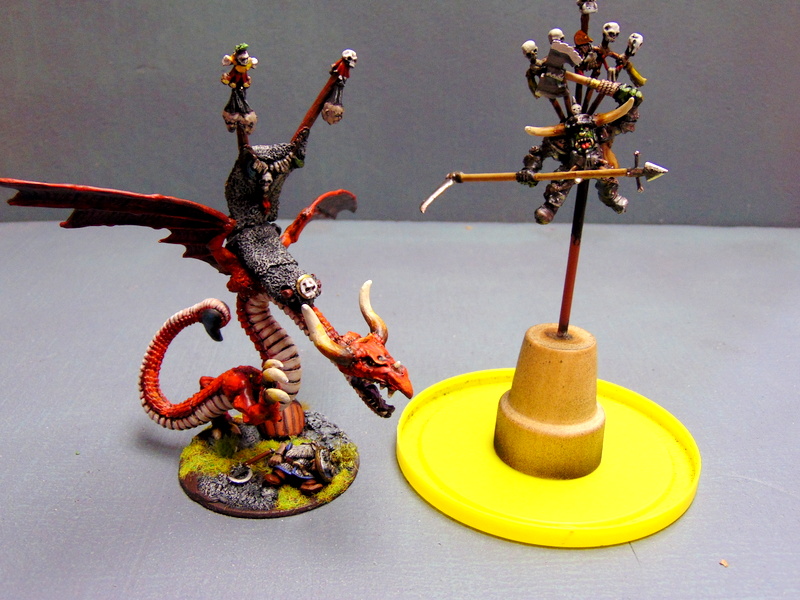
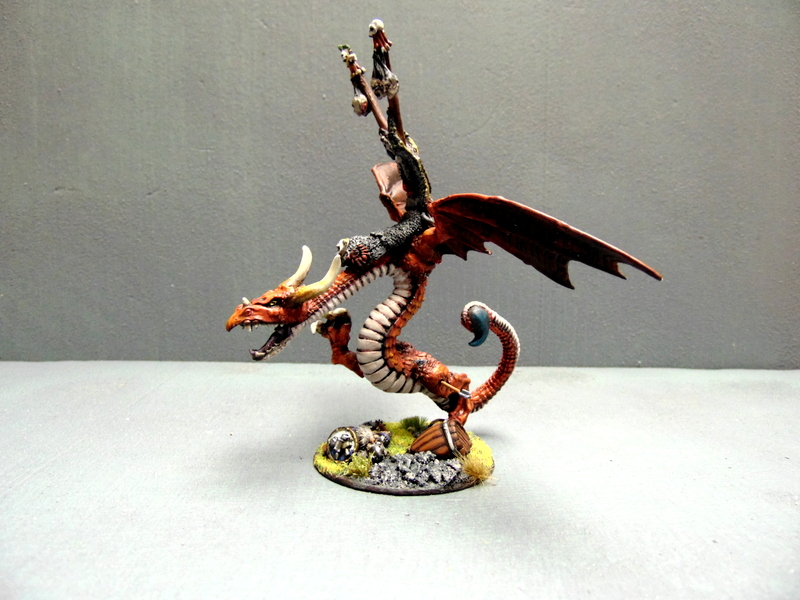
Here are the results. Because of the large amount of conversion on the orc, I needed to paint them separately prior to assembly. This is actually the first time I mounted a model on something to handle it while painting (I usually just hold it between my fingers). The wooden “plant pot” was intended to provide some stability, but it didn’t do much as the model kept falling over whenever I accidentally hit it (which was often). After the third time fixing the spear, I got wise and glued it to this coffee can lid for added stability.

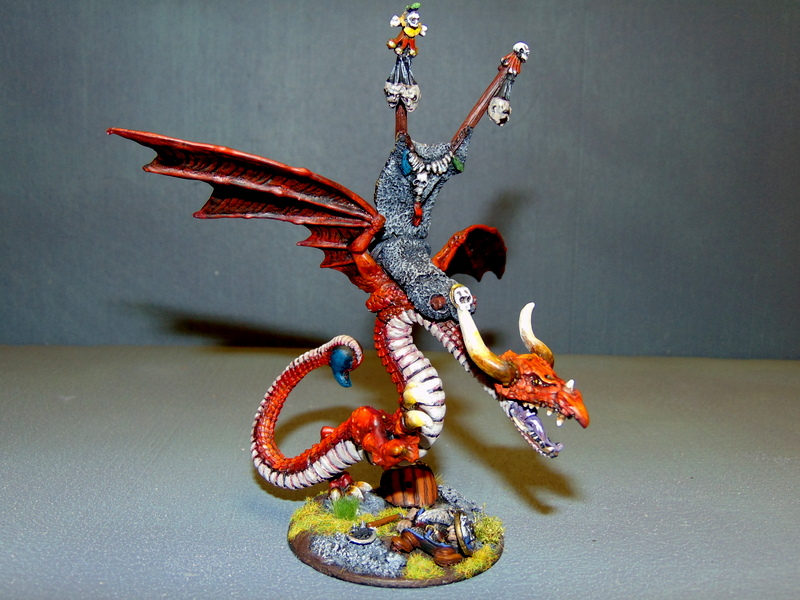
I don’t go in for the double banners on the wyvern’s back, because I think it looks stupid. Also, I suck at making banners. I opted to add some severed heads from an old GW zombie sprue instead.

I couldn’t find the “back end” of the lance pole. It disappeared some time in the last 25+ years or so. Instead I used a piece of plastic rod. I thought it looked kind of boring, so I added this scythe blade from a GW zombie sprue to the end, turning it into a nasty, unique-looking pole-arm.

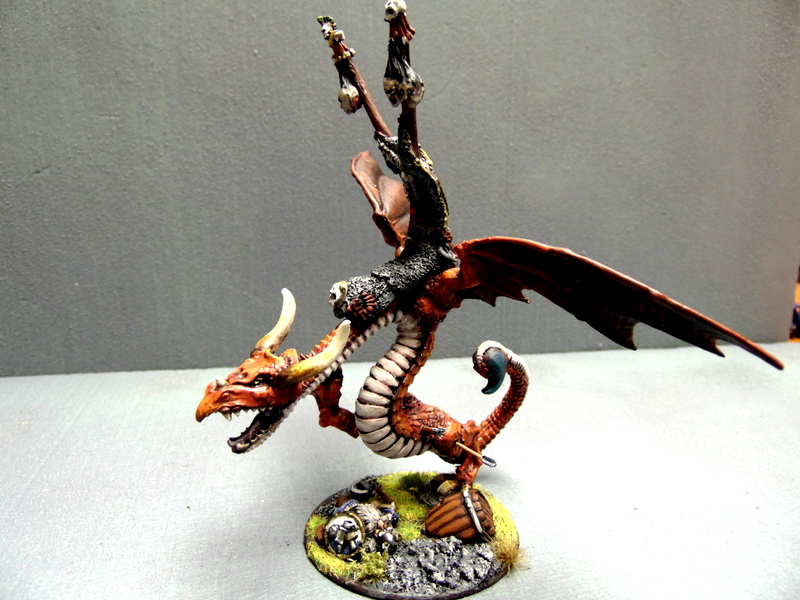
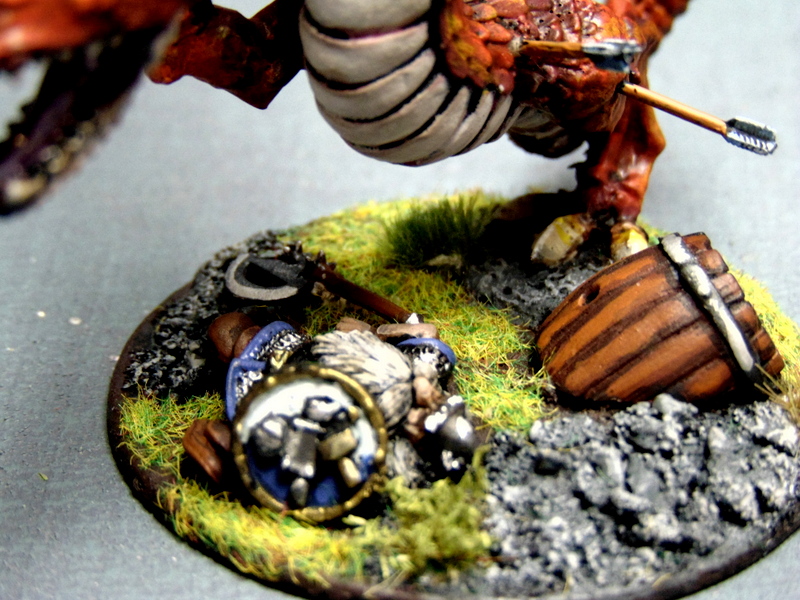
I drilled a couple of holes in the wyvern’s flank and added some arrows. Monsters, and the generals on them, tend to attract missile fire.

My friend’s Dwarfs, IIRC, were painted in a green color scheme. I decided to paint this dwarf blue to make him really stand out against the grass and under the wyvern’s claw. The broken barrel is from an Army Painter basing kit.

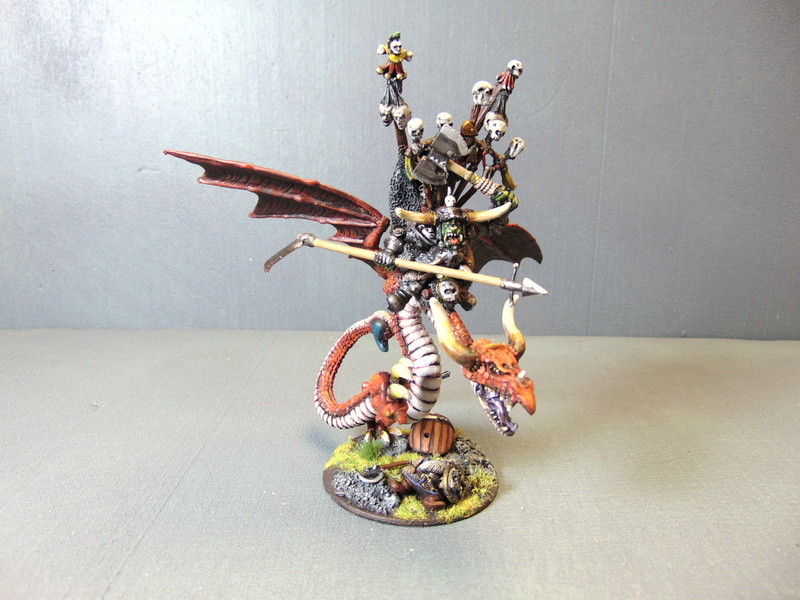
At last, some final pictures of the complete wyvern with the rider. I give you Varg Bonebreaka, a name inscribed forever in the Book of Grudges many times over! WAAAAAAAAAAAGH!!!!!!!!

Makes me wish I still played Warhammer.

This model took me longer than I thought to complete, so I’m glad I started when I did. Unfortunately, I still have a few monsters that aren’t quite finished, and the end of Monster Month is nigh! Oh well. Perhaps I will finish them up soon, and post them as an intermission during next month’s Forgotten Heroes challenge!


Insanity Pile Progress

Miniatures Painted Thus Far: 8

Miniatures Purchased: 0

Total: +8

Griffon and Land Shark

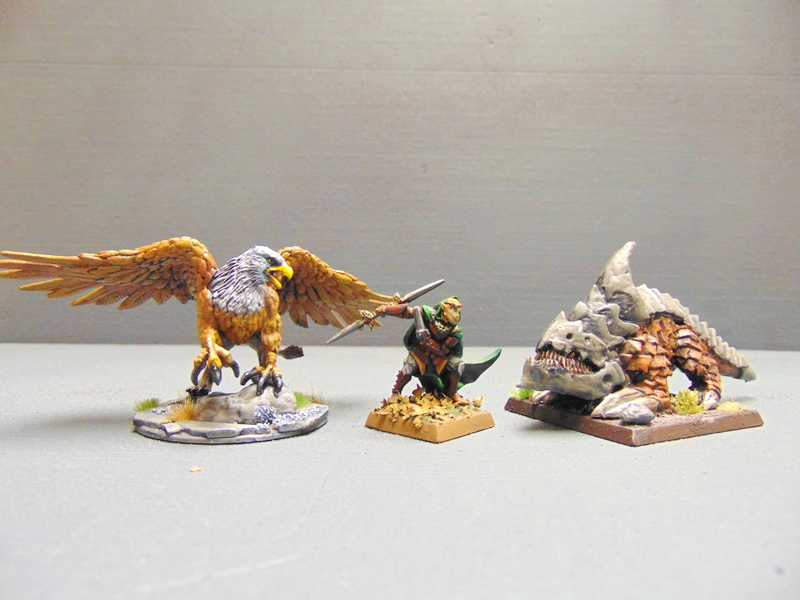
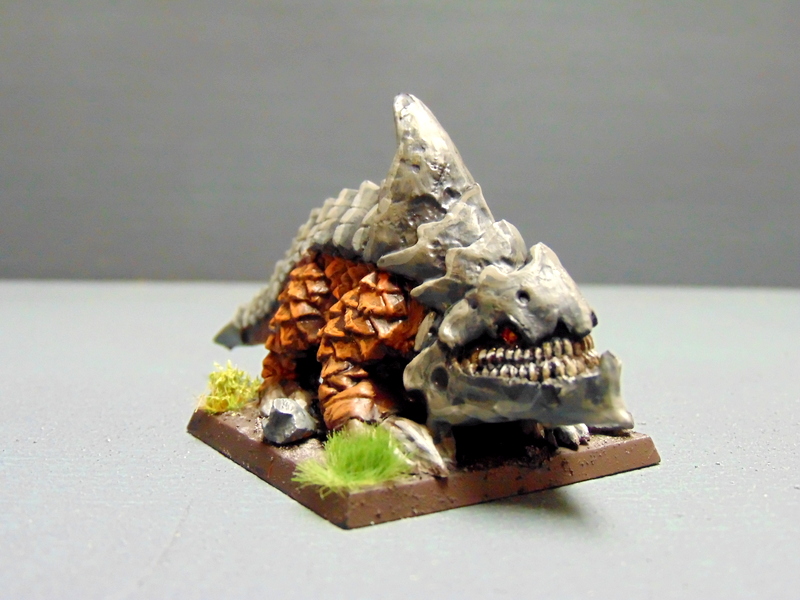
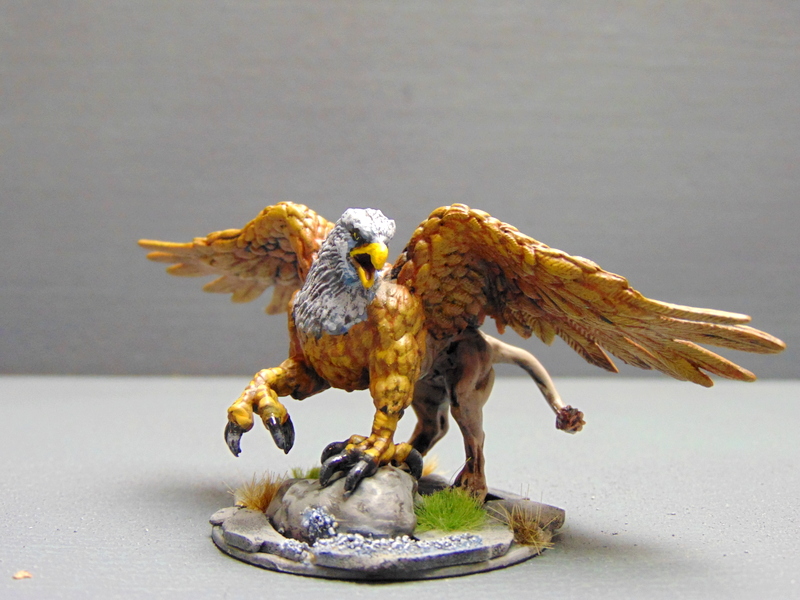
My latest two “monster month” projects have arrived! Presenting: the Griffon and the Bulette (Land Shark).

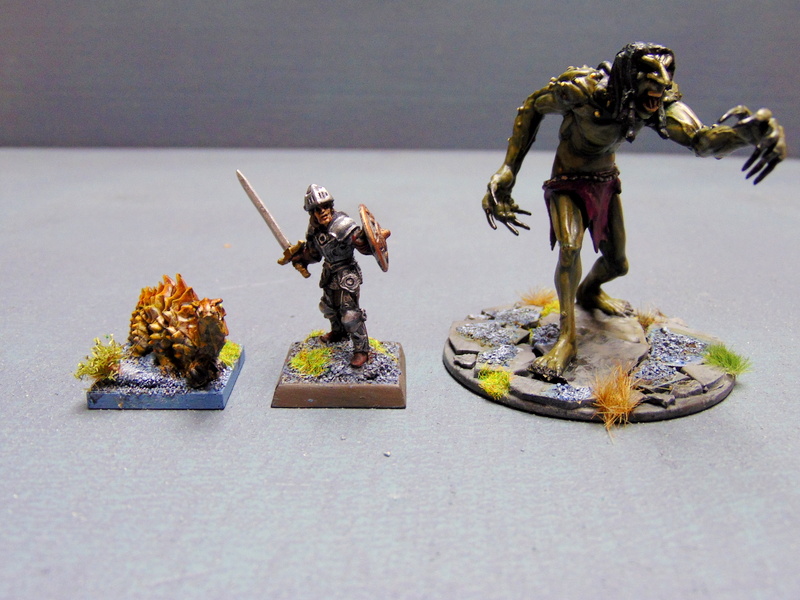
(Astute observers may notice that the model in the middle of these two monsters has changed since the last post. That’s because I couldn’t seem to find that human fighter who found himself between an Umber Hulk and a Purple Worm, and then between a hungry Troll and a Basilisk. Perhaps his luck finally ran out…)

The Bulette, also known as a land shark, is a terrifying predator that lives only to eat (much like a regular shark). It burrows beneath the ground and bursts to the surface whenever it detects the vibrations of movement. A bulette has a territory of about 30 square miles, and will attack anything it comes across, completely consuming its prey (clothing, armor, weapons, etc.). When it has eaten everything in its territory, it will move on to another area.

Bulettes are not usually smart; however there is a famous case of one land shark ringing the doorbells of unsuspecting victims, fooling them into opening the door by pretending to have a delivery of something (flowers, candy, etc.). Once the victim opened the door, the land shark would strike!

This bulette is a Reaper Bones “land shark” (appropriate, no?).

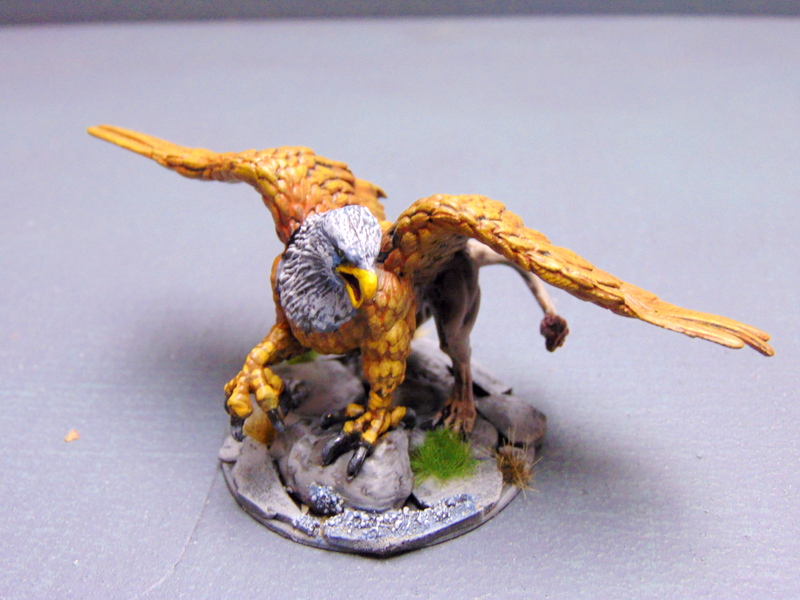
A griffon, as everyone knows, is a majestic beast with the body of a lion and the head, wings and front legs of a great eagle. Griffons are fierce predators and enjoy eating horses most of all. Griffons are semi-intelligent and are much prized as mounts for heroic characters, as they are capable of being trained by those with enough daring and skill.

This griffon is yet another of Nolzur’s Marvelous Miniatures.  I used the hot water/cold water bath method to reshape its wings somewhat, but that’s about it. In all my years of painting, I have never painted a griffon before. I really like this miniature (score another for Nolzur’s); therefore I have named him Merv.

You see what I did there?


Insanity Pile Progress

Miniatures Painted Thus Far: 6

Miniatures Purchased: 0

Total: +6

Basilisk and Troll

Monster Month continues with a couple more beasties: the dreaded basilisk and the AD&D version of  a classic monster: the troll!

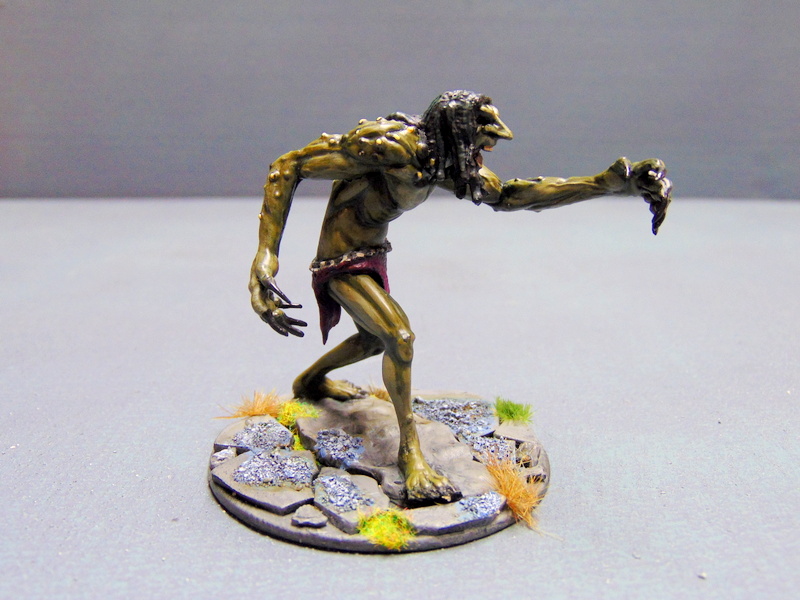
The troll is from Nolzur’s Marvelous Miniatures, and I am hard-pressed to recall seeing a finer version of the classic AD&D troll. I absolutely love this sculpt. If I have one criticism, it’s that he’s a bit too big; most trolls are 9 feet tall or so; this guy looks like he’s twice the size of the fighter next to him. In addition, his built-on base is somewhat problematic if you plan on mounting him on the included 50mm circular base, as it overlaps the circle somewhat due to his wide stance. I chose to use a bigger (60mm) base, but that meant I had a lot of space to fill. I used some cut-up pieces of craft foam to simulate dungeon flagstones and here is the finished result.

Everyone knows what a troll is, but the AD&D version of a troll is particularly nasty, as they regenerate all damage—including severed limbs—given enough time. The only way to put a troll down for good is with fire or acid. Other than that, run. The AD&D troll has a somewhat unique look to them as well; the long arms ending in ragged claws, the rubbery body, socketed eyes and wiry hair. They’re pretty horrific. And they’re always hungry. Thankfully, they’re not that bright, so it’s somewhat easy to outthink them.

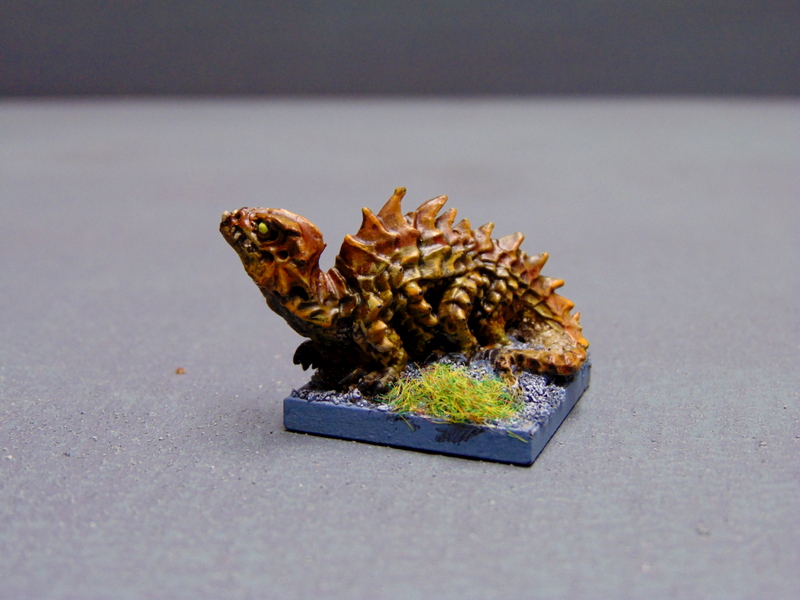
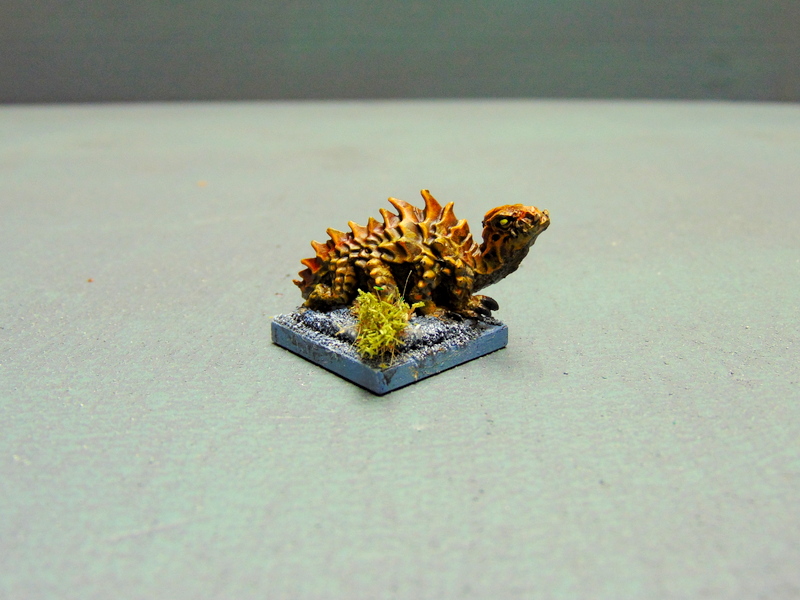
A basilisk is an eight-legged reptile that petrifies victims with its gaze, much like Medusa. A significant difference between the two, however, is that Medusa decorates her lair with the statues she creates, while the basilisk just eats them. Yes, a basilisk is fully capable of eating the stone bodies of its victims. Basilisks are about as smart as your average reptile. In other words, not very.

This basilisk is a Reaper Bones version. This was a miniature that I was unhappy with throughout the entire painting process. I felt like I chose the wrong colors and I everything I did just seemed to make the miniature look worse. Finally, I applied a wash of GW’s Fuegan Orange to his spine and the tips of his scales, and everything looked a million times better. Now I’m pretty happy with how he came out.


Insanity Pile Progress

Painted Miniatures Thus Far: 4

Purchased Miniatures: 0

Progress +4


Umber Hulk and Purple Worm

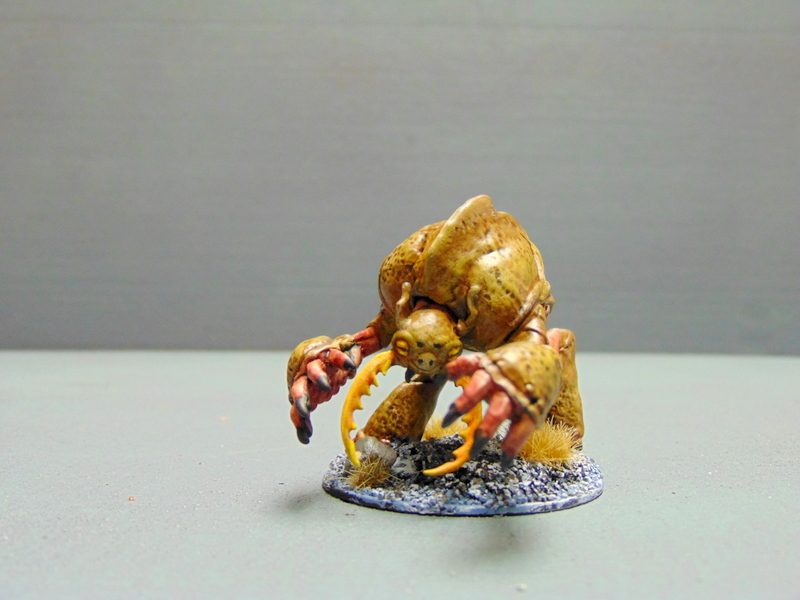
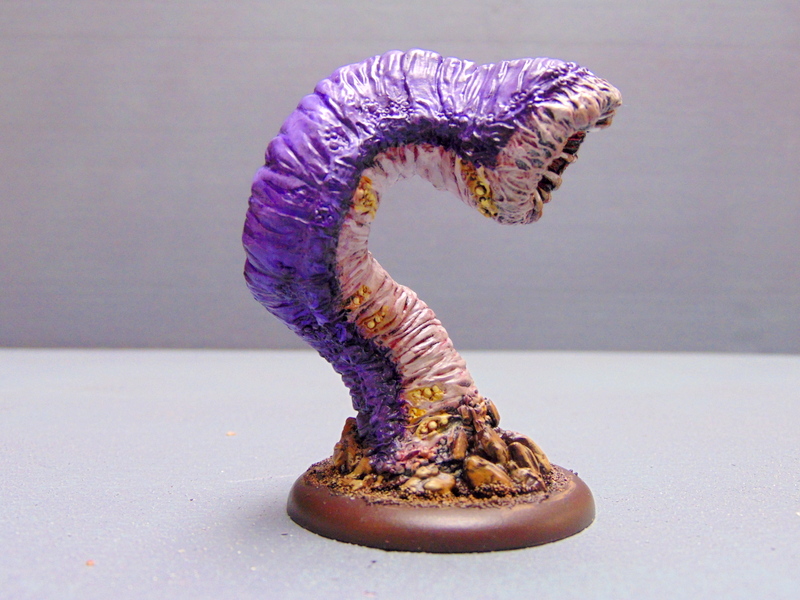
Monster Month kicks off with two classic AD&D monsters straight from the Monster Manual: the Umber Hulk and the Purple Worm—two very good reasons not to adventure underground.

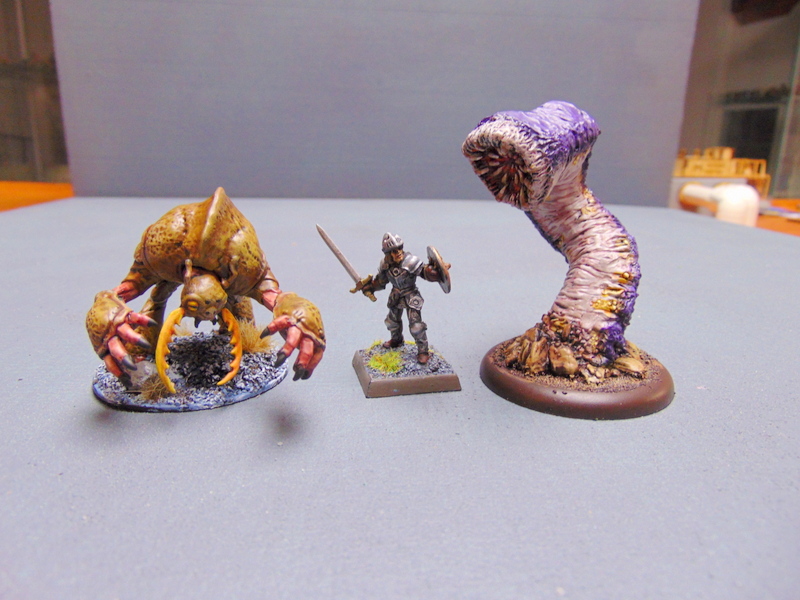
The Umber Hulk is from the Nolzur’s Marvelous Miniatures line, which is a new-ish Wizkids line of computer sculpted miniatures that are both inexpensive and impressive. Wizkids has the rights to produce all the “official” AD&D monsters like the Umber Hulk, which is why you’ll see them called by their true names and not by a knockoff (i.e. Reaper’s  rust monster, the “oxidation beast”). I have to imagine that Wizkids is taking their cue from the massive success of Reaper Bones, because the Umber Hulk cost a mere $3.99. He’s a pretty decent size, too, as you can see from the (very nervous-looking) 28mm Reaper fighter standing between him and the worm. The Purple Worm is a Reaper Bones version of their “Great Wyrm” sculpt. I believe it also retailed at $3.99. Again, great price, decent size, great sculpt.

These Nolzur’s miniatures are, like Bones, supposed to be ready to paint without priming; in the case of Nolzur’s, they are supposedly primed already. Regardless, I choose to prime both Nolzur’s and Bones miniatures with Vallejo surface primer, because the paint rubs off if you don’t (no matter what they say). The Umber Hulk miniature required a little additional preparation prior to painting. Like Bones, many of the Nolzur’s miniatures set in weird positions after the casting process and need to be repositioned, which is actually pretty easy to do. Initially, this Umber Hulk’s mandible hung lower than its base, which would have made standing him up impossible. A quick dip of the miniature in some hot (but not boiling) water allowed me to bend it into a more upright posture, then a quick bath in some cold water made sure it re-set that way and wouldn’t go back. This method also works with Bones and even Heroclix, depending on the thickness of the plastic you’re trying to reshape.

Once he could stand up without stepping on his own jaw, I got to work:

According to the Monster Manual (3.5 edition in case anyone cares), an Umber Hulk resembles a cross between an ape and a beetle. It dwells deep within the earth, and can rip through solid stone like it was paper. AD&D player characters fear the Umber Hulk for several reasons. It’s covered in armored plates, it’s strong and can dish out a lot of damage, and it can hypnotize you with its eyes. But perhaps the scariest thing about an Umber Hulk is that it’s smart; often, it’s smarter than the PCs. The average human ability score (including Intelligence) is a 9. An Umber Hulk has an average Intelligence of 13!

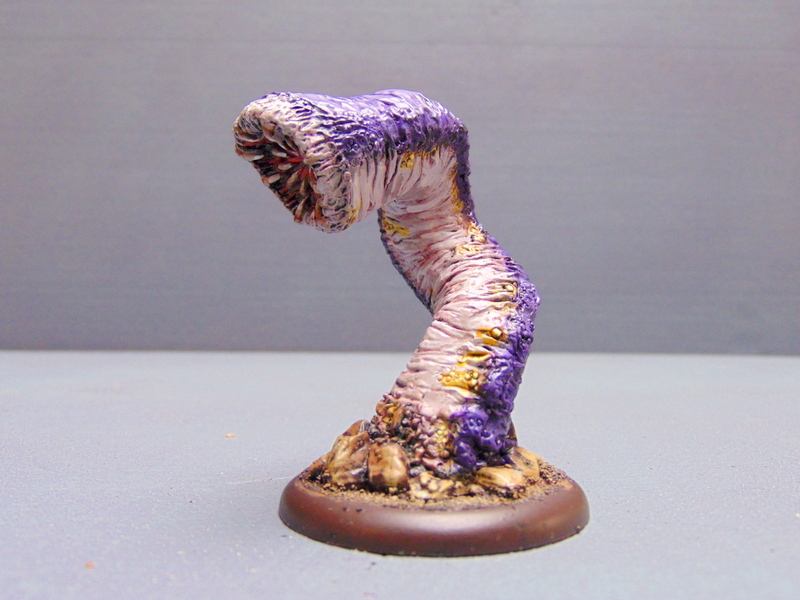
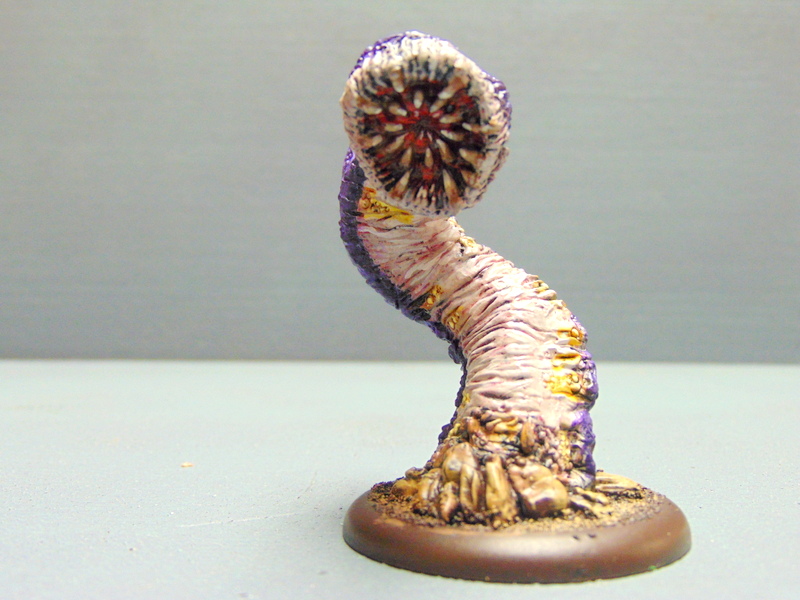
The Purple Worm is another well-known AD&D monster. It’s a massive scavenger worm, covered in purple chitinous armor. A mature Purple Worm has a 6′ diameter mouth and is about 80′ long. (This one must be a baby.) It can easily swallow prey whole, including humanoids. To top it off, it has a poisonous stinger in its tail.

Being a Reaper Bones miniature, it’s not an “official” Purple Worm. I just painted it up that way.

Unlike Umber Hulks, Purple Worms aren’t smart. They’re just huge and mean and very tough to kill.

Insanity Pile Progress

Off to a good start, even though it’s only the first week. I’ve painted more than I’ve purchased. Good on me.

Painted Miniatures: 2

Purchased Miniatures: 0

Progress +2

Monster Month (and Getting My Shit Together)

First up, the good news: May is Monster Month! Now that my Gaslands project is (somewhat) complete, I’ve decided to get back to my first love: fantasy miniatures. And to that end, I have decided it’s high time I got around to painting some good old-fashioned monsters!

With the arrival of Reaper Bones and other inexpensive miniatures like Nolzur’s Marvelous Minis, it’s easier than ever to get your hands on some large beasties for not a lot of cash. And for the most part, the sculpting is top-notch on these miniatures, whether sculpted by hand (Bones) or 3d designed (Nolzur’s). Some of the monsters I’ll be painting this month have been in my insanity pile for years, whereas some are relatively recent purchases. Some are metal, some are plastic or resin. Old school, new school; the point is, they’re all monsters, and they’re all getting painted this month!

Now, the less-fun news. A couple of months back, I reminisced about the early Grenadier miniatures that were my first steps into what would eventually become my wargaming hobby. If you missed that post, you can read it here (if so inclined). One thing  I wrote in that post has been on my mind ever since.

Here’s what I said: “…even if I were to (paint) one miniature every day for the rest of my life, I would likely never finish what I already own, never mind any future tempting purchases. A somewhat sobering and morbid thought, but true nonetheless.”

Guess what? It is true. And it is sure as hell sobering.

(Actually, what I wrote was about stripping and repainting old miniatures, not painting new ones, but that changes nothing. Between what I have that I would like to strip and repaint, and what I have that has never yet seen paint, the reality remains the same. It ain’t gonna happen in my lifetime.)

Like many gamers nowadays, I am of a certain age. I am not the oldest grognard wearing a “Keep Calm and Cthulhu Fhtagn” T shirt, but neither am I a youngster any more. I’m in my mid 40’s, and I’ve been gaming since I was 12, collecting and painting miniatures since I was 13 or so. While mid-40’s is hardly old, especially considering the well-known and often-discussed “greying of the hobby”;  and although I’m reasonably healthy at the moment (knock wood), I have no illusions about my life.  In addition to other vices (like indolence), I really like scotch and gin, and I’ve liked them for many a long year now. The sad truth is that I have a lot of lead, both painted and unpainted; and a lot of half-started and wish-list projects I’m simply not going to ever complete.

As I’ve stated elsewhere in this blog, the last big gaming convention I attended was Gen Con in 2012. In addition to a comprehensive review of the convention, that post includes a list of all the stuff I bought when I was there. I knew buying most of that crap was a mistake as soon as I got back home. Most of it is still sitting right here in the original packages. I haven’t painted or used most of it, and it doesn’t look like I ever will.

Herein lies a problem faced by many wargamers: Let’s say you drop dead. What happens to your stuff? Many wargamers would naturally pass their armies on to the next generation, assuming their children had any interest in such things. I don’t have kids, and likely (and hopefully) never will. So what then?

It goes without saying that it becomes a problem for those we leave behind. Someone (or, if you’re lucky, several someones) who probably doesn’t need any more to deal with while grieving your death, as it may make them reach the “anger” stage of grief much faster. In my case, it’s not just my painted miniatures and the insanity pile that would be left behind. (That link leads to a description of my insanity pile that is outdated by several years. Like Scrooge, I have labored on it since.) It’s also the thousands of books and comics that I have amassed in almost four decades of collecting. All this stuff is going to land squarely in the lap of people who may love me, but may not necessarily love my hobbies and want to deal with 30 plus years of accumulated academia, esoterica, and plain-old geekery after my death.

It’s time to get real, and prioritize what I can realistically keep and what I should just bid a fond farewell to. And like many gamers, I need to STOP BUYING NEW STUFF. Not just new stuff, but old “new-to-me” stuff too, no matter how great a deal it is. I have to start saying no.

To this end, I’ve come up with an action plan.

Part 1: As a way to motivate myself to shrink the lead pile, I’m stealing an idea I saw on fellow TMPer Oiler72’s blog: the lead mountain progress total. With every post, Oiler keeps track of the number of miniatures he’s painted vs. the number of new miniatures he’s purchased, for a plus or minus overall progress total. I’m doing that, starting with my next post. I’m not about to count what I already have (that would make me mental). But whatever the starting point number may be, it should be easy to track whether I’m up or down relative to it if I keep logging painted vs. purchased.

(Note: this is for miniatures only. I do not consider terrain projects or things like Gaslands conversions, which are technically not miniatures, to be any progress towards adding to or shrinking the lead mountain.)

Part 2: I need to narrow my interests. I need to decide what games I’m going to focus on and what projects I can realistically complete. I need to look at the stuff I already have, and decide, once and for all, whether to keep it or get rid of something I know I’m never going to paint and/or play with. Is it worth the investment in time and/or money? If not: adios, muchacho. When deciding what to keep, I should consider whether it can be used in multiple games or whether it will only be used in one system; for example, unpainted police miniatures can be used for zombie, pulp, supers or any other modern game, whereas pirates can pretty much only be used as pirates.

Example: Wow, those Firestorm Armada ships look really fucking cool! Should I keep them? Let’s see:

  1. I’m never going to find anyone else near me who plays Firestorm Armada,
  2. Spartan Games went out of business, which means the game is no longer supported,
  3. While I could conceivably use the ships for other games, I don’t have any other space games except for War Rocket and X-Wing, neither of which match the theme or scale,
  4. I don’t want to buy any more space games,
  5. I have way too much other stuff to paint.

So should I keep them? Sounds like a big fat NO.

Firestorm Armada was easy. I have many other games/miniatures to consider, and many miles to go before I sleep.


Aryllus Thenra

A brief intermission, if you will permit me, from all things Gaslands.

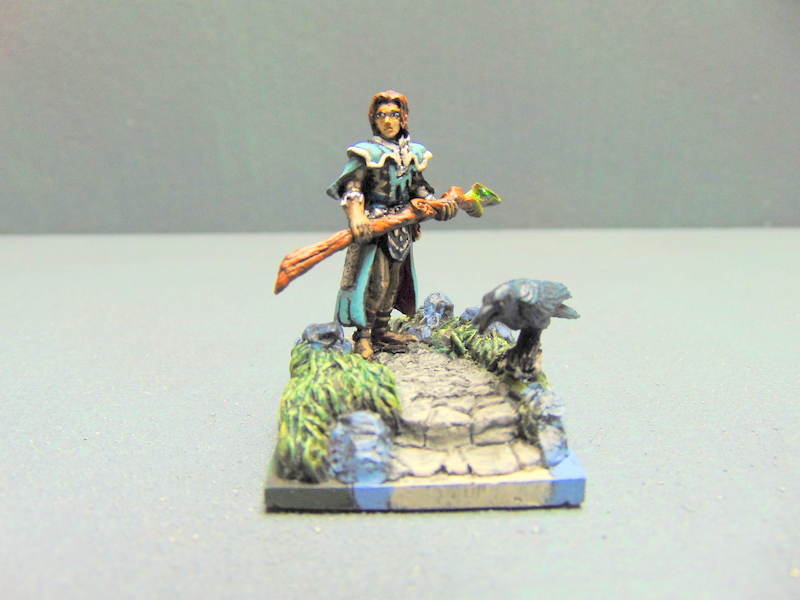
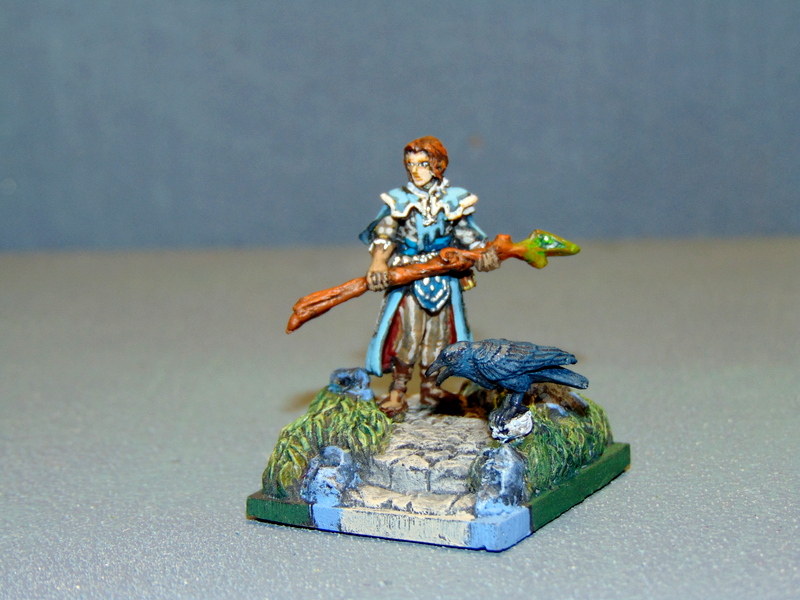
If you’re a longtime role-playing gamer like me, then you probably have a character or two somewhere that you would have liked to play more often than you were able to. This is one of mine.

When my friend Chris decided he wanted to run an AD&D 3.5 campaign about 10 years ago, I decided I would play a standard (non-specialist) wizard. (Prior to this, my only real experience playing a magic-user was a 2nd ed. AD&D campaign back in college, when I played a shameless Raistlin ripoff; and a MERP game where I played an acrobatic Dunedán mage. Please don’t ask.) Chris’s campaign was called Jamestown, and it involved the political intrigues of rival brothers against a backdrop of standard monster-slaying and fantasy ass-kickery that you would expect from an AD&D game. Like many games and campaigns I have played in over the years, it was over too fast, as lack of time and the responsibilities of real life soon got in the way.

In Chris’s world, mages are rare and mysterious, and command a certain respect simply by virtue of their profession. Aryllus was a young and talented wizard with a calculating and detached manner. He was soft-spoken and carefully considered his words and actions. Although he was certainly capable of laying down offensive magics, Aryllus was more of a support player in the party. I chose a wide variety of spells for him that would enhance allies and hinder enemies, rather than having him go full Tiltowait (kudos if you get that reference!) all the time. Aryllus was content to let the fighters fight and the cleric heal. His job was to make their jobs easier.

Sometimes he forgot that. Like when he tried to blast the gates of a fortress open with a Fireball spell. Since the fireball wasn’t explosive, all it did was light the gate on fire. Dumb.

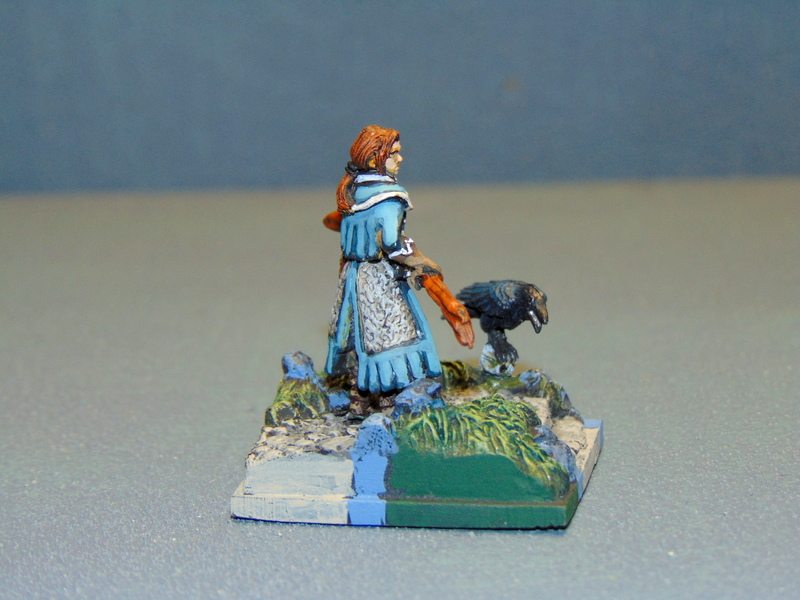
Aryllus had a raven familiar named Corax (original, I know). Corax was useful as a scrying tool; Aryllus could see through Corax’s eyes and could instantly communicate with his familiar over a respectable distance. Corax had his own personality and was essentially a second character. I found the interplay between the two to be a lot of fun.

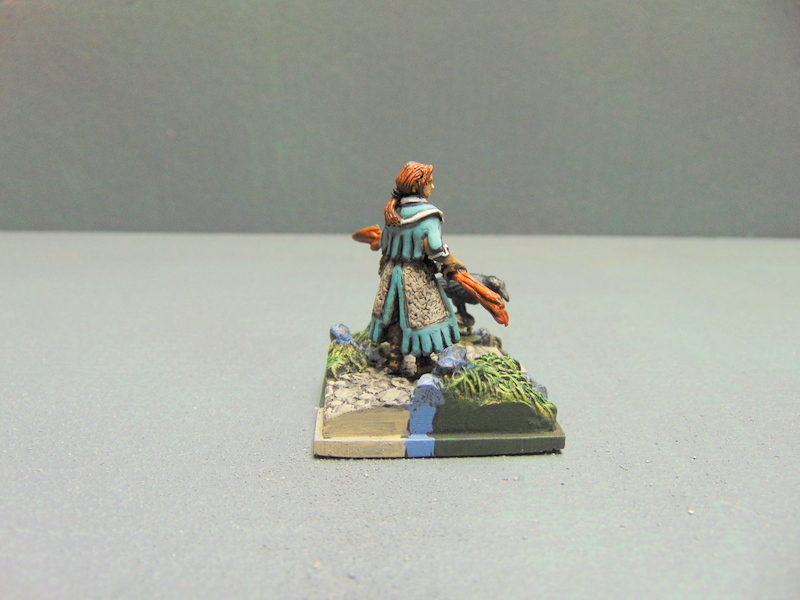
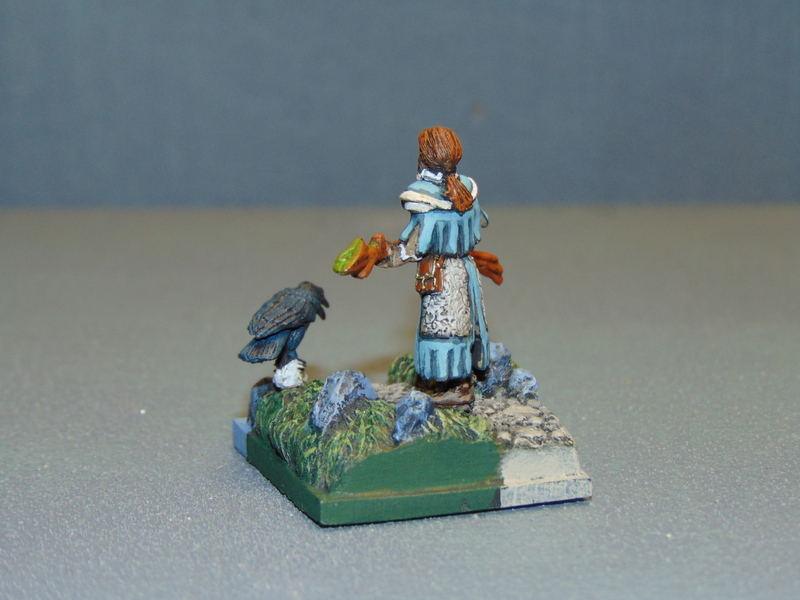
I’m not sure why, but I had a lot of trouble painting this figure. I couldn’t settle on a color scheme that I liked and I just kept putting it off. Since I’ve been painting up my favorite RPG characters lately, I decided it was high time for me to finish Aryllus. This miniature has been in my side pile for around ten years, with only a basecoat of blue paint on his jacket. He is Reaper’s Piers, Young Mage (02836), sculpted by one of my favorite artists, the great Sandra Garrity. He shares an Armorcast gallery base with Corax (a Reaper familiar from Familiar Pack VIII). I bought the miniature long before I created the character. When I decided to play a mage I used this figure for inspiration.

For whatever reason (perhaps my failing eyesight), this miniature looks much better in person, away from the unforgiving high-resolution camera lens. I must admit that in the pictures, he looks kind of sloppy in some places, but the flaws are not as glaring to the naked eye. Anyway, he’s done now, and out of the side pile. And he’s not going back.

Up next: more Gaslands! Vrrrrrooooooooommmmm!!!!!


Poison Ivy

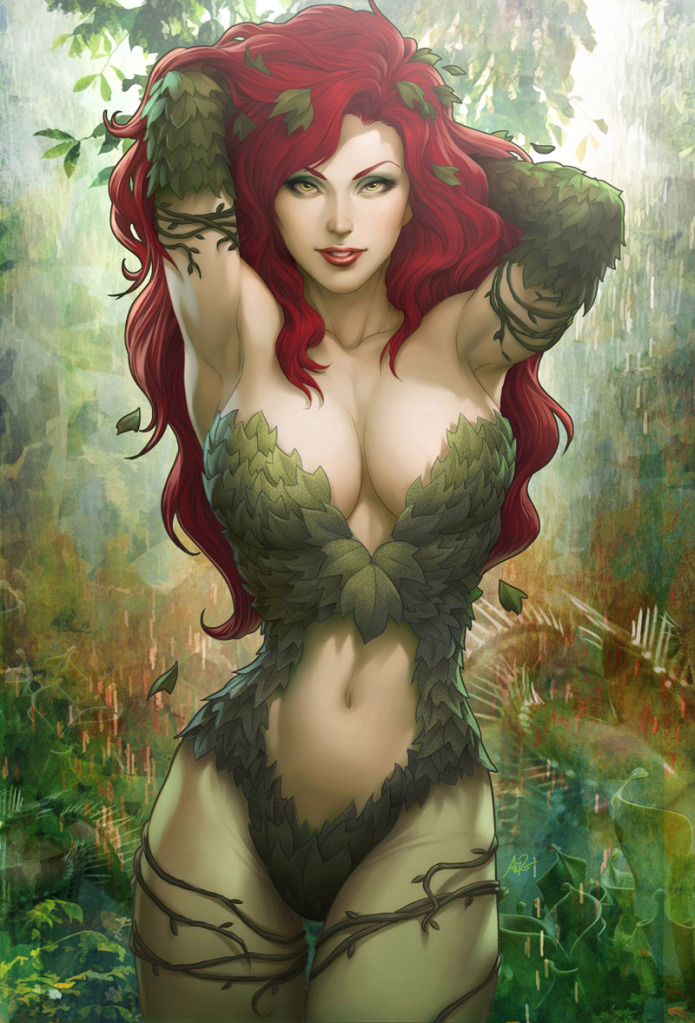
Poison Ivy has become one of my favorite Batman villains, although it wasn’t always so. (Take the movie Batman and Robin, for example; like Arnold Shwarzenegger’s Mister Freeze, the less said about Uma Thurman’s portrayal of Ivy, the better.) I didn’t really start to like her until the Batman: The Animated Series episode “Harley and Ivy”, in which the two ladies team up to take over Gotham’s crime scene, at least until Batman and the Joker find out about it.

Ivy appears in all but one of the Rocksteady Batman: Arkham series of video games, of which I am a huge, obsessed fanboy. And now, with a particularly cold-blooded version of Poison Ivy running amok on the current season of TV’s Gotham, I thought it was a good time to feature her here.

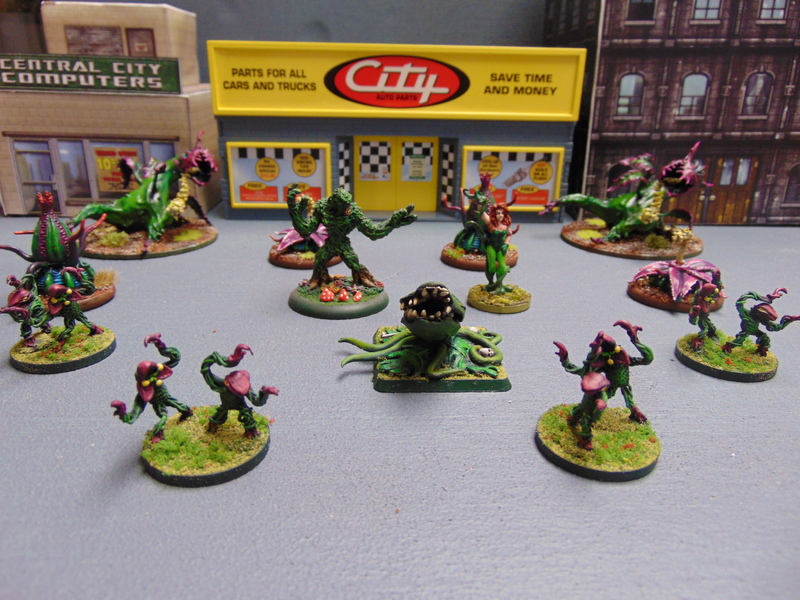
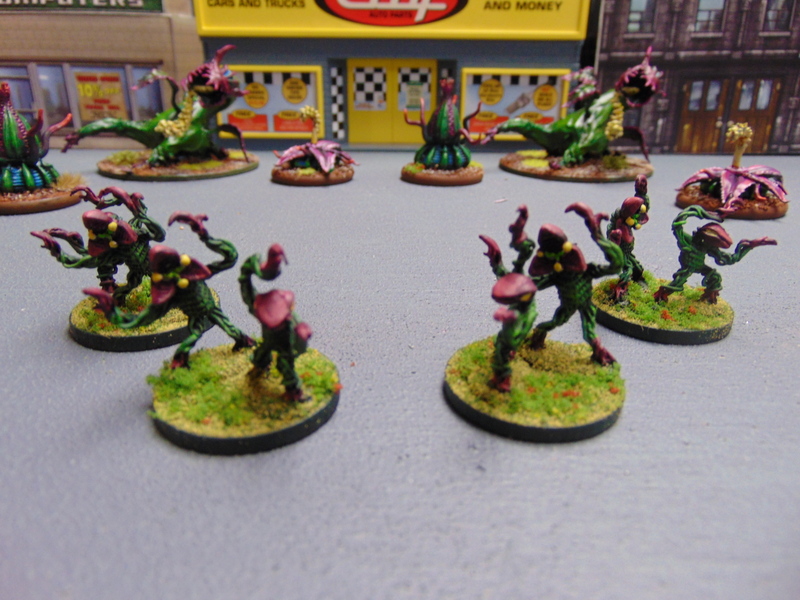
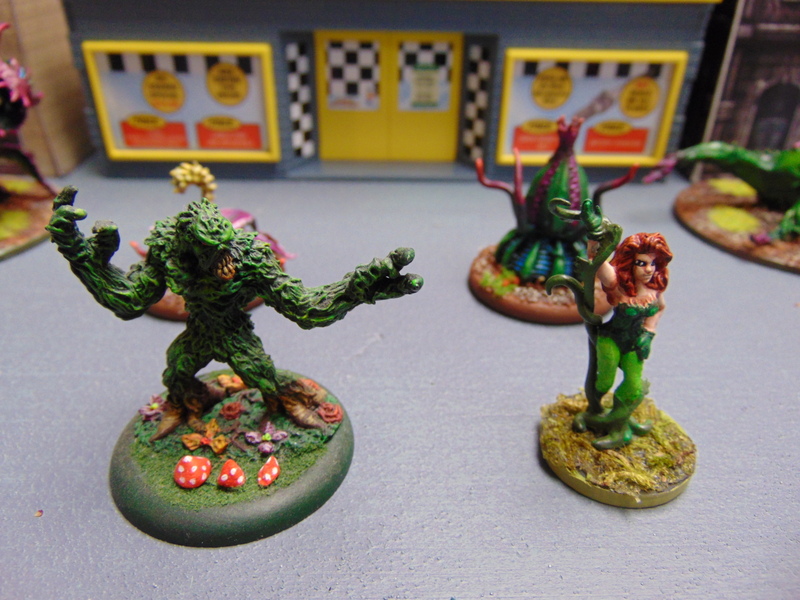
This repainted Heroclix Ivy is from the DC Cosmic Justice set. It’s the classic, early version of Ivy, before she got chlorophyll for blood and became more plant than human. I based her on a small piece of Spanish moss. Behind her are some of her pets: the big monster plants are Dragon Plants, new from Reaper’s Bones collection. The pod plants are also from Reaper Bones; they’re Death Star Lilies.  The big Man-eating Plant in the middle is from Armorcast.


The little plant people are Vardu Sprouts, from Hydra Miniatures’ Primal Dawn range. When I ordered them I thought they would be bigger than they are, but they’re sprouts, after all. I just based them two to a base. I plan on having the pod plants spit them out as a renewable source of plant henchmen.

Lastly, the big guy is an old version of Reaper’s Swamp Shambler. I painted him years ago, and he looks a lot like a certain…bayou-dwelling…Plant Elemental…known for…punctuating…his speech…with lots…of…elipses…but in this context he’s Ivy’s bodyguard, should Batman ever get too close. He’s better than that horrible version of Bane in Batman & Robin, anyway.

Man, was ANYTHING in that movie any good? No. Not a thing.

Anyway, here is my Super Mission Force build for Poison Ivy:

Poison Ivy (Wild Card) Minor: Barrier, Entangle, Summoning, Telekinesis

I can hear some of you already: “Now hold on a second, Angry Piper! Barrier and Entangle, I can see. But since when does Poison Ivy have Summoning and Telekinesis?”

To that, my friends, I would say you must think outside the box a bit. What is Poison Ivy’s main power? Plant control. Unfortunately, there is no plant control power in SMF. Ivy can get plants to do a lot of stuff, like entangle enemies or form barriers…or grapple enemies at range with super strength, bear herself aloft to higher elevations (a’ la Jack and the Beanstalk), or manipulate objects at a distance using plant-y tendrils. (In other words: Telekinesis, only using the plants instead of her mind.) She can will plants to fight for her and pretty much instantly mutate normal plants into killing machines. Kind of sounds like Summoning, no?

Of course, if you don’t like my version of Poison Ivy, you could substitute some or all of these powers with others you may find more thematically appropriate, like Armor, Damage Field, or Enhanced Senses, to name a few. When using Ivy in a scenario, I would let her have a few plant guardians and/or henchmen in place at the start of the game. She’s really not that tough, otherwise; and she would likely be defeated before she could use her powers to summon reinforcements. Just my 2 pesos.


Juggernaut and Black Tom

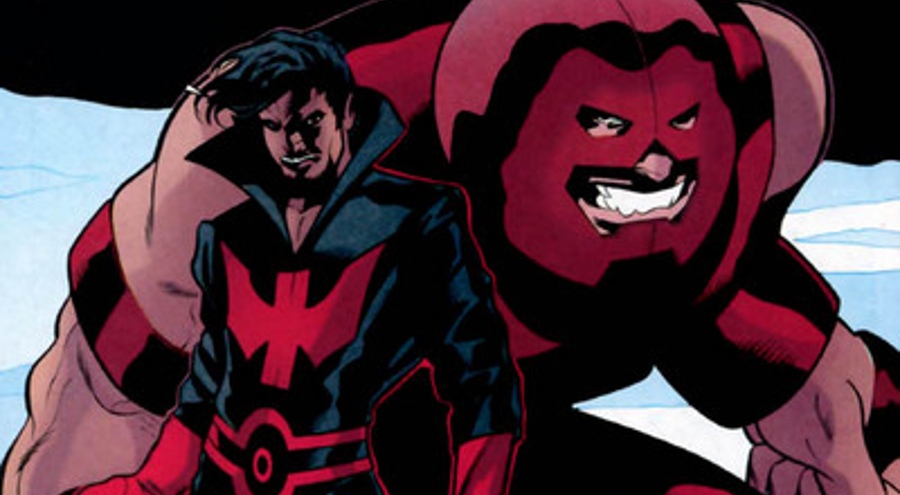
Juggernaut is a classic X-Men villain, a physical titan who is counterpoint to his brother Charles Xavier’s mental mastery. Unfortunately, he often hangs out with Black Tom Cassidy.

Black Tom is the cousin of Sean Cassidy (not to be confused with Shaun Cassidy, the Hardy Boy), better known as the X-Men’s Banshee. Black Tom was created by veteran X-Men scribe Chris Claremont, a man responsible for many great X-Men storylines and characters. Unfortunately, he’s also responsible for many horrible X-Men characters (like Black Tom Cassidy), as well as the nightmare “alternate-reality/timeline” clusterfuck that characterizes the X-books to this day.

I have mixed feelings about Mr. Claremont. On the one hand, his X-Men work with John Byrne in the late 70’s/early 80’s is iconic. But then, in the 90’s, he created Gambit.

No matter how conflicted I feel about Mr. Claremont, my feelings about Black Tom are crystal clear. Like many of Claremont’s characters (Moira Mac Taggart, for example), Black Tom suffers from ridiculous ethnic stereotyping. He’s all “begorrahs” and “boyos” and “blimeys”.  I get that he’s a comic book villain, but fer Chrissakes, man. Black Tom also channels his powers through a shillelagh, because of course he fucking does. 

In case you can’t glean as much from the tone of this post, I actually hate Black Tom Cassidy more than I hate Gambit (I didn’t know that was possible). Nevertheless, he hangs out with Juggernaut, so….

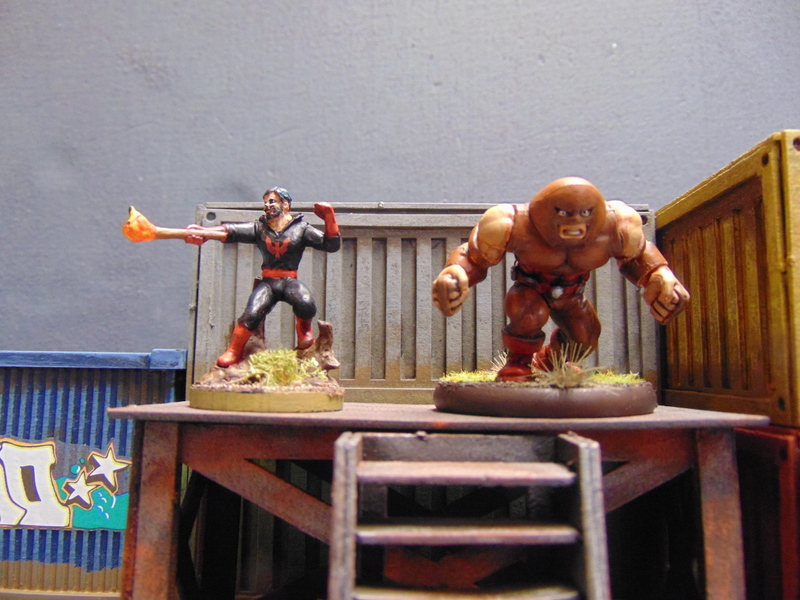
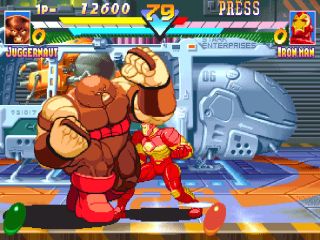
Here are my Heroclix repaints of Juggernaut and Black Tom. I look at these and while I’m happy with the repaints, I have a slight problem…Juggernaut is way too small. According to the Marvel wiki, Juggernaut is 9’5″. The fact that he’s hunched over (no doubt plodding forward) doesn’t help, but I feel like Juggernaut should be HUGE. Take this screen shot from the Marvel Super Heroes video game:

Yeah. That’s Juggernaut. Not someone slightly larger than Black Tom Cassidy. He can fit his whole hand around Iron Man’s waist! (In the video game, he’s actually bigger than the Hulk.)

There are other Heroclix versions of Juggernaut, but, IMO, this one is the best sculpt. I wish it was bigger, but I’ll live with it.

As far as Black Tom goes, his sculpt is fine, although the flame coming out of his shillelagh (why does that sound dirty?) is made out of that translucent ‘Clix plastic I hate so much. I painted flames over it, for better or worse.

Here are my Super Mission Force builds for Juggernaut and the reviled Black Tom Cassidy:

Juggernaut: (Super) Major: Super Strength, Minor: Armor, Density Increase, Resistance, Tough

Special Rules: Unstoppable: Juggernaut’s Density Increase power is ALWAYS on. He doesn’t have to activate it, nor can he choose to deactivate it. This makes him immune to knockback at all times. It also means he can’t charge, only move at his normal rate. Juggernaut can be Entangled, but only until his next activation. He automatically wins any opposed roll to escape an Entangle. He just plods forward. Juggernaut can be grappled normally. (If you want try grappling Juggernaut, good luck.)

Black Tom Cassidy: (Blaster) Major: Power Blasts, Minor: Clever, Rapport (Juggernaut)

Note: this is the old version of Black Tom, the one I know and hate from a few decades ago. Apparently, Black Tom is now part wood, and can control wood. If you prefer, I guess you could give him Armor and Melee Specialist instead of the minor powers I gave him to reflect his current version. He’ll still suck, though, because he’s still Black Tom Cassidy.


Khelden Josek, Dwarf Brewer

Today, I present to my readers my favorite role-playing character of all time: Khelden.

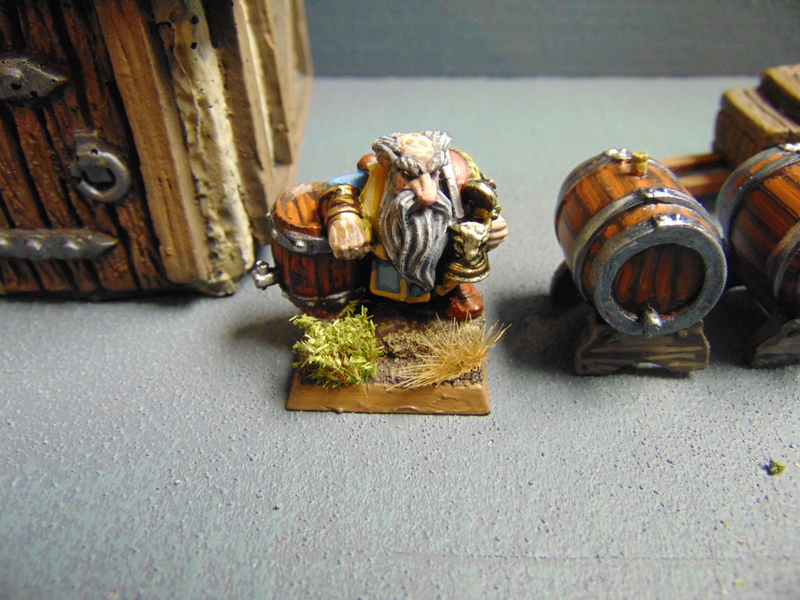
Khelden is an Ultangen Dwarf, a race from my good friend Owen’s fantasy setting, Gandaria. (Owen used to have a whole website dedicated to this setting and some of his other gaming and writing endeavors, but he took it down a couple of years back, which is a real shame.) Like many dwarfs, Khelden was a soldier for decades, a veteran of countless battles and a formidable warrior. But Khelden left the Dwarflands to start a life elsewhere. A brewer by trade, Khelden set up a prosperous business in the large, mostly human city of Brimshire. His wealth and character allowed him to achieve some status among the merchant class and the nobility.

Khelden is immensely strong; and while he is no deep thinker, he possesses the canniness of one who has lived by his wits and skills for many long years. He is an exceptional fighter, but he considers brewing his profession. While he excels at brewing (it’s his highest GURPS skill, in fact), he is constantly being called away from his brewery to battle monsters or deal with the intrigues of evil beings. Khelden wields Arshavir, a dwarven mace of great power and a relic from many centuries past, long thought to be lost. The mace has an adverse and dangerous effect on the weather the longer it is used in battle. Luckily, Khelden finishes most fights quickly.

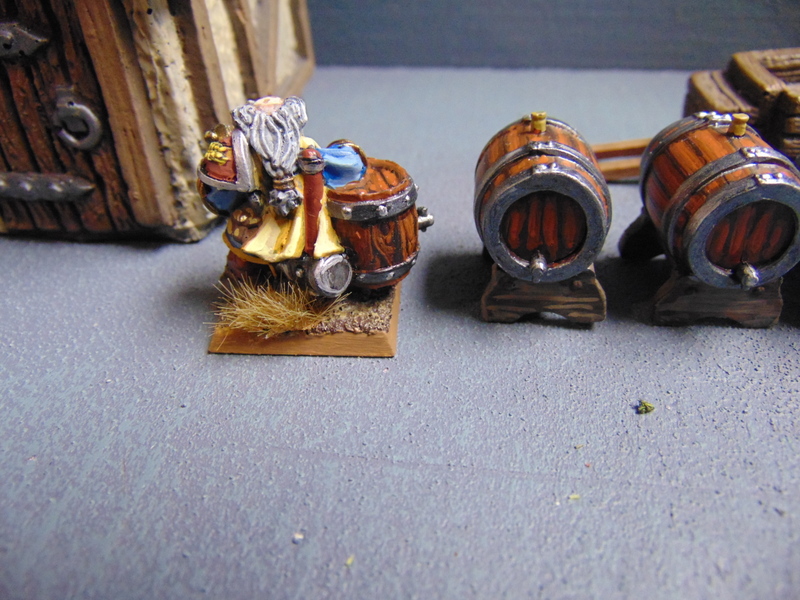
This miniature is a perfect representation of Khelden as a Master Brewer in his later years, assuming he ever got to live that long (unlikely, considering the lethality of Owen’s campaign). He has finally settled down and retired, enjoying the fruits and rewards of a life well-lived. At long last, he has perfected his recipe for his dwarven stout, better known as Khelden’s Black. Unfortunately, this miniature does not have a mace, but a hammer instead. Khelden used a hammer in his early years. I imagine that since he is now old, Khelden has passed Arshavir on to a younger, worthy dwarf; and is content to take up the hammer again.

The miniature is the Dwarf Brewer from the Reaper Bones line. The ale casks on the right of the picture are from Deep Cuts, part of the Pathfinder scenics they’re putting out nowadays. Both Bones and Deep Cuts claim they do not need primer and that paint can be applied directly to the model, but I primed everything with Vallejo surface primer and I’m glad I did. I like the ale casks. At $3.99 for the three pack they’re priced nicely, but they don’t sit levelly. It’s a minor quibble, but it’s there. The Reaper dwarf miniature was only $2.50! I’m starting to find a new appreciation for Reaper Bones…

If you’re interested in yet another of my old characters, I posted a short write-up of my monk, Brother Jerrod, way back in March 2015.