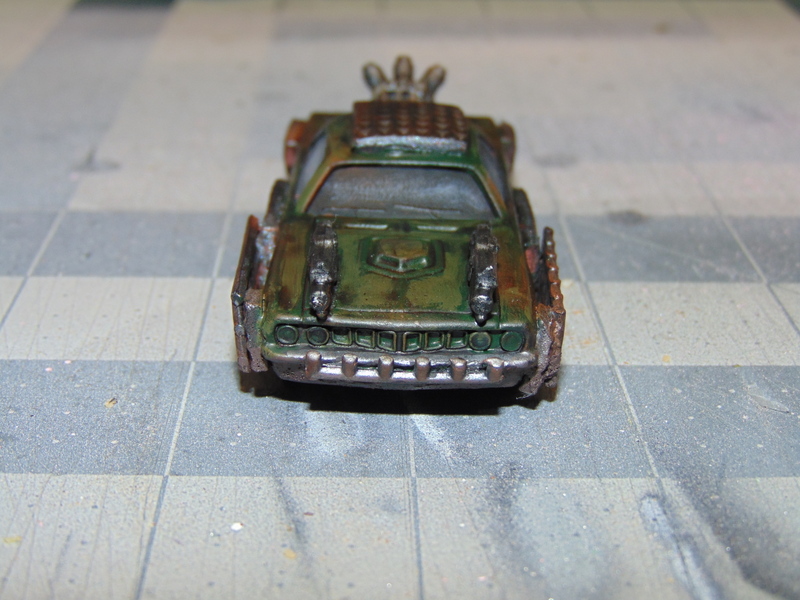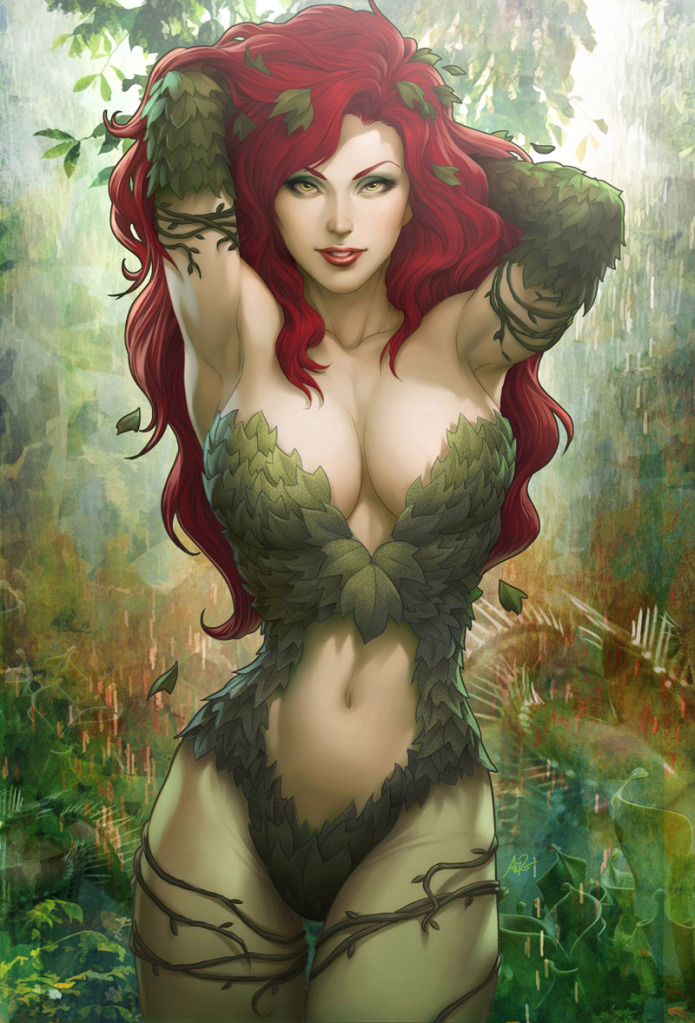
Category Archives: Repaints

Gaslands 2: Nitro Burn and Oil Can Harry!

I was warned this would happen. I have officially been bitten by the Gaslands bug. I guess that’s why I decided to convert some buggies next.

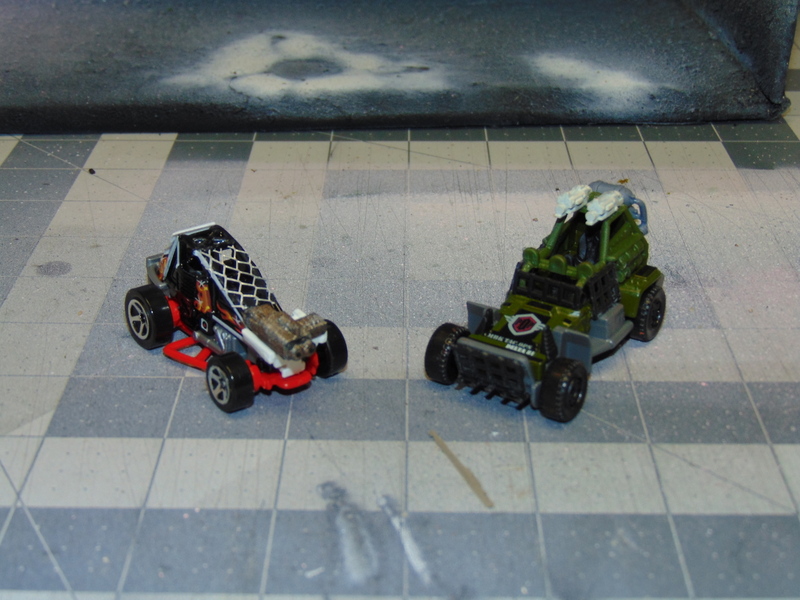
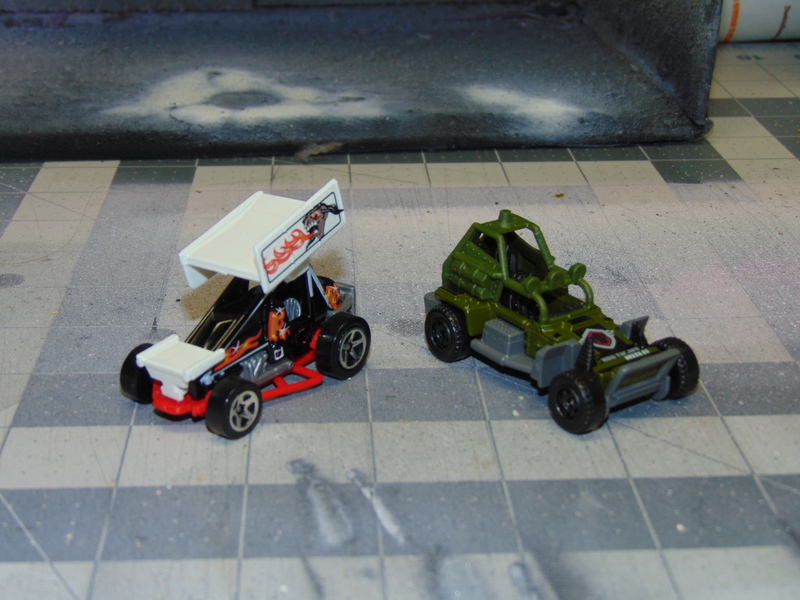
These are what I started with. I bought both of these cars brand new (a dollar apiece at soon-to-be-gone Toys R Us). The one on the left is a Hot Wheels car, the one on the right is Matchbox. Both are open-topped buggies. I really like the look of the one on the right. It has two front seats and a raised back seat, perfect for a gunner!

Buggies are light vehicles in Gaslands, meaning they’re pretty much just there to cause as much trouble as possible before they blow up.  I put minimal armor on the frames, since armoring up a buggy is a waste of a build slot, IMO. Still, I wanted the overall “Road Warrior” aesthetic…

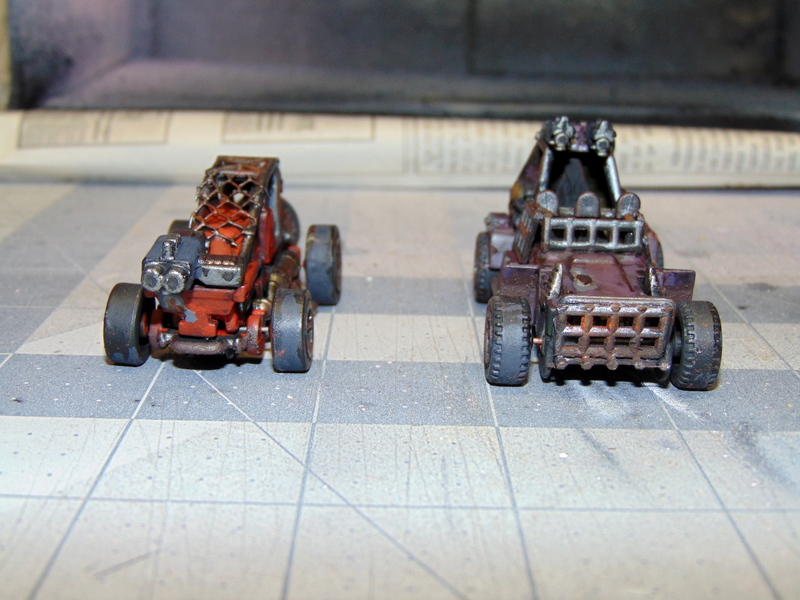
Nitro Burn, on the left, had that ridiculous I-don’t-know-what on his roof, so I got rid of that immediately. For “armor”, I glued some some wire mesh to his canopy and some styrene to his back window. I gave him a GW storm bolter as a front-mounted machine gun and stuck a flamer tank to the side as a nitro booster.

Oil Can Harry, on the right, got two space marine bolters mounted on his roll cage as machine guns. I made an oil slick dropper from an old heavy flamer nozzle (pointed downward) and some flamer tanks. For “armor”, I covered his front and side windows with plastic mesh, and gave him a spiky front bumper.

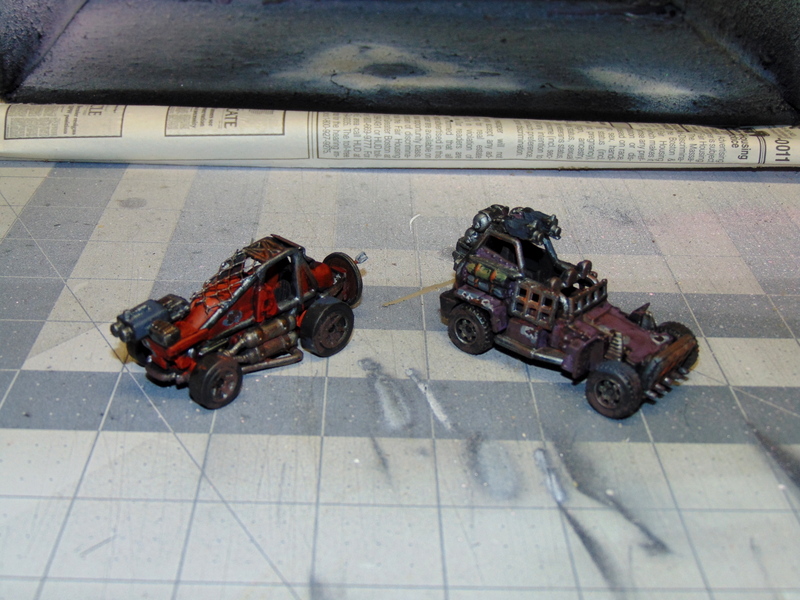
Here’s what they look like after some painting and weathering. After priming both black, I used a mixture of Reaper, Cote D’Arms, Vallejo, Army Painter and GW paints. Nitro Burn got a basecoat of Black Red (V), highlighted with Rusty Red (R), while Oil Can Harry was based with Dusky Grape (R) and highlighted with Faded Purple (R). The metal on both buggies was Gunmetal Grey (V) and the wheel rims and guns were Gun Metal (CD). The gun casings were painted Necromancer Cloak (AP). The colors on both got a wash of Nuln Oil (GW), while the metallics were washed in Armor Wash (CD). I also used some Dawnstone, Administratum Grey and Tin Bitz (all GW) to pick out some dinged up and rusted spots. I used some Stirland Mud and Typhus Corrosion (both GW) where it made the most sense. Lastly, I applied some MIG Rust pigment to all the “armor” and to the rims.

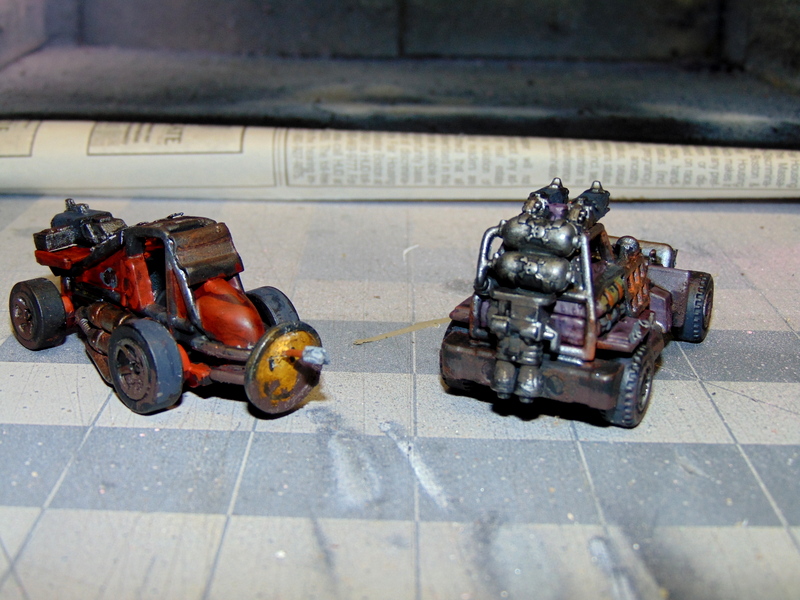
As a final touch, I decided to have a little fun with Nitro Burn. I attached an old GW Fantasy round shield to his rear, painted up like a smiley face. I figure Nitro Burn likes to live dangerously. He likes to taunt his opponents by speeding ahead of them, forcing them to look at that infuriating yellow smile. Naturally, that face is a prime target for weapon fire, so I drilled a small hole and stuck an arrow in it, no doubt fired by some enraged wasteland scavver!

My next Gaslands project is a doozy, but I think I’m going to try to paint something non-Gaslands related first.

But I make no promises.


First Gaslands Build: Coughin’ Joe!

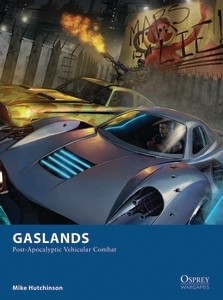
I discovered Gaslands by reading Miniature Wargames magazine a couple of months back. It’s a game of post-apocalyptic vehicular combat put out by Osprey.  It’s designed to be played with standard Matchbox/Hot Wheels cars that you convert into Mad Max-esque death machines, and it looks like a lot of fun.

While my experience with Osprey Games has been hit-or-miss so far, I figured why not give it a shot? After all, the entry cost to a game like this is minimal; you only need the rules and a bunch of toy cars to play. The rules are reasonably priced at under $20, and toy cars are easy enough to come by. They’re pretty cheap even brand new, and better still; there are tons of thrift shops, flea markets and secondhand stores where you can pick up used and banged up toy cars for even less! (If you have kids, you can probably find a bunch laying around your house on inconvenient places, like stairs.) You’re going to convert them anyway, and cosmetic damage is the look you’re going for!

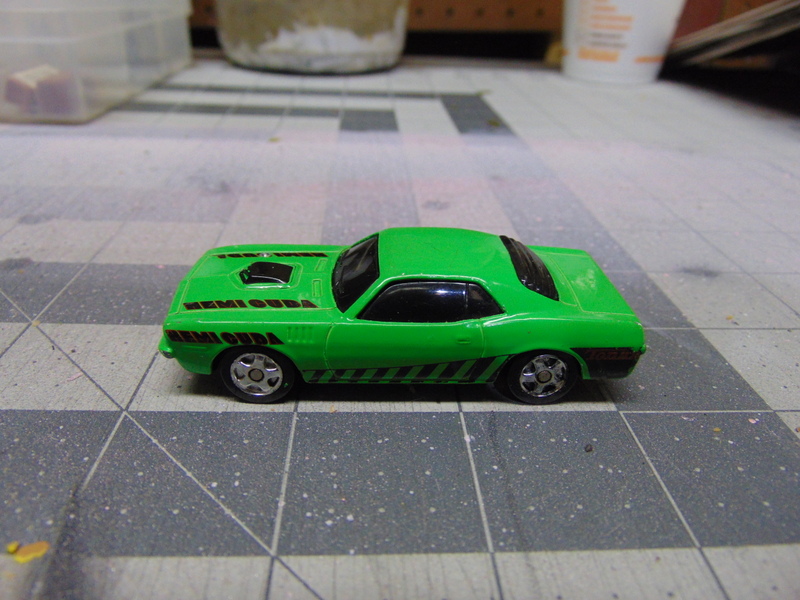
I went by a thrift shop and bought a bag of 6 cars for $3.00. It contained this car, a “Plymouth Hemi Cuda” by Maisto.  I actually know a guy who owns a 1969 Plymouth Barracuda. He drove it all through high school and still has it to this day, some 30 years later. It gets about 3 miles to the gallon, but it’s absolutely the coolest car I’ve ever been in, and it hauls balls, to put it mildly.

I decided this is going to be my first Gaslands conversion.

Images abound on the Interweb of Gaslands vehicles; simply Google “Gaslands” and you’ll see for yourself. There are also many Youtube videos to view on the subject. One particular creator, JH Miniatures, does a terrific series entitled Wastelands Workshop. It’s a bit technical, but you don’t need to get as fancy as he does. I highly recommend his videos.

If you’re like me, i.e. an obsessive hoarder of bits from previous kits, then rejoice, for Gaslands is the game for you. I played a lot of Warhammer 40K back in the day, using Space Marines (of course) and Imperial Guard. In other words, I have a lot of old vehicle bits that have been sitting in boxes for a very long time. But you don’t need to have a ton of fancy bits like me, or be as technically savvy as JH Miniatures to get to work on Gaslands conversions. DM Jim over at Game Terrain Engineering does a bunch of Gaslands videos, and this one in particular shows how to use common junk items as weapons and armor. Good stuff!

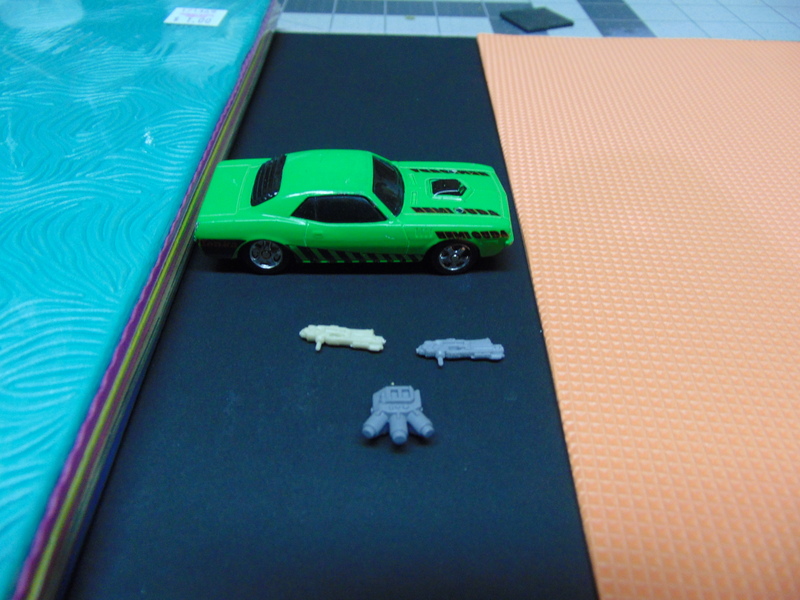
But back to me…I decided not to go too crazy with my first car. I’ve opted to use some bolters from some old Rhino kits and smoke launchers from a Leman Russ tank as conversion bits. The bolters are machine guns, and the smoke launchers could represent turbo boosters, caltrop or glue droppers, oil dispensers, or…well, smoke launchers, which is what I’m going to use them for. Coughin’ Joe, get it?

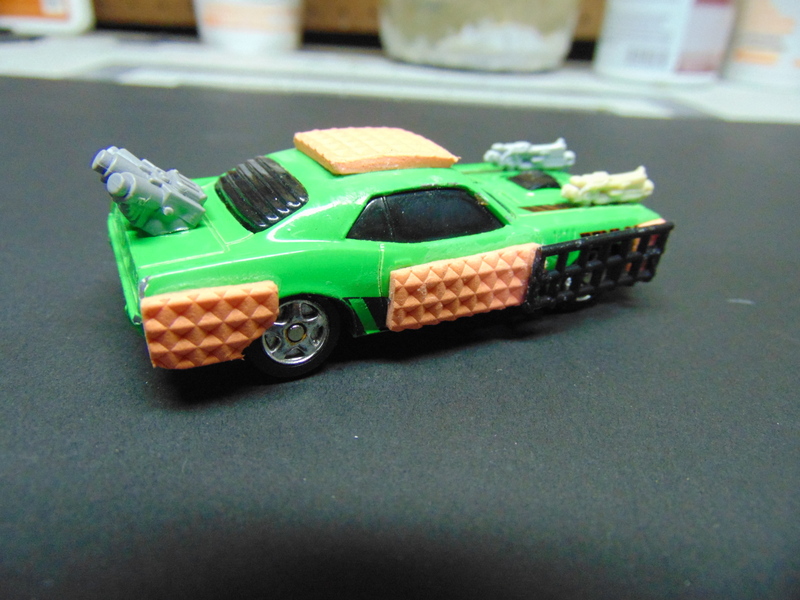
For armor, I used some old material I had laying around: these textured craft foam sheets. Each package cost me a dollar, and you get six different texture patterns. Four of these have patterns that are useless (like the one pictured), but there are two that could work.

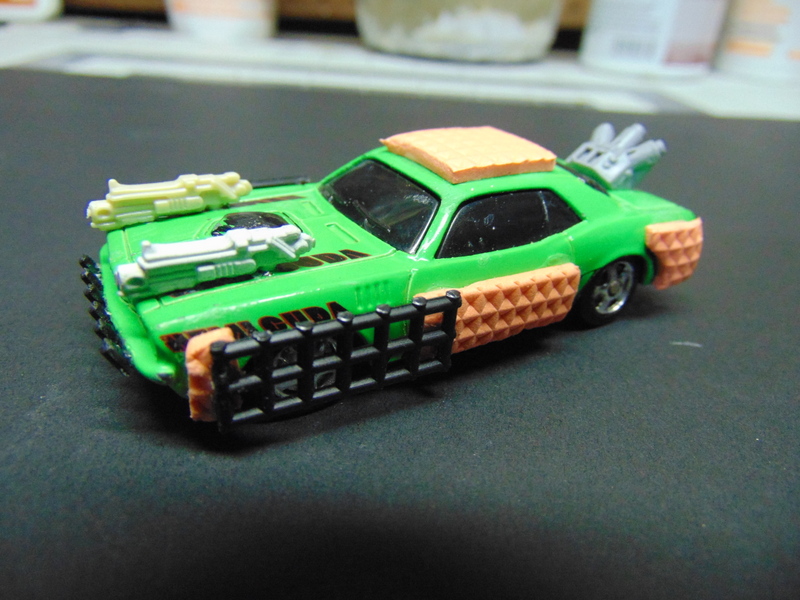
The orange stuff is the craft foam. It’s easy as pie to cut and glue, and the grid pattern makes it look industrial enough to serve as armor. I also clipped some plastic mesh from a needlepoint sheet (I think that cost a dollar, too), and glued it around the front wheel wells to offer the tires some protection.

The smoke launchers glued easily to the back of the car. The bolters have little mounting pegs on them, so I decided to drill tiny holes to accommodate the pegs. This was surprisingly difficult, even with my Dremel on max rpm. Turns out I needed a cobalt drill bit to get through the car. One quick trip to Home Depot sorted that out, and voila! Front mounted machine guns!

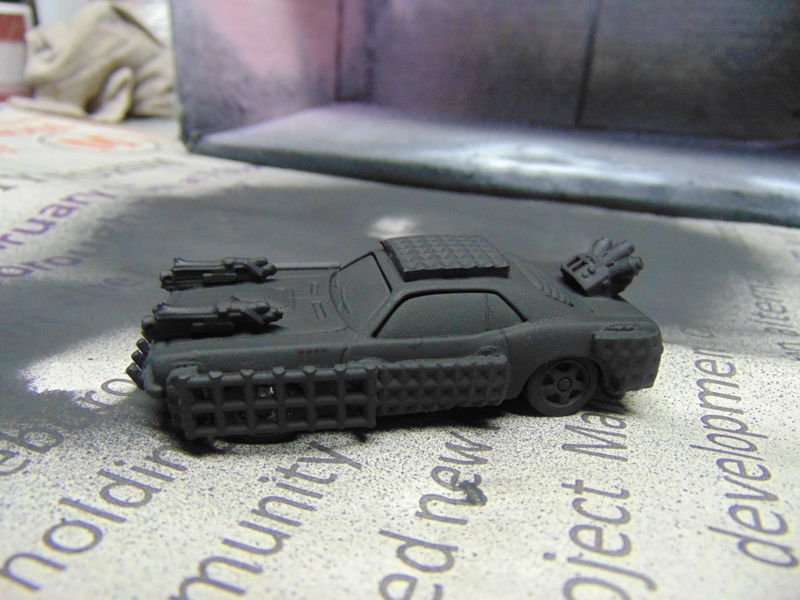
Once assembled (it took less than 20 minutes, not counting my trip to Home Depot), I primed it black.

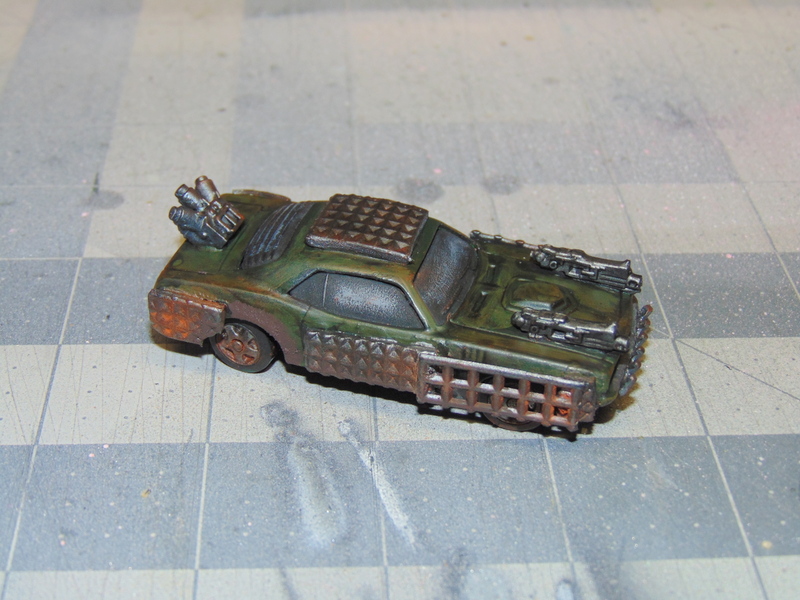
I used a mixture of Vallejo, Cote D’Arms and GW paints. I based the car in Military Green (V) and highlighted it with Cayman Green (V) before giving it a thorough wash in Nuln Oil (GW). I painted the armor plating Gunmetal Grey (V) and the guns and wheel rims with Gun Metal (CD) and washed all the metallics with Armour Wash (CD). Then I liberally applied some MIG rust pigments to the armor sections and the rims. I used some Stirland Mud (GW) on the wheel wells and the front and rear bumpers. A light drybrush of Dawnstone (GW) on the windows, and that was that.And here he is, in all his grimy glory…Coughin’ Joe!

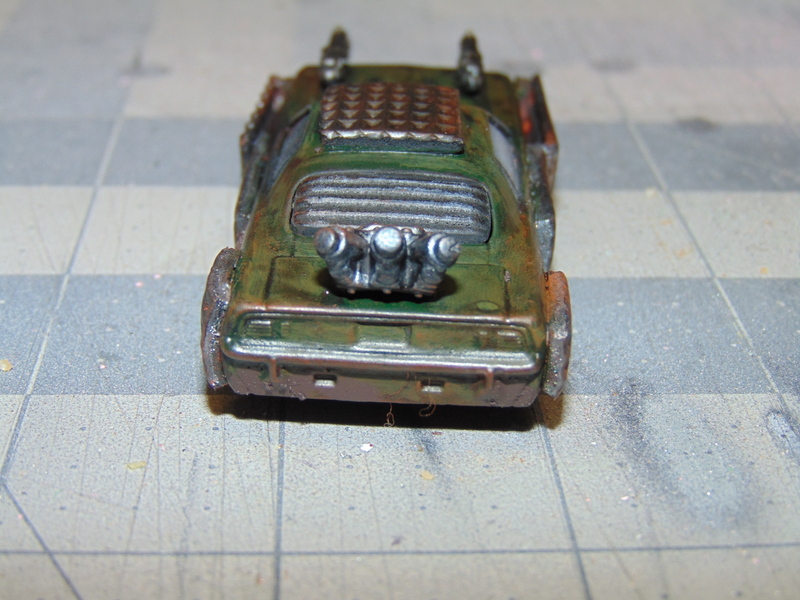
Rear view. Most people never see this on account of the thick black smoke pouring out of those launchers…

If you see this in your rear-view mirror, you’re about to get shot. A lot.

I read somewhere that it’s easy to get addicted to converting cars for Gaslands, and I am already hooked. I have a bunch of toy cars and bits scattered around my hobby space as we speak. More Gaslands conversions soon!


Poison Ivy

Poison Ivy has become one of my favorite Batman villains, although it wasn’t always so. (Take the movie Batman and Robin, for example; like Arnold Shwarzenegger’s Mister Freeze, the less said about Uma Thurman’s portrayal of Ivy, the better.) I didn’t really start to like her until the Batman: The Animated Series episode “Harley and Ivy”, in which the two ladies team up to take over Gotham’s crime scene, at least until Batman and the Joker find out about it.

Ivy appears in all but one of the Rocksteady Batman: Arkham series of video games, of which I am a huge, obsessed fanboy. And now, with a particularly cold-blooded version of Poison Ivy running amok on the current season of TV’s Gotham, I thought it was a good time to feature her here.

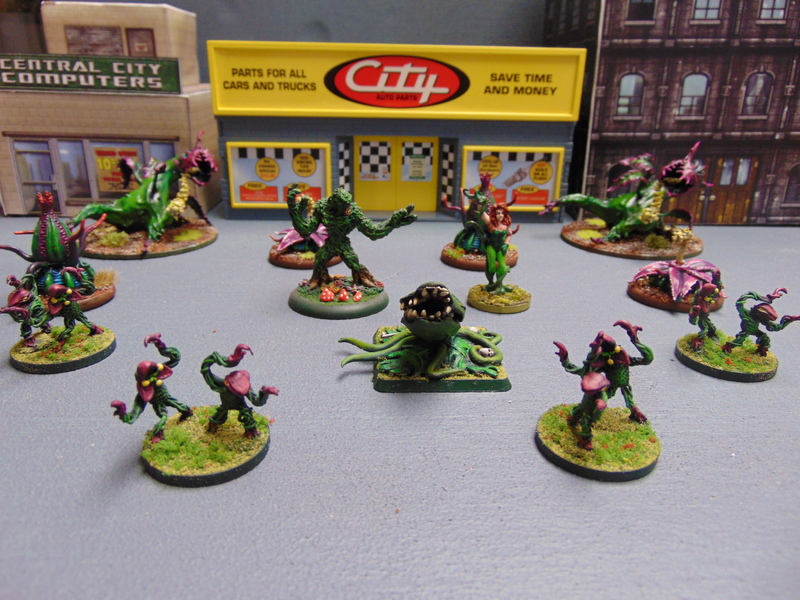
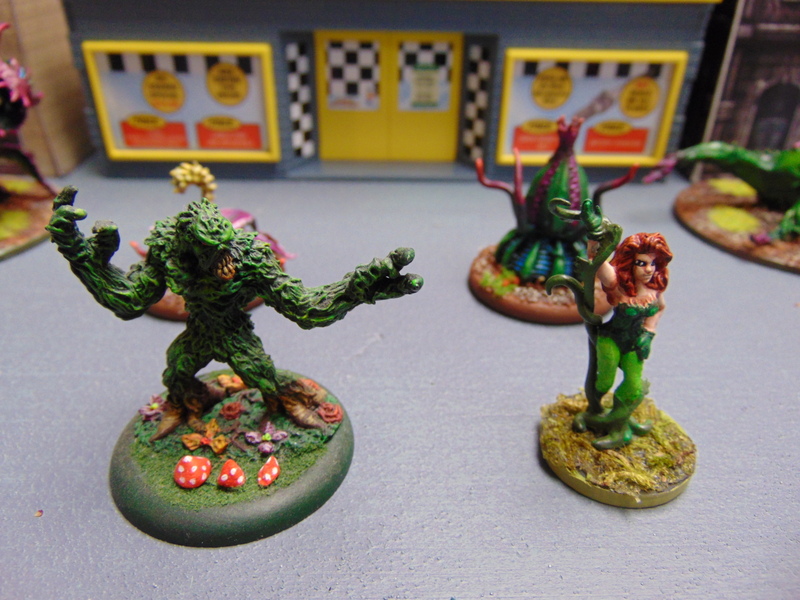
This repainted Heroclix Ivy is from the DC Cosmic Justice set. It’s the classic, early version of Ivy, before she got chlorophyll for blood and became more plant than human. I based her on a small piece of Spanish moss. Behind her are some of her pets: the big monster plants are Dragon Plants, new from Reaper’s Bones collection. The pod plants are also from Reaper Bones; they’re Death Star Lilies.  The big Man-eating Plant in the middle is from Armorcast.


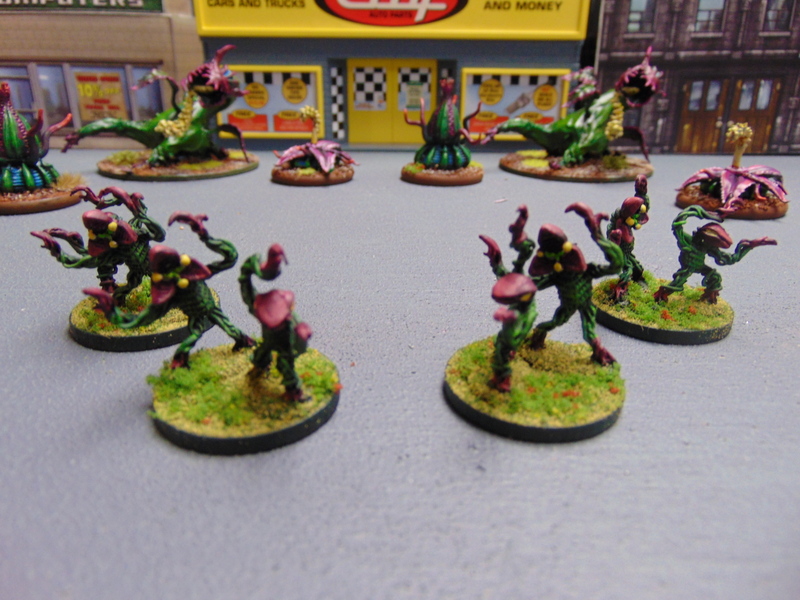
The little plant people are Vardu Sprouts, from Hydra Miniatures’ Primal Dawn range. When I ordered them I thought they would be bigger than they are, but they’re sprouts, after all. I just based them two to a base. I plan on having the pod plants spit them out as a renewable source of plant henchmen.

Lastly, the big guy is an old version of Reaper’s Swamp Shambler. I painted him years ago, and he looks a lot like a certain…bayou-dwelling…Plant Elemental…known for…punctuating…his speech…with lots…of…elipses…but in this context he’s Ivy’s bodyguard, should Batman ever get too close. He’s better than that horrible version of Bane in Batman & Robin, anyway.

Man, was ANYTHING in that movie any good? No. Not a thing.

Anyway, here is my Super Mission Force build for Poison Ivy:

Poison Ivy (Wild Card) Minor: Barrier, Entangle, Summoning, Telekinesis

I can hear some of you already: “Now hold on a second, Angry Piper! Barrier and Entangle, I can see. But since when does Poison Ivy have Summoning and Telekinesis?”

To that, my friends, I would say you must think outside the box a bit. What is Poison Ivy’s main power? Plant control. Unfortunately, there is no plant control power in SMF. Ivy can get plants to do a lot of stuff, like entangle enemies or form barriers…or grapple enemies at range with super strength, bear herself aloft to higher elevations (a’ la Jack and the Beanstalk), or manipulate objects at a distance using plant-y tendrils. (In other words: Telekinesis, only using the plants instead of her mind.) She can will plants to fight for her and pretty much instantly mutate normal plants into killing machines. Kind of sounds like Summoning, no?

Of course, if you don’t like my version of Poison Ivy, you could substitute some or all of these powers with others you may find more thematically appropriate, like Armor, Damage Field, or Enhanced Senses, to name a few. When using Ivy in a scenario, I would let her have a few plant guardians and/or henchmen in place at the start of the game. She’s really not that tough, otherwise; and she would likely be defeated before she could use her powers to summon reinforcements. Just my 2 pesos.


Juggernaut and Black Tom

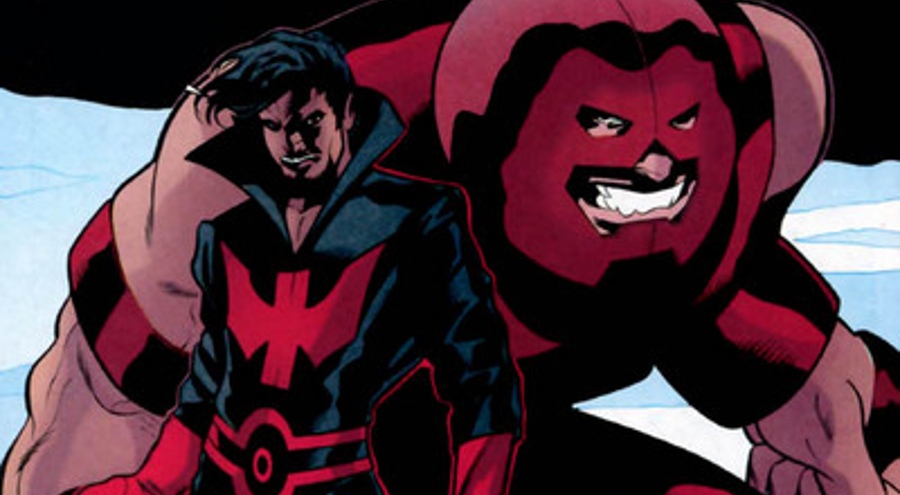
Juggernaut is a classic X-Men villain, a physical titan who is counterpoint to his brother Charles Xavier’s mental mastery. Unfortunately, he often hangs out with Black Tom Cassidy.

Black Tom is the cousin of Sean Cassidy (not to be confused with Shaun Cassidy, the Hardy Boy), better known as the X-Men’s Banshee. Black Tom was created by veteran X-Men scribe Chris Claremont, a man responsible for many great X-Men storylines and characters. Unfortunately, he’s also responsible for many horrible X-Men characters (like Black Tom Cassidy), as well as the nightmare “alternate-reality/timeline” clusterfuck that characterizes the X-books to this day.

I have mixed feelings about Mr. Claremont. On the one hand, his X-Men work with John Byrne in the late 70’s/early 80’s is iconic. But then, in the 90’s, he created Gambit.

No matter how conflicted I feel about Mr. Claremont, my feelings about Black Tom are crystal clear. Like many of Claremont’s characters (Moira Mac Taggart, for example), Black Tom suffers from ridiculous ethnic stereotyping. He’s all “begorrahs” and “boyos” and “blimeys”.  I get that he’s a comic book villain, but fer Chrissakes, man. Black Tom also channels his powers through a shillelagh, because of course he fucking does. 

In case you can’t glean as much from the tone of this post, I actually hate Black Tom Cassidy more than I hate Gambit (I didn’t know that was possible). Nevertheless, he hangs out with Juggernaut, so….

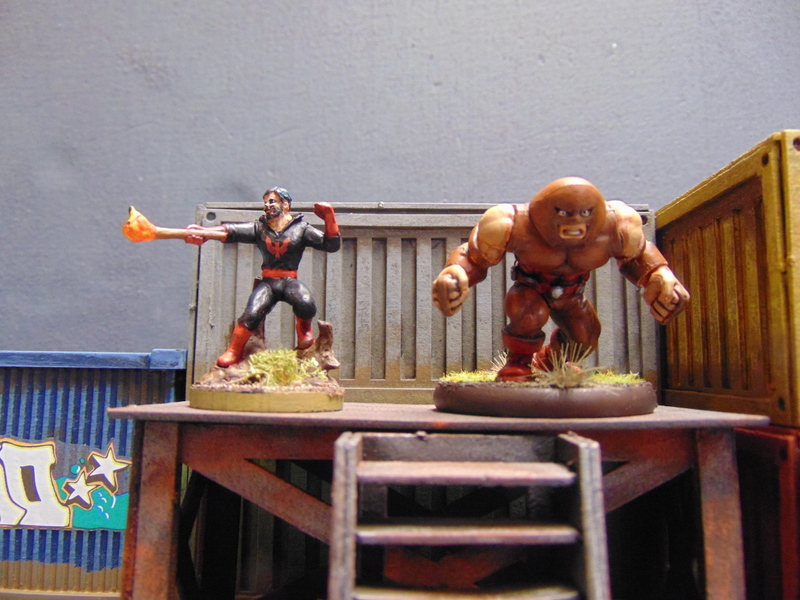
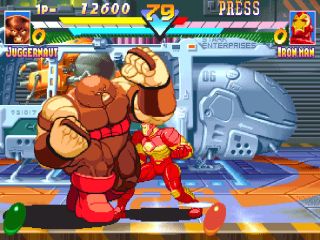
Here are my Heroclix repaints of Juggernaut and Black Tom. I look at these and while I’m happy with the repaints, I have a slight problem…Juggernaut is way too small. According to the Marvel wiki, Juggernaut is 9’5″. The fact that he’s hunched over (no doubt plodding forward) doesn’t help, but I feel like Juggernaut should be HUGE. Take this screen shot from the Marvel Super Heroes video game:

Yeah. That’s Juggernaut. Not someone slightly larger than Black Tom Cassidy. He can fit his whole hand around Iron Man’s waist! (In the video game, he’s actually bigger than the Hulk.)

There are other Heroclix versions of Juggernaut, but, IMO, this one is the best sculpt. I wish it was bigger, but I’ll live with it.

As far as Black Tom goes, his sculpt is fine, although the flame coming out of his shillelagh (why does that sound dirty?) is made out of that translucent ‘Clix plastic I hate so much. I painted flames over it, for better or worse.

Here are my Super Mission Force builds for Juggernaut and the reviled Black Tom Cassidy:

Juggernaut: (Super) Major: Super Strength, Minor: Armor, Density Increase, Resistance, Tough

Special Rules: Unstoppable: Juggernaut’s Density Increase power is ALWAYS on. He doesn’t have to activate it, nor can he choose to deactivate it. This makes him immune to knockback at all times. It also means he can’t charge, only move at his normal rate. Juggernaut can be Entangled, but only until his next activation. He automatically wins any opposed roll to escape an Entangle. He just plods forward. Juggernaut can be grappled normally. (If you want try grappling Juggernaut, good luck.)

Black Tom Cassidy: (Blaster) Major: Power Blasts, Minor: Clever, Rapport (Juggernaut)

Note: this is the old version of Black Tom, the one I know and hate from a few decades ago. Apparently, Black Tom is now part wood, and can control wood. If you prefer, I guess you could give him Armor and Melee Specialist instead of the minor powers I gave him to reflect his current version. He’ll still suck, though, because he’s still Black Tom Cassidy.


Cowabunga, Dude!

I first discovered Teenage Mutant Ninja Turtles when I was a freshman in high school. It was 1986, a pretty amazing year for comics as a whole. That year would see the publication of Batman: The Dark Knight Returns and Watchmen, two pivotal and iconic stories that would rock the foundations of the comics industry and change comic books forever.

Up until then I only collected Marvel titles, and all of those were in color. Black and white comics, i.e. small press titles,  were unknown to me. Then my friend introduced me to TMNT #7, and I was immediately hooked. I hunted down as many back issues as I could find. They were surprisingly scarce and first printings of the first 3 issues were well above anything I could afford even if I could find copies. I managed to get everything from issue 4 and up, but even to this day I do not own copies of the first three issues. Instead I had to content myself with the First Comics graphic novel, which reprinted all three issues in color. (Prior to this reprint, the only TMNT color material was in a Munden’s Bar story in Grimjack #26. I bought that for the turtles, and ended up becoming a much bigger fan of Grimjack than of TMNT!)

The original turtles, by which I mean the version as presented in the comics prior to the first (1987) animated television series and the (1990) live-action movie (featuring the great Corey Feldman as Donatello), were a bit different than what we know today. The comic, although a parody of Daredevil (among others), was kind of dark. It managed to take itself somewhat seriously even in the midst of its absurd premise. For example: the turtles killed people. Lots of people. Ninja henchmen, mostly, but still people (I guess). When Leonardo slashed with his swords, someone bled. Obviously, this kind of thing didn’t make it into the cartoon, which was unsurprisingly targeted towards children. Also (as we knew from their early colorized appearances) the original turtles all wore red bandannas. The only way to visually distinguish which turtle was which was by the weapons they carried. Among other changes, the cartoon toned the turtles down, outfitted them in different colors, created a catchphrase (“Cowabunga!”) and inexplicably made them go crazy for pizza.

TMNT’s success spawned many imitators and started a “funny animal” comic craze, giving rise to the likes of such mercifully-forgotten titles as Pre-Teen Dirty-Gene Kung-Fu Kangaroos, Geriatric Gangrene Jiu-Jitsu Gerbils, and the Adolescent Radioactive Black Belt Hamsters.  None of these were any good. All of them were pretty blatant ripoffs. Nonetheless, the Hamsters seemed to enjoy the most success as a poor-man’s Band-Aid in between the irregular TMNT publishing schedule.

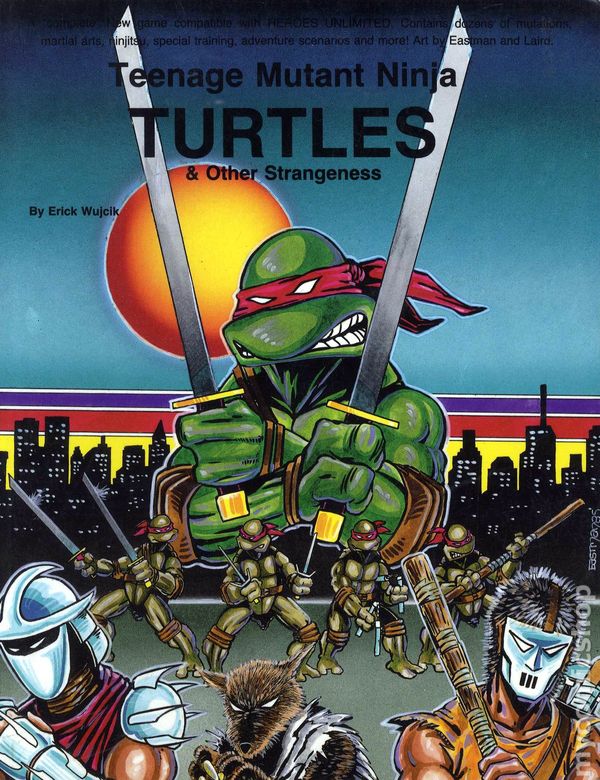
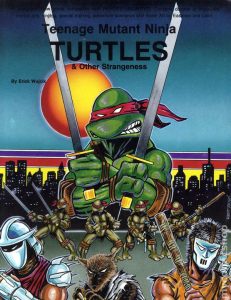
My friends and I got so hooked on TMNT that we played many hours of the Palladium RPG: Teenage Mutant Ninja Turtles and Other Strangeness (see above). This, in turn led us to Heroes Unlimited and later, briefly, RIFTS, before we abandoned the Palladium system altogether in favor of other games.
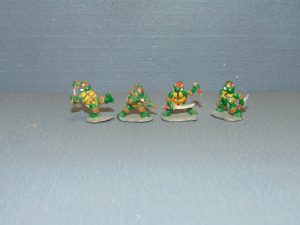
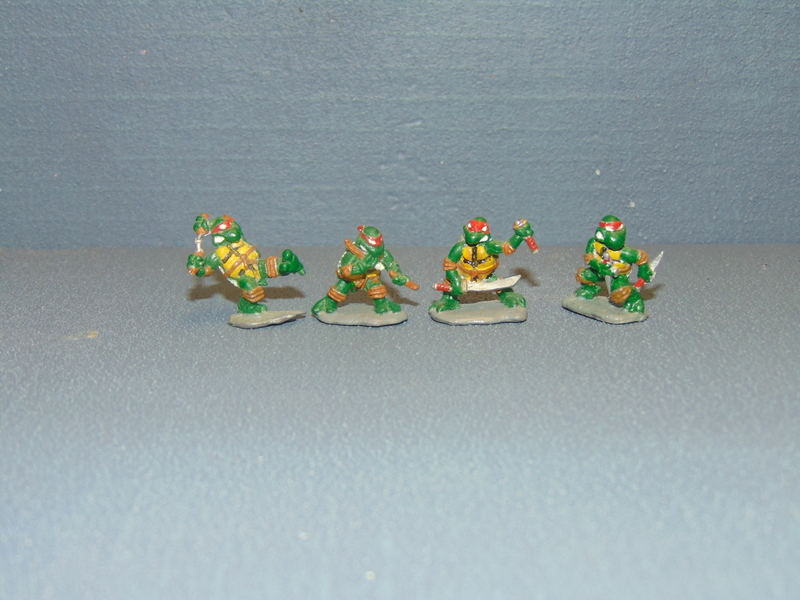
Before we did this, though, I managed to get my hands on these TMNT miniatures, released in very limited numbers from Dark Horse (yes, THAT Dark Horse). These figures go for a pretty penny nowadays, especially the other releases in the line (like the Mousers). I remember I bought this pack on Martha’s Vineyard on a day trip. Retail space isn’t cheap on the Vineyard, so who would have thought that Martha’s Vineyard would have had a comic shop, never mind one that sold miniatures, too? (Aside: even though I live on the South Coast of Massachusetts, I haven’t been back to the Vineyard since I bought these, mainly because I hate boats.) They’re supposedly 25mm scale, but they’re more like 15mm. Between my awful paint job, Donatello’s miscast staff, and Leonardo’s broken sword, they’ve seen better days…

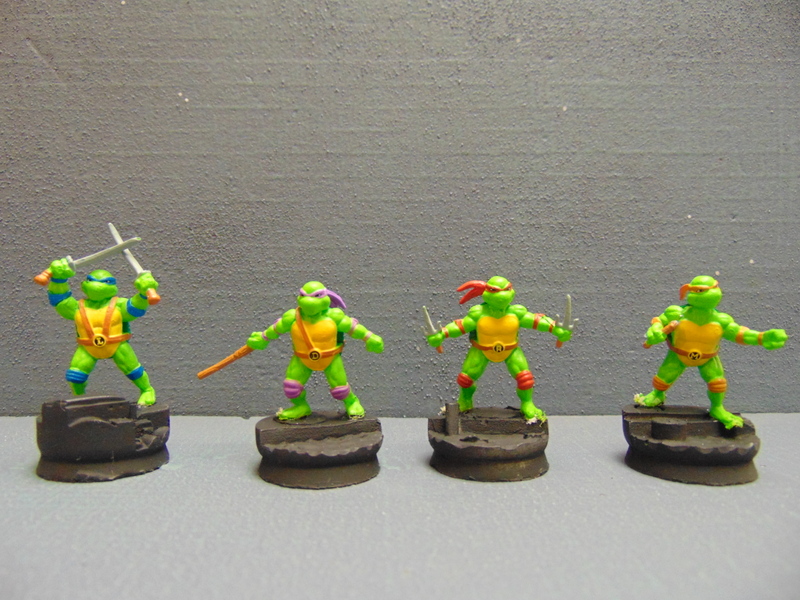
And so, when I heard Wizkids got the license for TMNT Heroclix, I was happy. When I saw this set marked half off at the FLGS, I didn’t hesitate. Here’s what they looked like out of the box:
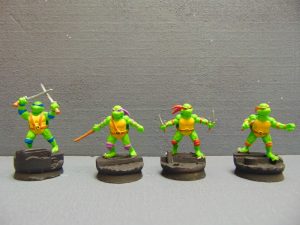
It appears I’m unlucky with turtle miniatures. Brand spankin’ new, both Leonardo and Donatello suffered from bent weapons that can’t be fixed. Bummer. They’re also all a  bit too bright and cartoony for me. I knew I wanted to repaint them as the original badass turtles of my youth.

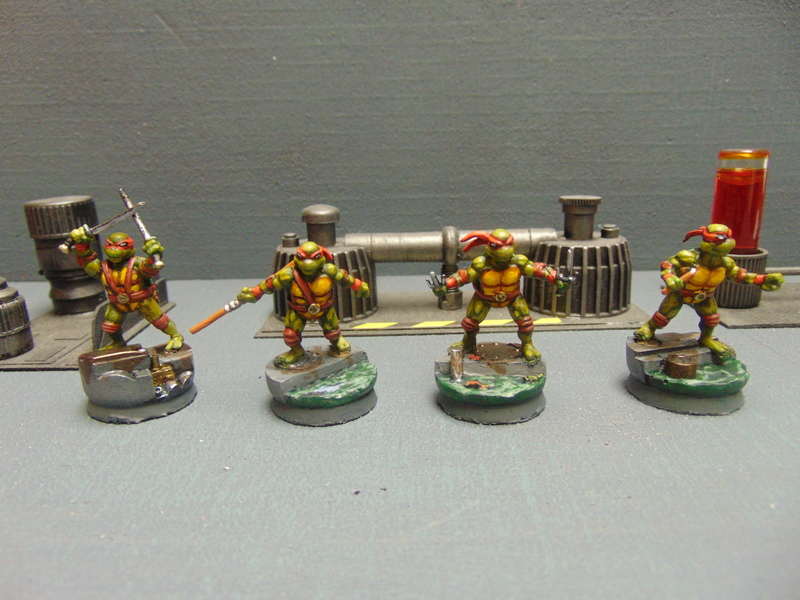
Here is the result:
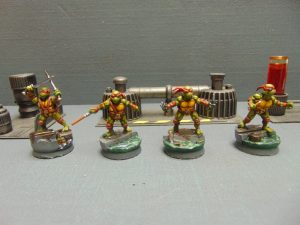
To continue my run of bad luck, somewhere in the painting process I appear to have broken one of Raphael’s sai. Drat! I based them on Armorcast sewer bases that I purchased specifically for this project. I don’t know if I will ever use them in a scenario, or what system I would use if I did; but, since Super Mission Force is my current favorite gaming system, here are my SMF builds for the Teenage Mutant Ninja Turtles:

Aside from the weapons they favor, the turtles aren’t much different. The easy way to build them for SMF is to make them all the same.

All Turtles: (Brawler) Major: Scrapper;  Minor: Armor, Super Agility

Of course, that’s not much fun. The other way I would do it is to make them all Wild Cards. Yes, I know that is against the “two wild cards per team” rule, but who really gives a shit? In this case the turtles would lose the Scrapper power (which is one of the best major powers in the game, IMHO), but would gain powers that would represent their personalities; in other words, make them different from each other in tangible ways. All of them are turtles who can kick ass, but they fill certain roles within the group: Leonardo is the leader, Donatello is the brain, Michelangelo is the clown, and Raphael is the hothead.

Leonardo: (Wild Card) Minor: Armor, Melee Specialist, Super Agility, Enhance

Donatello: (Wild Card) Minor: Armor, Melee Specialist, Super Agility, Savant

Michelangelo: (Wild Card) Minor: Armor, Melee Specialist, Super Agility, Clever

Raphael:  (Wild Card) Minor: Armor, Melee Specialist, Super Agility, Rage

(I couldn’t really think of a fourth minor power that would “define” Michelangelo, so I chose the “Clever” Boost purely for the team initiative bonus, since the turtles are rarely caught flat-footed). Mike has a tendency to ride around on a skateboard, so I guess you could substitute the “Fast” Boost instead, which would increase his movement by 4″.)

This little rush of nostalgia was so much fun I reread the first three issues of TMNT last night. And….well…let’s just say some things are better left in the past.

“Yesterday’s Lead”

It seems I took the month of January off from blogging, quite accidentally. For Christmas I was gifted with Mass Effect: Andromeda for PS4. It was released back in March of last year, but I’m not the kind of (video) gamer that needs to get a game as soon as it’s released. Thus I tend to spend less money on video games overall, as I can wait until the price drops. I am a huge fan of the Mass Effect series, and although this latest game was (unfairly, IMO) derided,  at least in comparison to the previous trilogy, it has accounted for my free time throughout January.

Anyway, it’s nice to be back.

I rarely pick up Wargames, Soldiers & Strategy magazine these days. Although it’s a fine publication, it’s not for me, as it is primarily geared towards the historical wargamer, and even casual visitors to this site will know I don’t fall into that category. The other day I found myself at my newsagent (see what I did there? I used a British term) by complete happenstance ( I was purchasing coffee and donuts for a work meeting at the Dunkin’ Donuts next door), and, since the latest issue of Miniature Wargames magazine hadn’t arrived yet, I gave in to whimsy and purchased WS&S #92. As expected, it had little to interest me as far as gaming goes. I am unfamiliar with most of the historical periods and battles covered throughout the issue. But what issue #92 did have was a worthy article by the great Rick Priestly, entitled “Time, Tide and Yesterday’s Lead.”

You might think Mr. Priestly waxes nostalgic for the early days of Citadel and Warhammer miniatures, but he quickly sets the record straight. Despite his involvement in Warhammer’s development, his particular enthusiasm is the Minifigs line of the 70’s, as those are what led him down the garden path to wargaming.
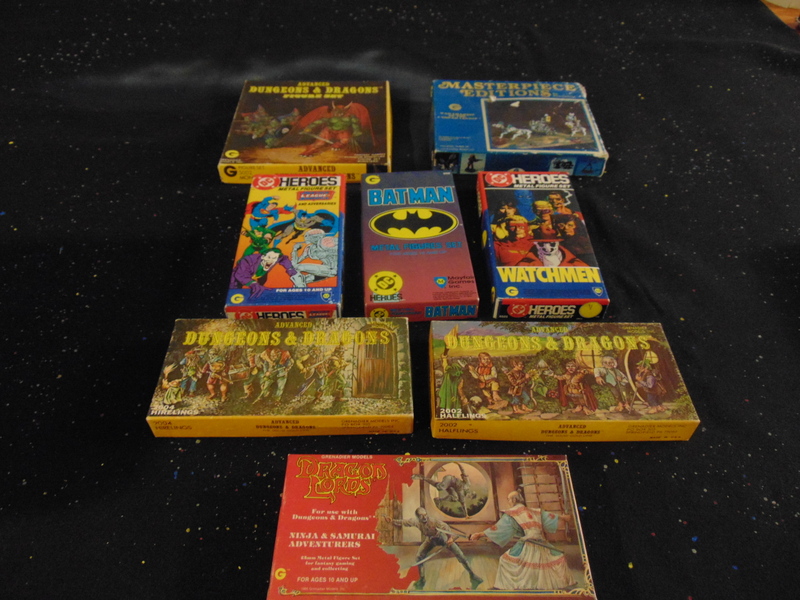
I must confess that since I live in the United States and I was born a good decade or so after Mr. Priestly, I am unfamiliar with Minifigs. Like so many others, I started gaming through Dungeons & Dragons, circa 1983 or so. I’m pretty sure I got the red box for my 10th birthday and it took me a year or two to start running “The Keep on the Borderlands.” I never played a miniature wargame until I was in college in the early 90’s. Predictably, my first introduction came through Warhammer 40K, then quickly moved to WFB. But I had already been collecting and painting miniatures before then. Despite all my failed attempts to introduce them into my roleplaying games, I found them really cool (an obviously still do). I certainly share nostalgic feelings for the miniatures that got me started down my own path, some 35 years ago. And those miniatures, primarily, are Grenadier and Ral Partha fantasy figures.

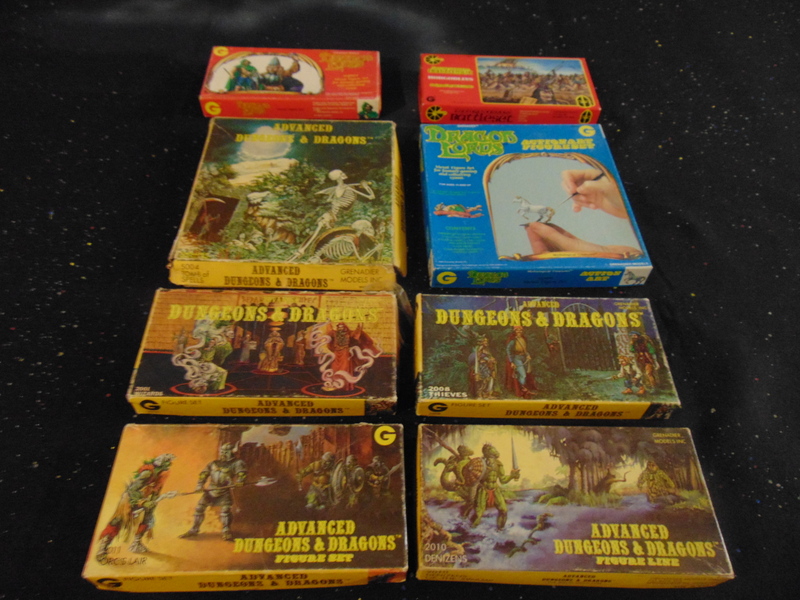
The first set of miniatures I ever bought was the often-reissued Grenadier Tomb of Spells set. It’s the second one down in the left column. Starting from the top left and continuing clockwise, we have Specialists, Hobgoblins, a Dragon Lords set that once included paints, Thieves, Denizens of the Swamp, Orc’s Lair, and Wizards. The Wizards set was the second set of miniatures I ever bought, and I repainted the set a couple of years ago. You can see the results here, if so inclined.

With the arrival of AD&D 2nd Edition, TSR started packaging miniatures under their own name. The above sets are examples of this era. I bought the Marvel Super Heroes and Dragonlance sets when they came out, and a friend gave me the Magic-Users set long ago. The remaining sets were all recent eBay acquisitions.

I probably paid too much for the Indiana Jones set (it’s rare). I paid less than I thought I would for the Star Frontiers and other AD&D sets, but again, probably more than I should have considering the quality. I’ve said this elsewhere: this era of miniature manufacture leaves a lot to be desired. The sculpting is pretty sub-par across the board. Scale is pretty much an afterthought, even between models within the same set (Star Frontiers is by far the WORST for this). I have been painting some of the Marvel miniatures for use in my supers gaming alongside Heroclix models, which should give you a idea of how random the scale is. Some are compatible with Clix models while some are on the small side of 25mm. To top it off, I have no idea what metal was used to cast this line of miniatures, but for some reason, they do not take paint well. Prior to sealing them, even casual handling can cause the paint to rub off, which is kind of a pain during the painting process.

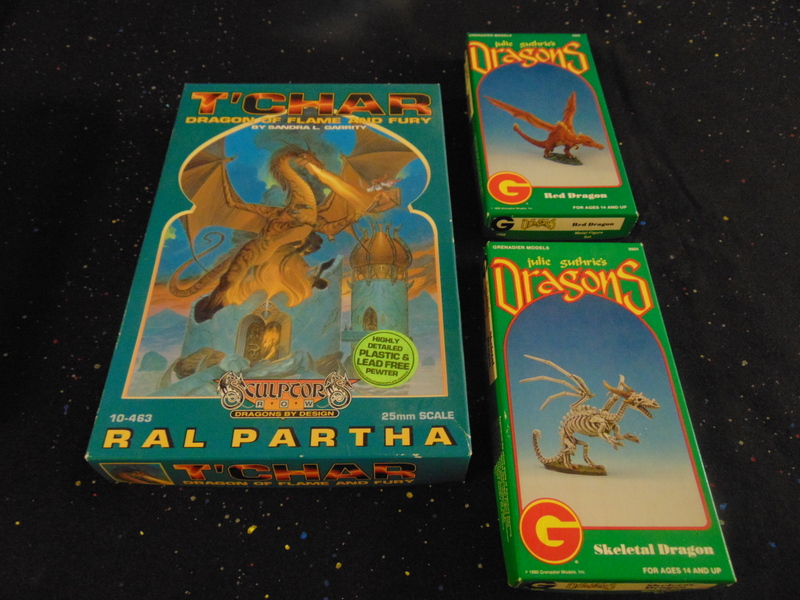
The last of my old sets are above. The Grenadier Secret Agents set is really good, containing lots of mercs and soldiers for use with Top Secret or any other skirmish wargame. Grenadier released two sets of these. I know I had both at one time, but I can’t remember what happened to the other set. (As an aside, the box art above was painted by famous Grimjack artist Flint Henry!) Below them is an exceptional set of ninja by Ral Partha. I recently bought a second set, because as everyone knows, you can never have enough ninja. The bottom row contains dragon models; a Ral Partha T’Char (one of the best dragons produced, IMO) and a couple of Julie Guthrie Grenadier Dragons. I painted up her Red Dragon a while back. You can see it here.

Nostalgia, as Mr. Priestly aptly observes, exerts a powerful force that drives one from affection for times gone by to collector’s obsession. All of the above boxed sets were purchased either on eBay or at a flea market over the last couple of years. With the exception of the Skeleton King’s chariot (top right), all these sets are complete and pristine. (I even managed to replace the 54mm Batman set with one that included a Joker this time.) The DC Heroes sets were a real find at $10 apiece, all bare metal! I painted up the 54mm Batman a few years ago, and recently painted the Grenadier Halfling set above. Batman is here; the Halflings are here.

Which brings me to painting, or rather, repainting. In his article, Mr. Priestly mentions that most Minifigs of the time were likely “favored with a hefty coat of Humbrol Enamel…and then gloss varnished to within an inch of their little metal lives.” Again, I can relate. Here in the States, Testors enamels were the model paints of choice, and I laquered many a miniature in them before “discovering” acrylics right around the time I started playing 40K. Prior to that, every miniature I painted, including many from the sets above, were done with Testors enamels and gloss coat. I shudder to look at them now, but if you’d like to see some before and after shots, look no further than here.

The question then becomes “To strip and repaint, or not to strip and repaint? I am a big advocate of repainting. I’m not the best painter in the world (not even close), but I am exponentially better than I was 35 years ago. I thoroughly enjoyed revisiting the old miniatures I have repainted recently, and I think they are the better for it. But, if even if I were to strip and repaint one miniature every day for the rest of my life, I would likely never finish what I already own, never mind any future tempting purchases. A somewhat sobering and morbid thought, but true nonetheless.

What do you think? Do you get dewey-eyed for a certain manufacturer or era of miniatures? Do you advocate repainting, or are you content with (and perhaps comforted by) viewing your early efforts for what they are?


Terror of the Toyman! Part 1

When it comes to superheroes, Superman isn’t one of my personal favorites. Of course, if I could be any superhero, I’d definitely pick Superman for x-ray vision alone (but having super-strength, invulnerability and flight wouldn’t suck either).  Despite this I never really found him all that interesting on his own.

That’s because it seems there are only three main ways to challenge Superman’s obvious superiority. Take away his powers (à la kryptonite), hit him with magic or mental manipulation (à la Mr. Mxyzptlk), or just be tougher and stronger than him (à la Doomsday).

The Toyman doesn’t really fit any of these criteria, and yet, he’s primarily considered a “Superman” villain.

For those not all that familiar with the Toyman, I could write a brief description of the character here. Or, I could just block quote and attribute a perfectly good description that needs no editing or embellishment. So, from DAMN Good Coffee, the blog of  Mr. Charles Skaggs, I present his description of the Toyman:

Created in 1943 by Don Cameron and Ed Dobrotka, The Toyman first appeared in Action Comics (vol.1) #64 as Winslow Percival Schott, a criminal who used various toy-themed devices and gimmicks when committing crimes. After Superman’s continuity was relaunched following the Crisis on Infinite Earths event miniseries and John Byrne’s The Man of Steel miniseries, The Toyman was reimagined in Superman (vol.2) #13 as an unemployed British toymaker who blames Lex Luthor for being fired from a toy company.

Years later, The Toyman became a darker, more sinister character who abducted and murdered Adam Morgan, the son of Cat Grant.  The character was reimagined once again in Action Comics (vol.1) #865 as a toymaker who lived with his wife Mary and agrees to sell his shop after Mary is killed in a car accident.  After learning that the buyer lied to him, Schott proceeds to bomb the business with an explosive teddy bear and Mary is revealed as one of his first robotic creations.

I can add nothing of substance to Mr. Skaggs’s words. That’s pretty much the history of the Toyman.

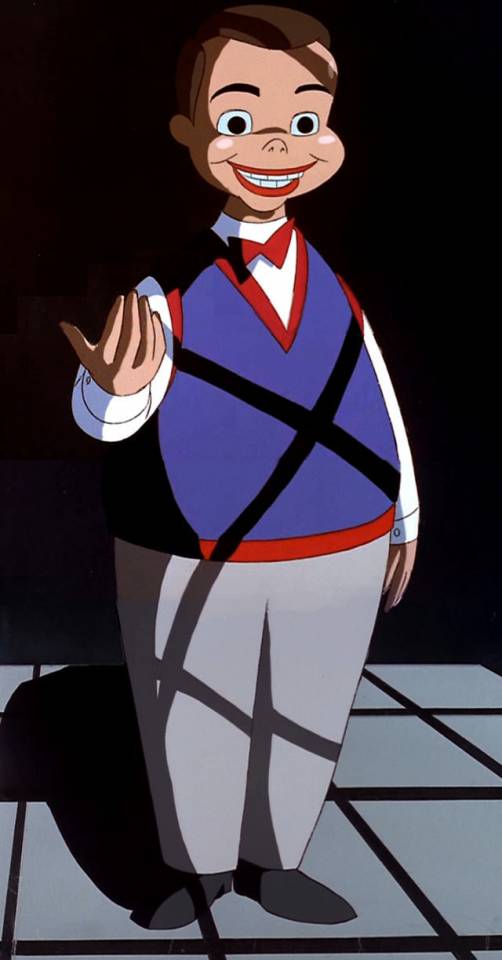
However, my favorite version of the Toyman is this one from the DC animated universe. This version is the unnamed son of Winslow Schott, and is obsessed with revenge against mob boss Bruno Mannheim, who he blames for his father’s imprisonment and eventual death, and his own miserable foster home upbringing as a result. He wears this creepy doll head and you never see his real face.

Anyway, about a year ago, I got an idea for a Supersystem 3 scenario featuring the Toyman. But, now I play Super Mission Force pretty much exclusively, and SMF being predominantly a game of Supers combat, I was in a quandary as to how to effectively use Toyman against Superman. After all, he has no super powers, and Superman could pretty easily wipe the floor with him in a straight-up fight. Toyman could, of course, have some super-tough toys for Superman to brawl with, but that just seemed kind of boring and not very imaginative.

I decided that Toyman isn’t really a threat to Superman, but he could easily be a threat to normal people. Protecting normal folks is what Superman is all about, so what if, for the purposes of the scenario, Superman had to protect as many civilians as possible? An idea took shape…

But first, if I was going to use the Toyman, I would need some toys. Behold what I found at the local dollar store:

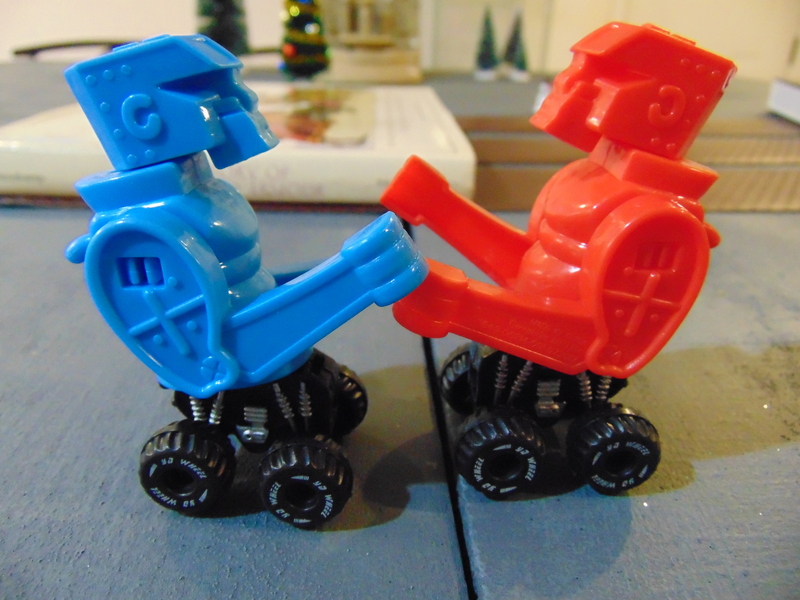
For a grand total of $3.oo, I purchased these cool rock’em, sock’em robot finger puppets and some cars I could cannibalize. Some nippy cutters and superglue later, here is the result:

Instant toy-themed robot menace!

I did a quick search for a Heroclix version of Toyman. Sadly, it seems Wizkids don’t have the rights to the DC animated universe (Knight Models does, I think…) so I couldn’t get a version of the doll-head wearing Toyman that I like. I had to settle for this guy:

Not a bad start, and it naturally got me thinking about Christmas, which would be an ideal time of year for Toyman to start some trouble. With that in mind, I did a quick repaint and scoured my miniatures for other things that could be used as deadly toys.

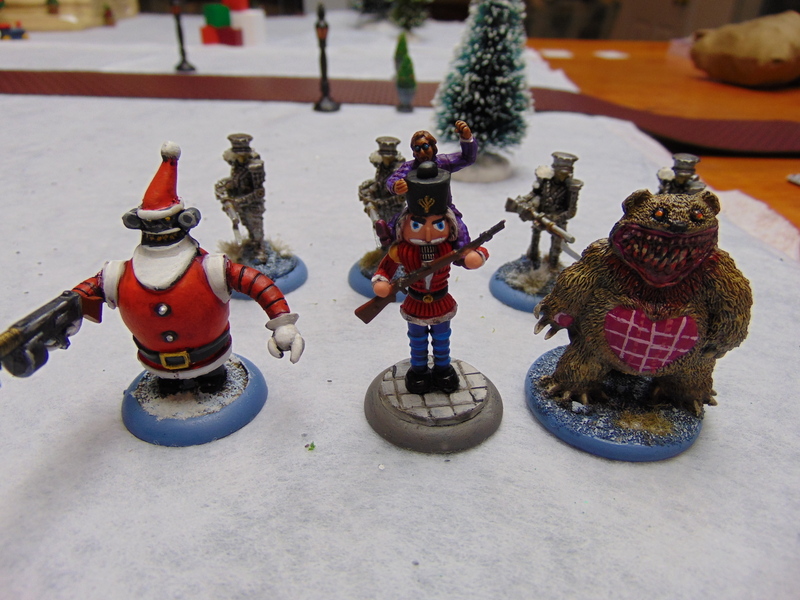
My repaint is in the center. I purchased some (sadly OOP) Parroom Station clockwork soldiers (in the back) from Matt Beauchamp of Hydra Miniatures, and I took advantage of Armorcast’s 20% off Christmas sale to pick up the Santa bot. I already owned Wyrd’s Teddy from the Malifaux line.  I just needed to paint him, and I did.

Turns out these Hydra War Rocket Galacteer fighters are just the right scale to double as deadly toy planes. So I planned on using them, too.

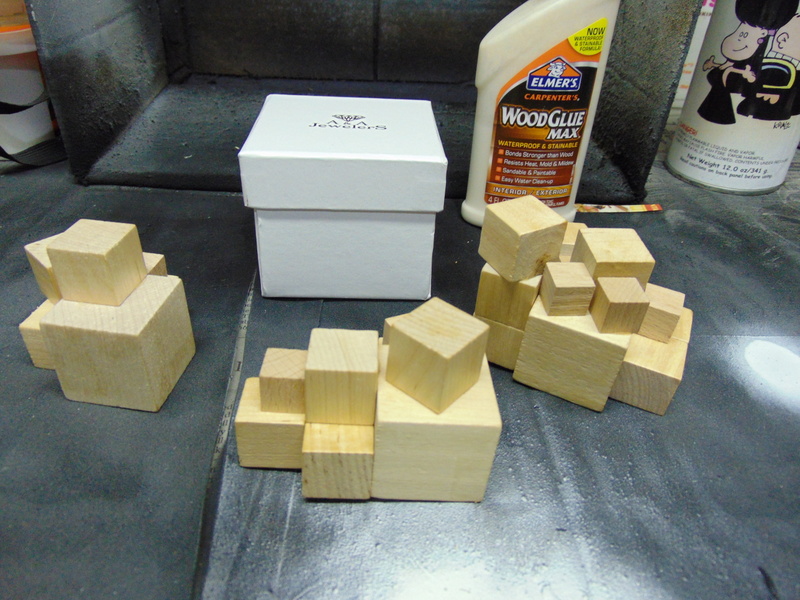
If Christmas was to be the backdrop for the scenario, I would need some thematic scenery, like piles of presents! I thought a ring box would make a good giant present (from which something deadly could emerge). I bought some wood cubes from an art store and glued them together in random formations. A little red, white and green craft paint and I’d be good to go.

I figure once I’m done with this scenario, I can repaint the blocks to use as crates and boxes for warehouse scatter terrain.

Stay tuned! Scenario to follow next post!

Gotham Girls


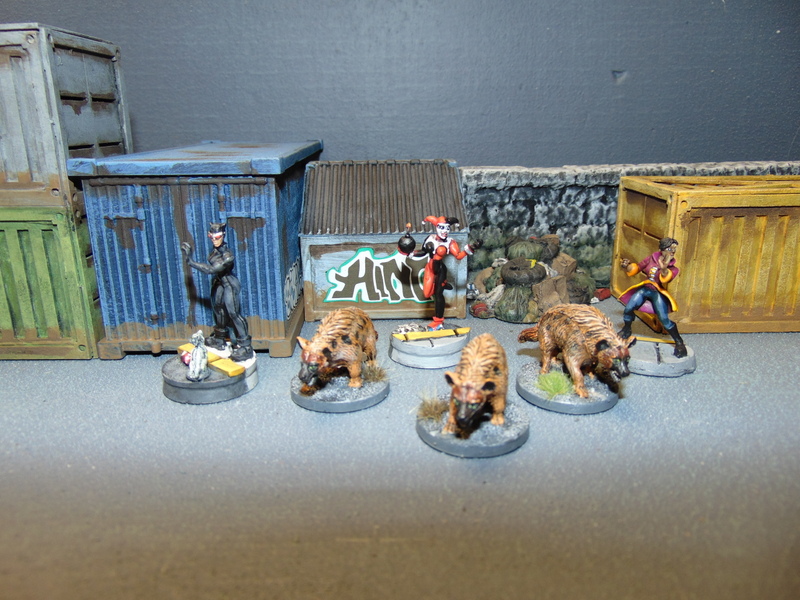
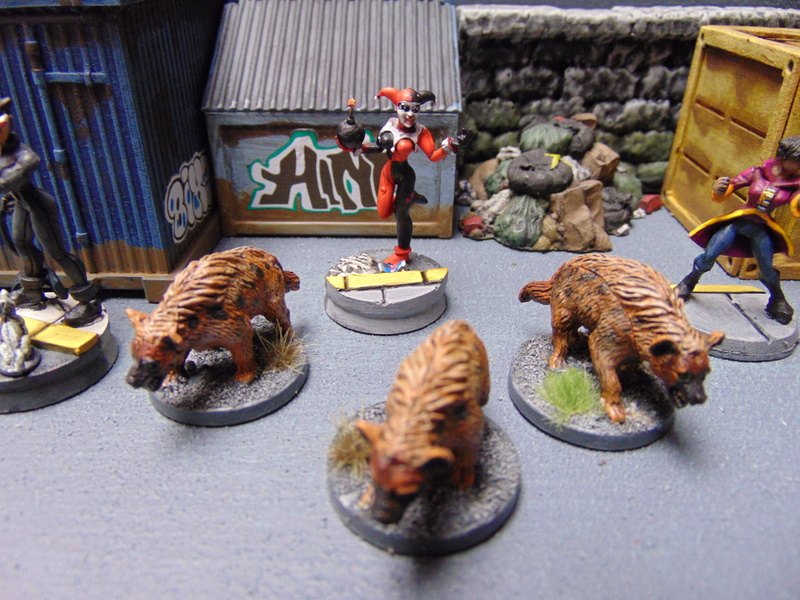
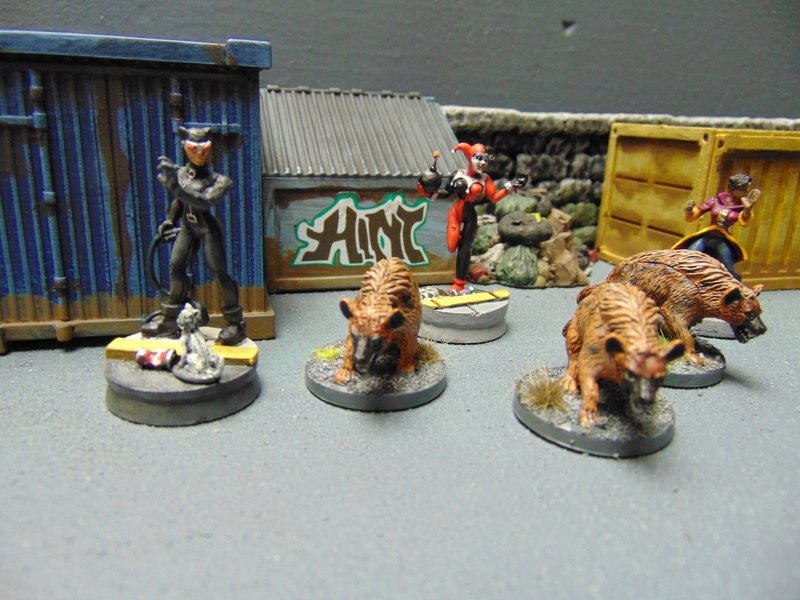
It’s funny how sometimes projects get completed without any clear plan whatsoever. From the crime-filled alleys of Gotham City: three of Batman’s most notorious femme fatales: Catwoman, Harley Quinn, and Lady Shiva!

These miniatures were in the freezer bin wherein all the Heroclix models I intend to repaint and rebase currently reside. A couple of months back I was painting up some Hasslefree martial artists, and I thought a Heroclix Lady Shiva might make a good addition to the theme. I fetched her from the freezer and rebased her, intending on repainting her whenever I got the chance. No rush, you understand. Just a miniature to add to when I had some extra paint I needed to use.

Then I picked up some miniatures in a Craigslist lot that included these AD&D hyenas. I immediately thought of Harley Quinn, and into the freezer I went yet again. A quick rebasing and she joined Lady Shiva in the side pile.

Then, while playing Arkham Knight on the PS4, I thought about the Heroclix Catwoman figure who was cooling her heels in the freezer. I took her out and rebased her with this Reaper cat familiar, and off to the side pile she went.

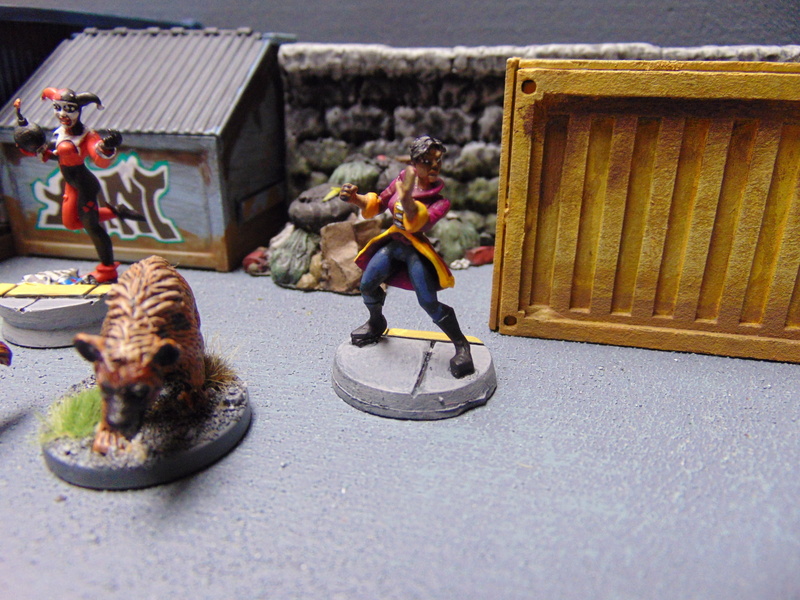
As fate would have it, these miniatures got painted at pretty much the same pace: a dab here and there while I did other things. Then one afternoon I took them out of the side pile and finished all of them off. I added some highlights and shading to the pre-painted hyenas and the Gotham Girls were done! I’m not wild about how Lady Shiva’s raccoon eyes look, but she’s ok for tabletop gaming. Maybe I’ll touch her up a bit. I’m also thinking of adding some gloss varnish to Catwoman’s costume and whip, but I’m not sure yet.

Incidentally, if you’re wondering about the conspicuous absence of a certain red-headed botanist-turned-arch criminal, all I can say is stay tuned. She’ll be here soon!


Tick, Tock…Time to Feed the Croc!

I find the Knight Models 32mm Batman miniatures to be terrific sculpts, but they’re generally too pricey for me to justify their purchase, except in rare cases.  I caved and bought the Frank Miller Batman, for example, because I just had to have it. Same thing with Killer Croc, here.

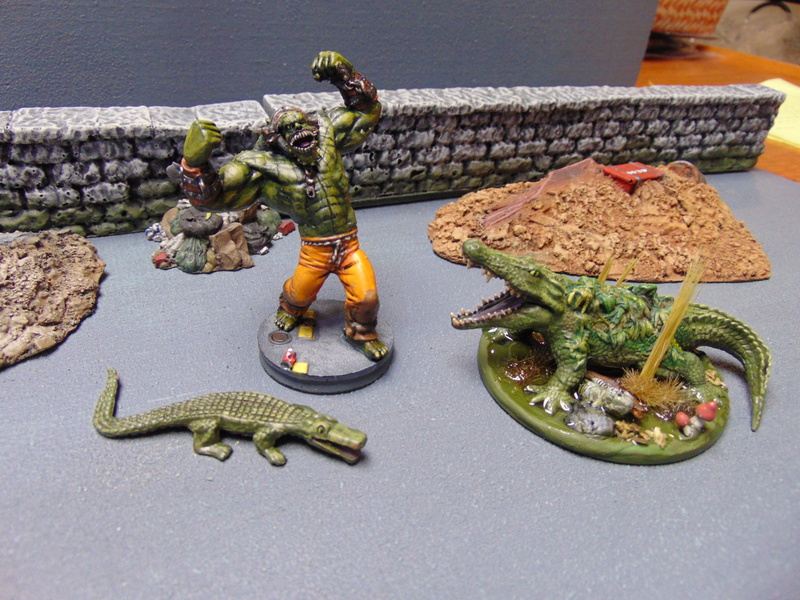
This version of Croc is based on the Batman: Arkham series of video games by Rocksteady. In total, there are four games. Arkham Asylum, Arkham City, Arkham Origins (a prequel), and Arkham Knight, which closes out the series. Croc appears in every game as a boss except for Arkham City, where he is mentioned, but doesn’t actually appear. (Technically, he doesn’t appear in Arkham Knight unless you purchase the DLC Season of Infamy, which is so good and so worth it I don’t know why you wouldn’t.) In the comics, Croc started out as a big ex-wrestler with a skin condition. He has since devolved through a half-man/half-reptile all the way to a full blown human/dinosaur hybrid complete with a tail!

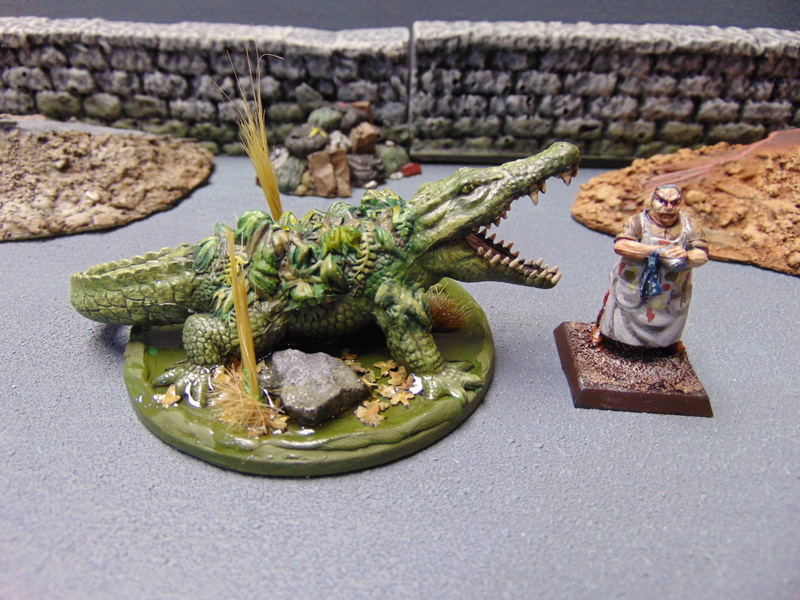
This version most accurately reflects Croc’s appearance in Arkham Asylum (no tail yet), the first game in the series. Much like the game, I love the miniature, too. I posed him with a couple of reptilian friends. The one on the left is a child’s toy I got at a flea market somewhere. I’m pretty sure I got two, but I can only find one.  The other one is a large Dungeons and Dragons Dire Crocodile. I bought it for use as a Pulp monster, but when I decided to paint Killer Croc I thought it was a good excuse to paint the Dire Crocodile as well.

The Dire Crocodile is quite large. Here he is next to a 28mm Reaper Inkeeper. I built a lip of green stuff around his base and applied scenic water with an eyedropper (sayonara, eyedropper). Three days later, the water still hasn’t cured and it sticks to everything it touches. Hugely annoying. Looks ok, though. It will look better when I can add some flock/leaves to the rim of the base, whenever the “water” dries.

Speaking of huge, even scaled at the 32mm range, this Killer Croc is gigantic. Here he is posed with a Heroclix version of himself. (I’m a big fan of Heroclix for many reasons, but I think everyone seeing this picture can understand why I splurged on the Knight  version of Croc.)

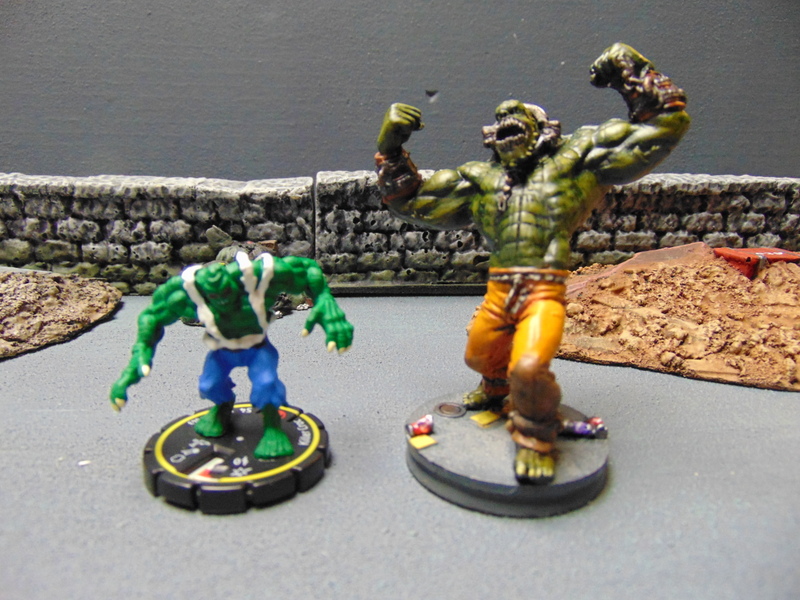
And here he is with a Reaper Ogre, a Heroclix Hulk, and a Heroclix Question. (Incidentally, here are my repaints of Hulk and The Question.) The Question model should give a good indication of how a “normal” 28mm model looks next to Croc.

This is somewhat problematic. Croc is big, but he’s nowhere near the size and mass of the Hulk. From a scale perspective, I find this irksome. Doubtful I would ever use them in the same scenario, but still…

I tried to repaint a Heroclix Solomon Grundy recently, but standing him next to Croc was laughable. In the comics, they’re about the same size; so too in the Knight Models range. But mixing and matching Knight Models with Heroclix may work fine with normal sized figures, but not so well with big guys like this.

Which means I’m probably going to have to buy the Knight Models version of Grundy. And while I’m at it, their version of the Hulk. But at $35 apiece, that’s a lot of cheddar for only two miniatures.

Luckily, ’tis the season. Black Friday is in two days….who knows?

We Are the Champions

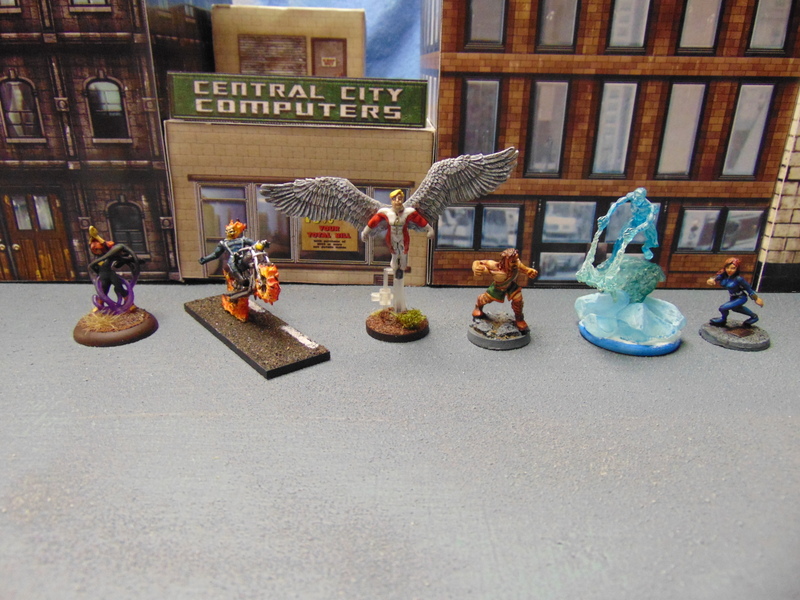
Here’s my latest team for Super Mission Force: The Champions of Los Angeles! L-R: Darkstar, Ghost Rider, Angel, Hercules, Iceman, and Black Widow!

The original Champions debuted in the mid-70’s, and to call them a lackluster team would be an understatement. Despite some interesting roster choices, the Champions never really gelled as a title or as a team. Nonetheless, I figured I’d give them a little repainting love. (Actually, that kind of happened by accident. I had painted up Black Widow and Darkstar for unrelated projects and realized I had one-third of the team. I decided to paint the others up when I could.)

Angel isn’t completely faithful to the Champions version, which is a good thing. Angel’s costume back then was one of the most hideous costumes ever to grace a superhero (look it up). This one is much better, and I am a big fan of this particular sculpt of Angel. Keen-eyed visitors to Dead Dick’s Tavern may recognize some superhero overlap: Darkstar was painted some time ago along with the rest of the Soviet Super Soldiers for my Breeder Bombs campaign, while Iceman was also done a while back. Last post he made an appearance as one-third of Spider-Man and His Amazing Friends.

Both Iceman and Ghost Rider contained that translucent plastic I loathe so much on Heroclix models. With Iceman, it’s his whole body and the ice slide he rode in on. It wasn’t much of a big deal to just dry-brush him with white and build a base out of frosted sea-glass, the same technique I used on the Penguin and Mr. Freeze. The base took longer than the model itself. (As a side note, I’m particularly happy with the way Hercules looks. His original clix paint job was underwhelming, to say the least.)

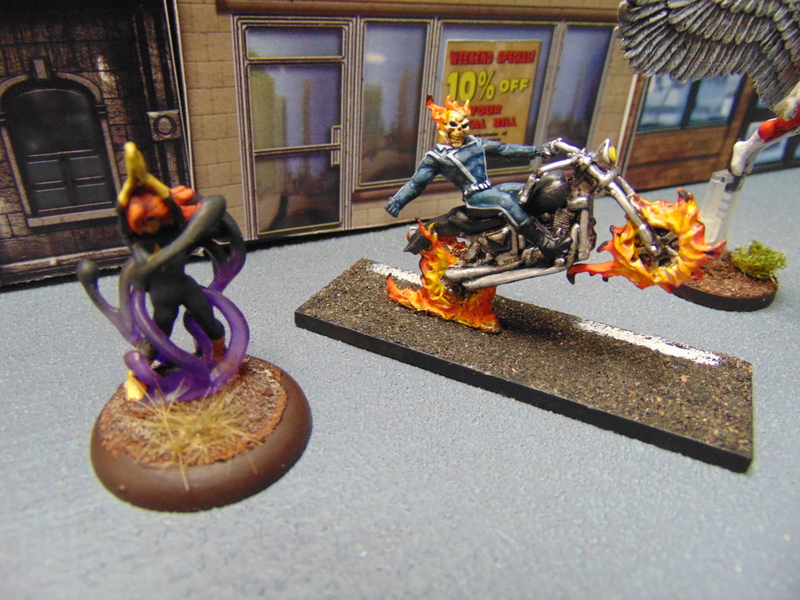
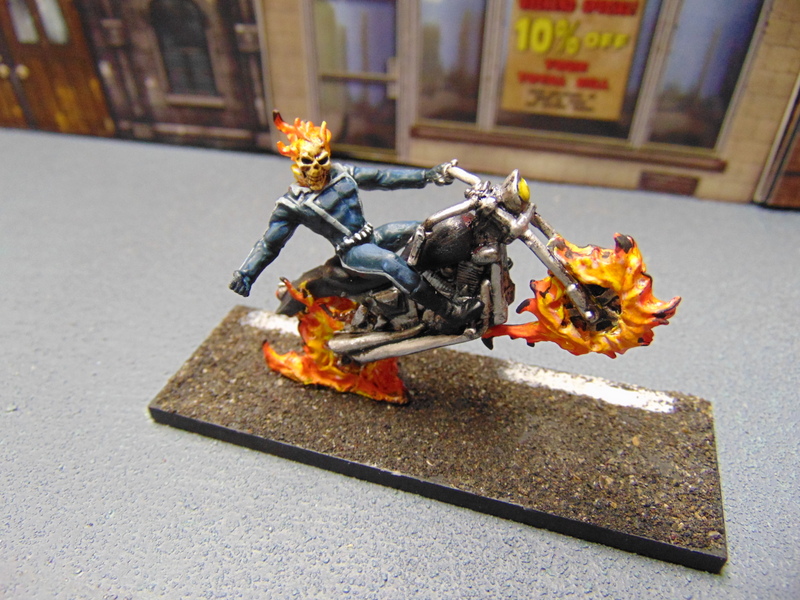
Ghost Rider had that translucent yellow plastic everywhere on the model where there is flame. I painted proper flames on his head and bike and this is the result. Originally, I thought this model was a tad too small to be in scale with the rest, but it’s not so bad after all. (The whole time I was painting him I was humming the Rollins Band’s version of “Ghost Rider Motorcycle Hero”.) I contemplated adding a chain, but then remembered this is the original Johnny Blaze Ghost Rider, so no chain needed…which turned out to be good, since I was considering buying some spiked chains from Reaper, only to find a pack of them costs 10 bucks! A bit steep for bits I will probably only use once. I also thought about making the flame trail go all the way to the end of the base by sculpting extra flames out of green stuff, but I lack the confidence and skill to do so. Oh well.

I’m much more likely to use the individual models in games rather than basing a scenario around this particular team, but you never know what could happen!