Author Archives: The Angry Piper

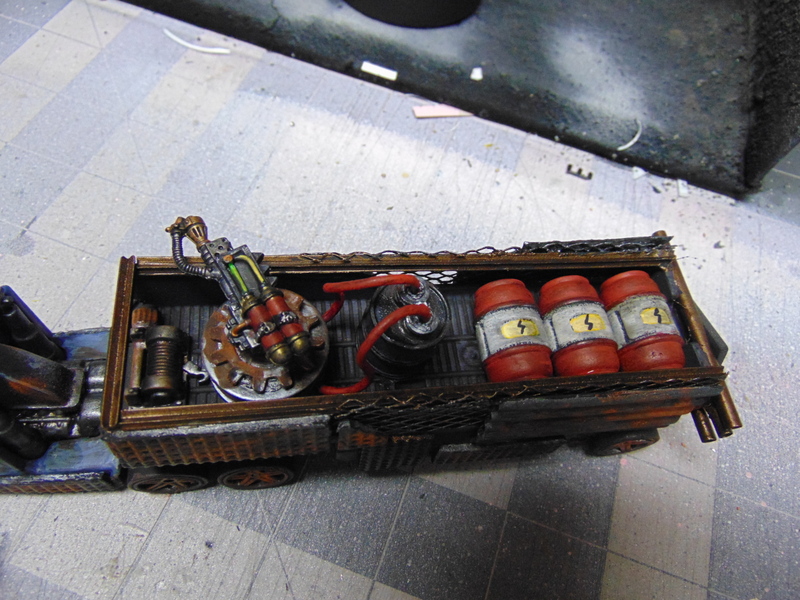
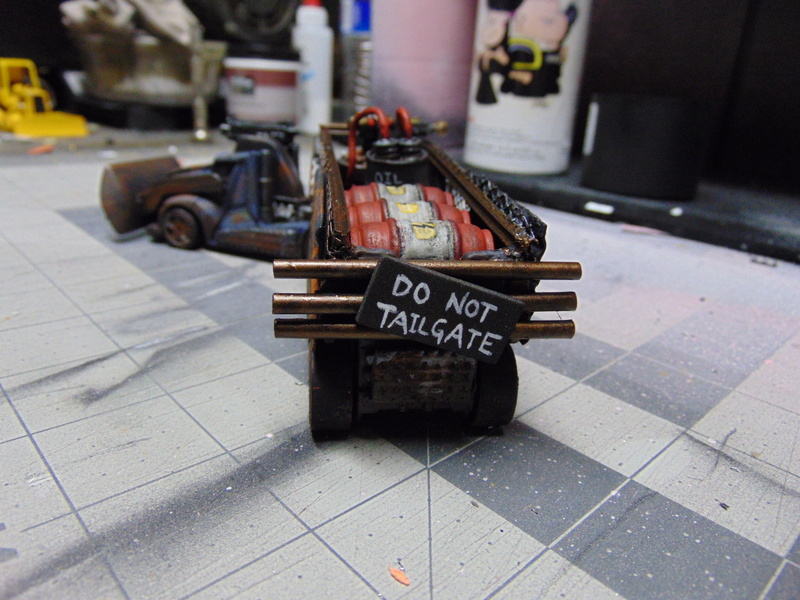
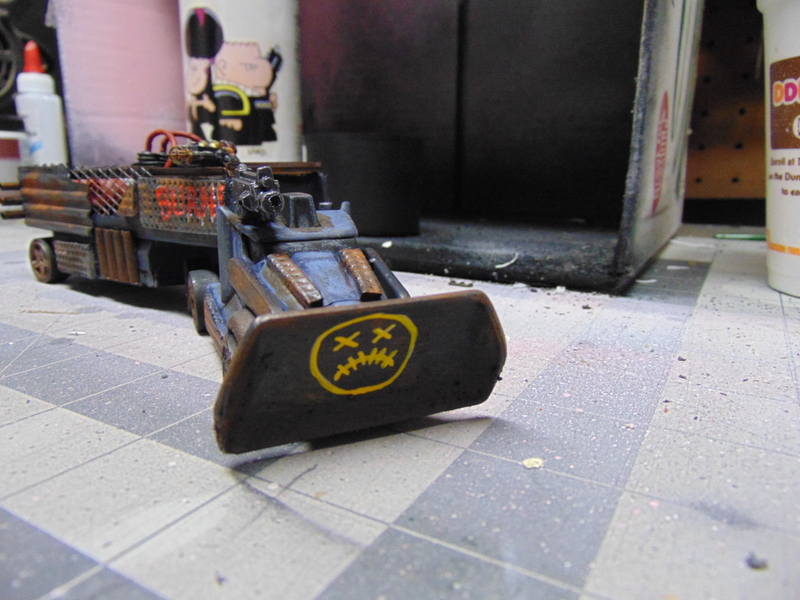
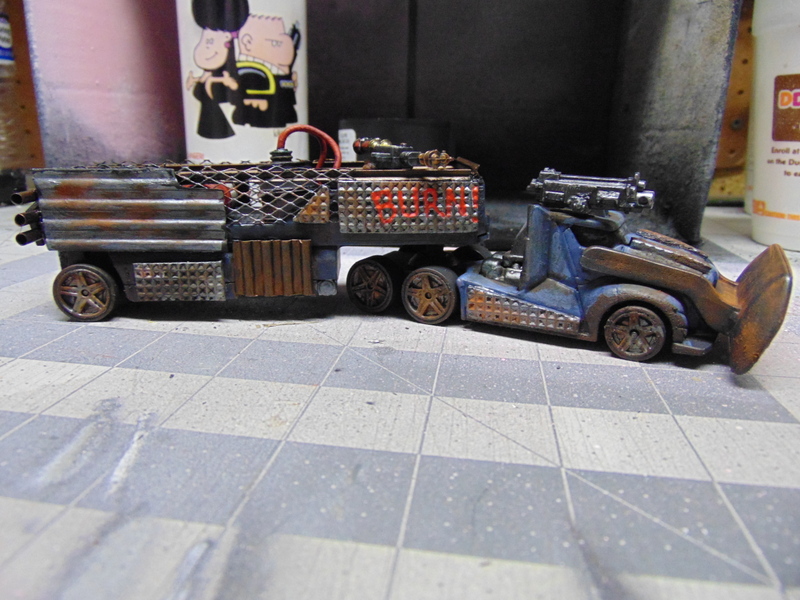
First Gaslands Build: Coughin’ Joe!

I discovered Gaslands by reading Miniature Wargames magazine a couple of months back. It’s a game of post-apocalyptic vehicular combat put out by Osprey.  It’s designed to be played with standard Matchbox/Hot Wheels cars that you convert into Mad Max-esque death machines, and it looks like a lot of fun.

While my experience with Osprey Games has been hit-or-miss so far, I figured why not give it a shot? After all, the entry cost to a game like this is minimal; you only need the rules and a bunch of toy cars to play. The rules are reasonably priced at under $20, and toy cars are easy enough to come by. They’re pretty cheap even brand new, and better still; there are tons of thrift shops, flea markets and secondhand stores where you can pick up used and banged up toy cars for even less! (If you have kids, you can probably find a bunch laying around your house on inconvenient places, like stairs.) You’re going to convert them anyway, and cosmetic damage is the look you’re going for!

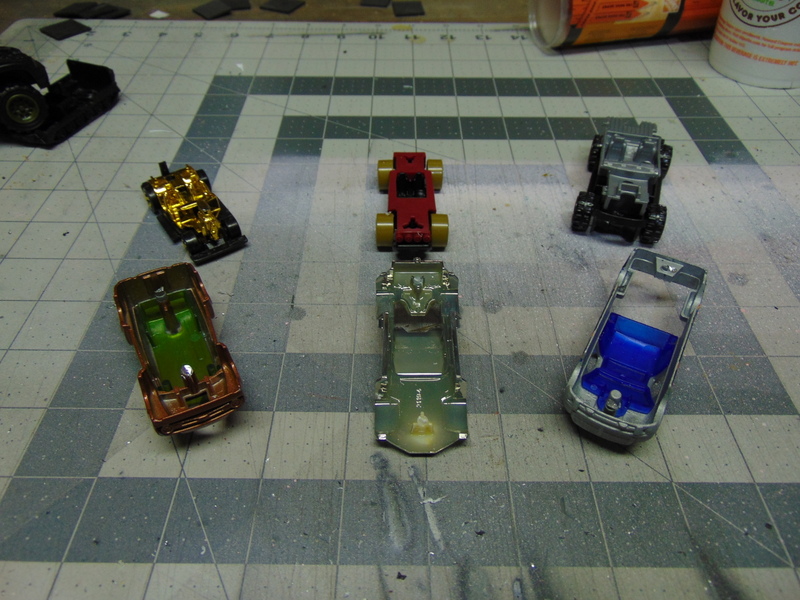
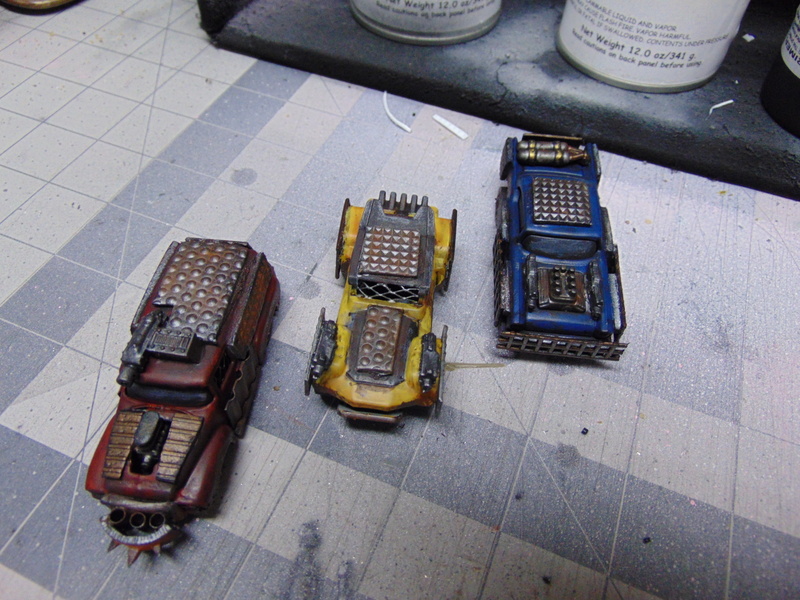
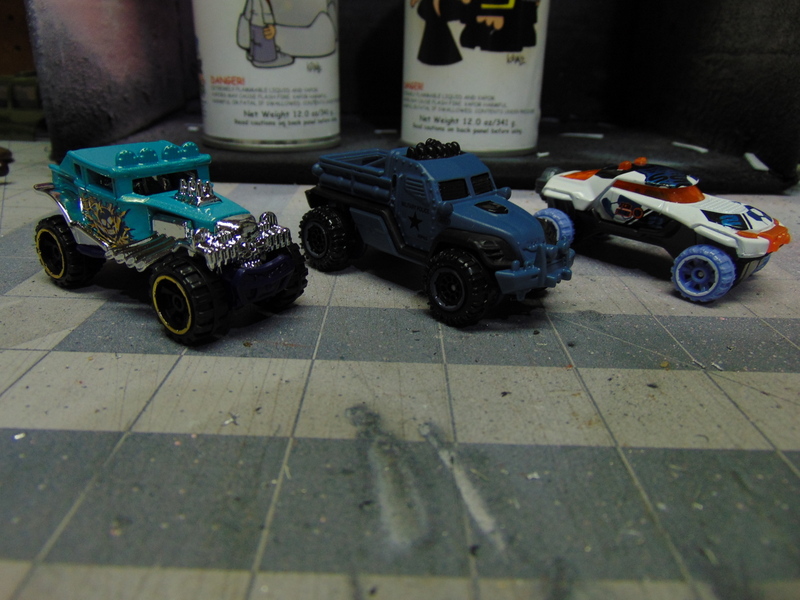
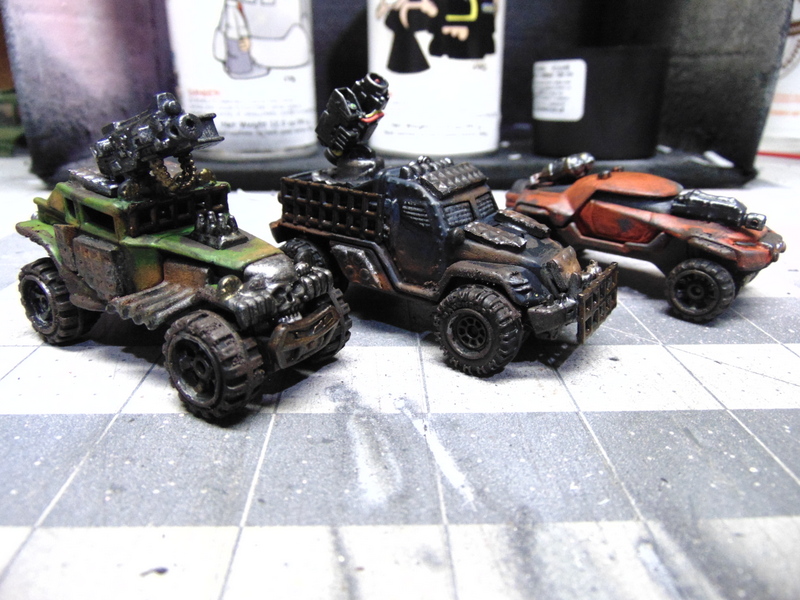
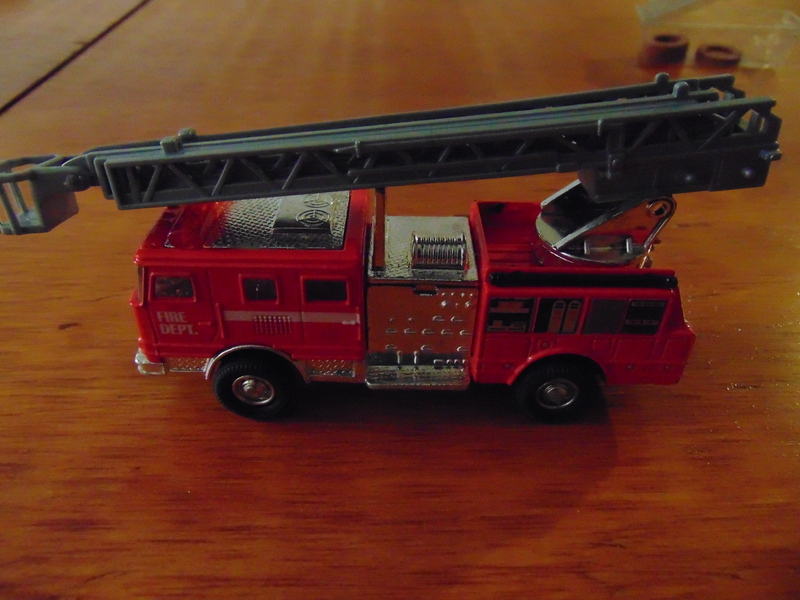
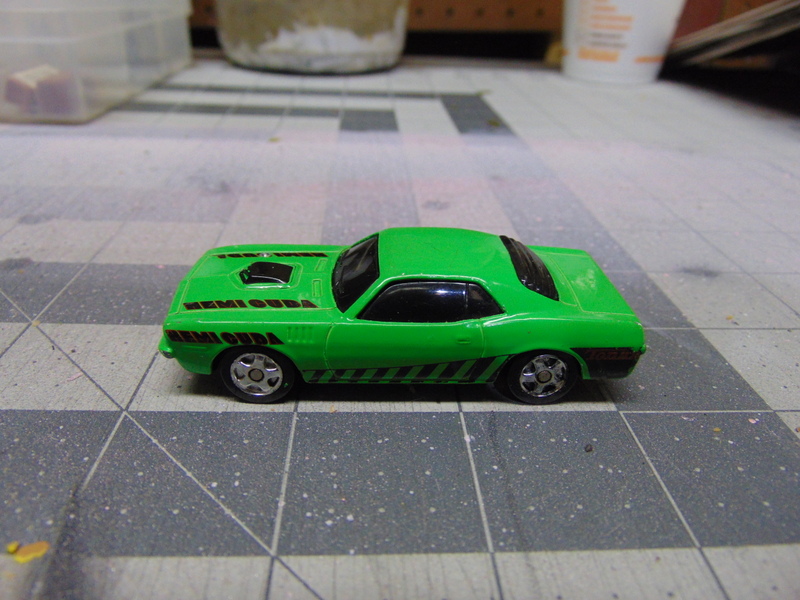
I went by a thrift shop and bought a bag of 6 cars for $3.00. It contained this car, a “Plymouth Hemi Cuda” by Maisto.  I actually know a guy who owns a 1969 Plymouth Barracuda. He drove it all through high school and still has it to this day, some 30 years later. It gets about 3 miles to the gallon, but it’s absolutely the coolest car I’ve ever been in, and it hauls balls, to put it mildly.

I decided this is going to be my first Gaslands conversion.

Images abound on the Interweb of Gaslands vehicles; simply Google “Gaslands” and you’ll see for yourself. There are also many Youtube videos to view on the subject. One particular creator, JH Miniatures, does a terrific series entitled Wastelands Workshop. It’s a bit technical, but you don’t need to get as fancy as he does. I highly recommend his videos.
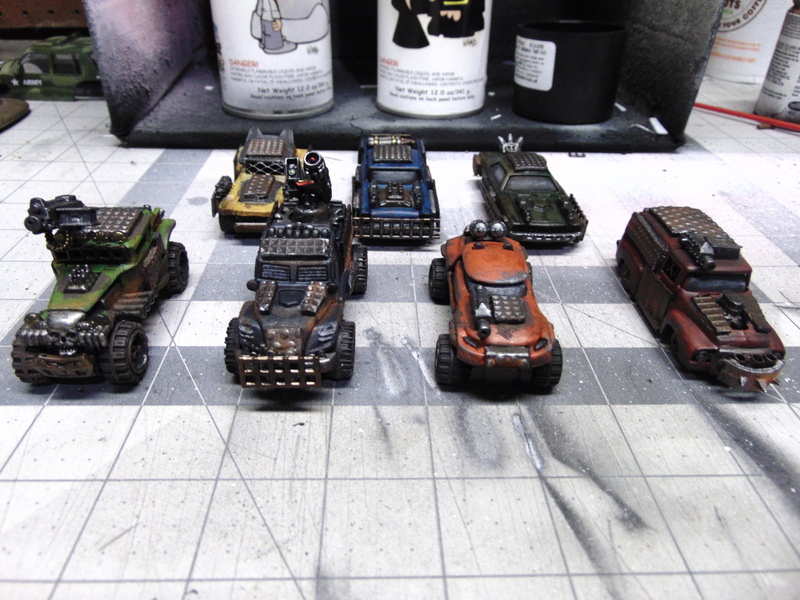
If you’re like me, i.e. an obsessive hoarder of bits from previous kits, then rejoice, for Gaslands is the game for you. I played a lot of Warhammer 40K back in the day, using Space Marines (of course) and Imperial Guard. In other words, I have a lot of old vehicle bits that have been sitting in boxes for a very long time. But you don’t need to have a ton of fancy bits like me, or be as technically savvy as JH Miniatures to get to work on Gaslands conversions. DM Jim over at Game Terrain Engineering does a bunch of Gaslands videos, and this one in particular shows how to use common junk items as weapons and armor. Good stuff!

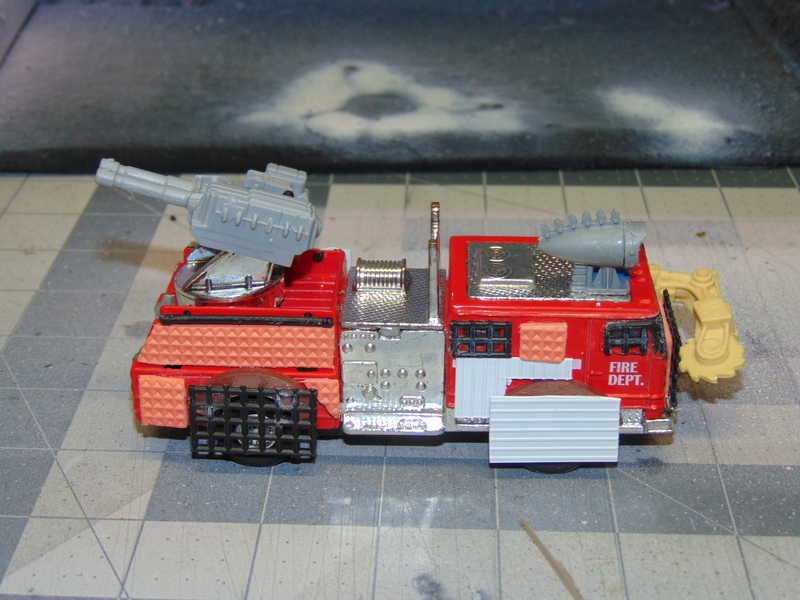
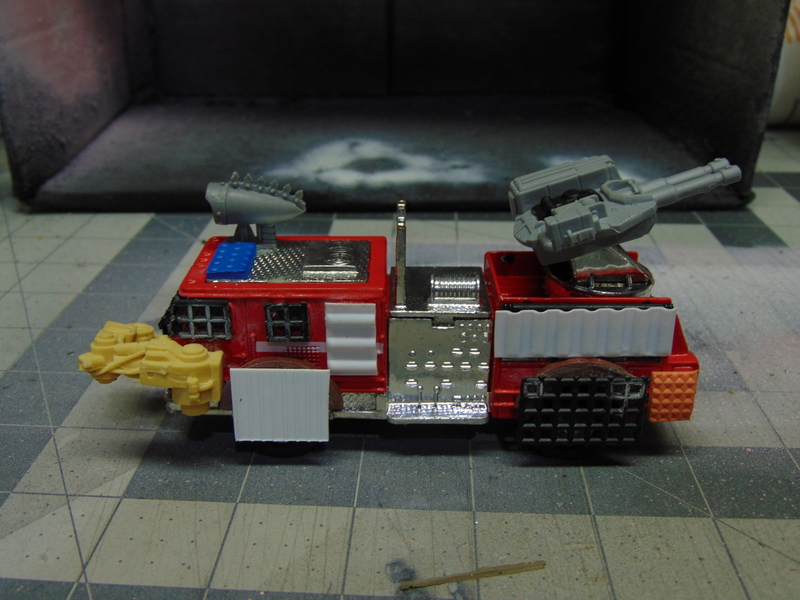
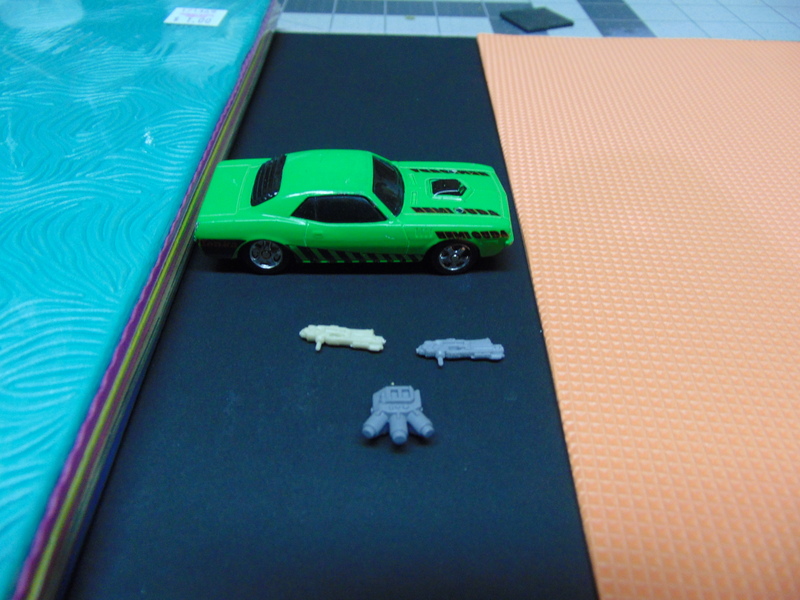
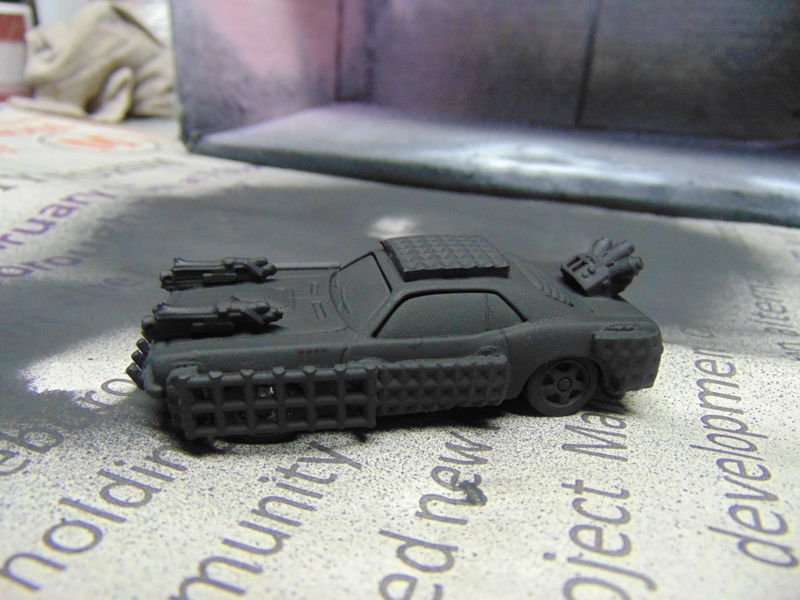
But back to me…I decided not to go too crazy with my first car. I’ve opted to use some bolters from some old Rhino kits and smoke launchers from a Leman Russ tank as conversion bits. The bolters are machine guns, and the smoke launchers could represent turbo boosters, caltrop or glue droppers, oil dispensers, or…well, smoke launchers, which is what I’m going to use them for. Coughin’ Joe, get it?

For armor, I used some old material I had laying around: these textured craft foam sheets. Each package cost me a dollar, and you get six different texture patterns. Four of these have patterns that are useless (like the one pictured), but there are two that could work.

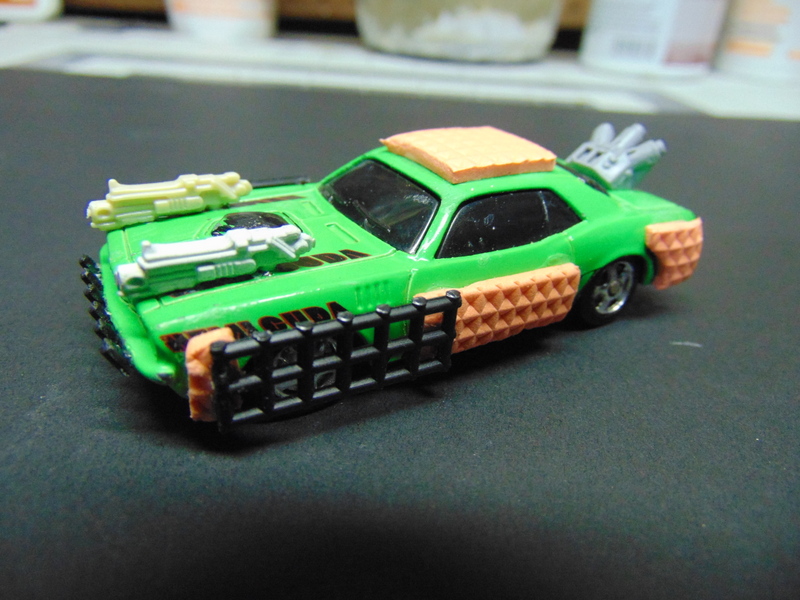
The orange stuff is the craft foam. It’s easy as pie to cut and glue, and the grid pattern makes it look industrial enough to serve as armor. I also clipped some plastic mesh from a needlepoint sheet (I think that cost a dollar, too), and glued it around the front wheel wells to offer the tires some protection.

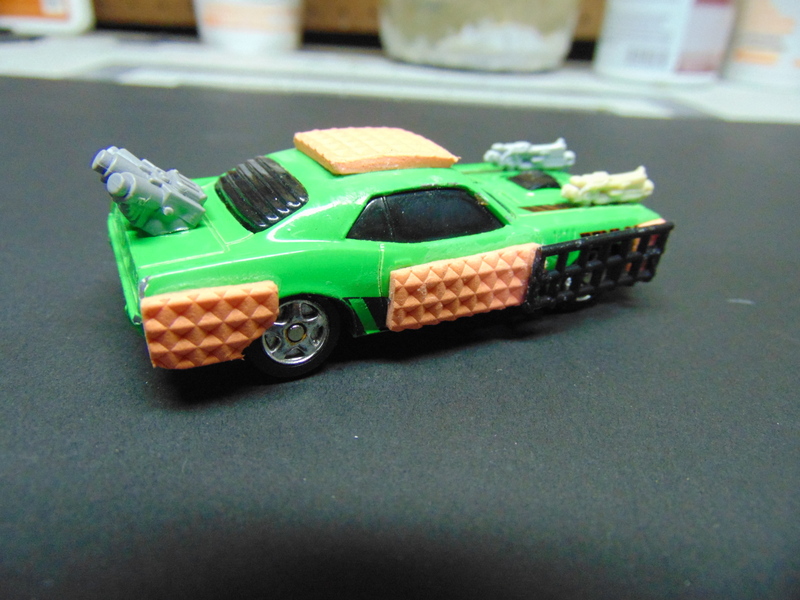
The smoke launchers glued easily to the back of the car. The bolters have little mounting pegs on them, so I decided to drill tiny holes to accommodate the pegs. This was surprisingly difficult, even with my Dremel on max rpm. Turns out I needed a cobalt drill bit to get through the car. One quick trip to Home Depot sorted that out, and voila! Front mounted machine guns!

Once assembled (it took less than 20 minutes, not counting my trip to Home Depot), I primed it black.

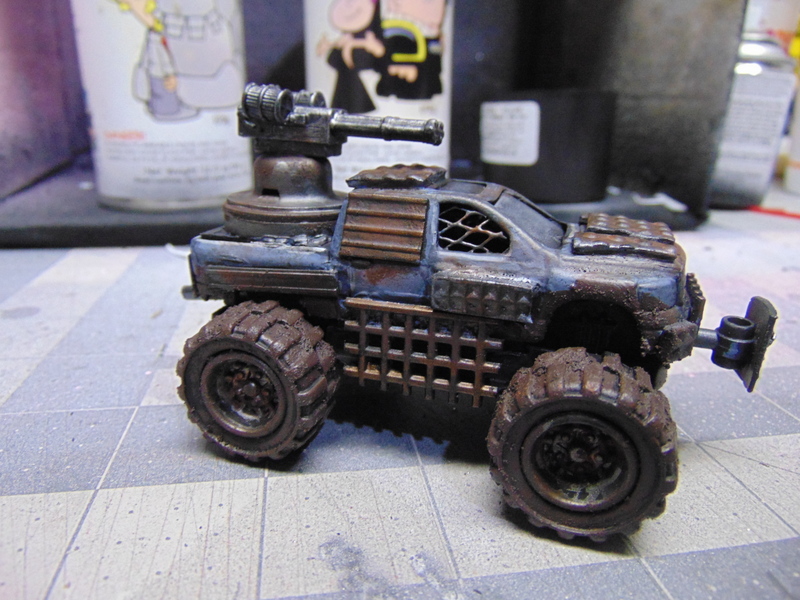
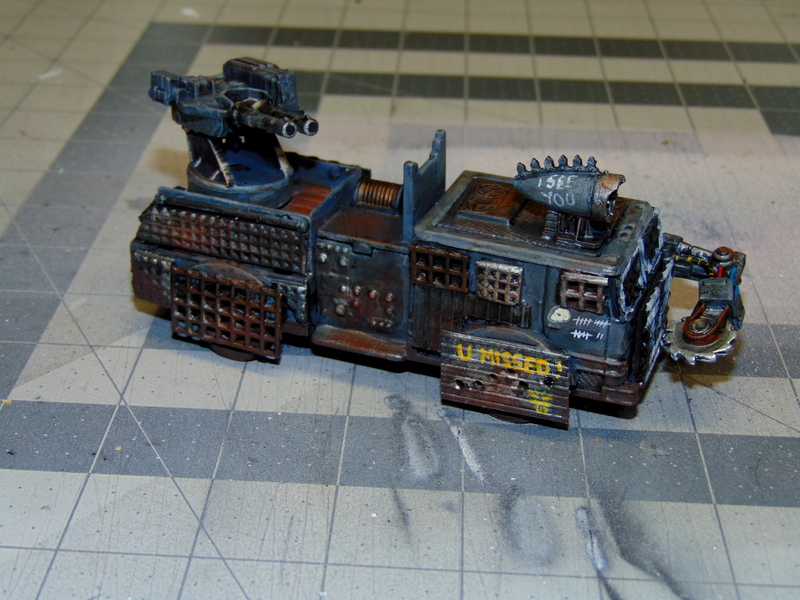
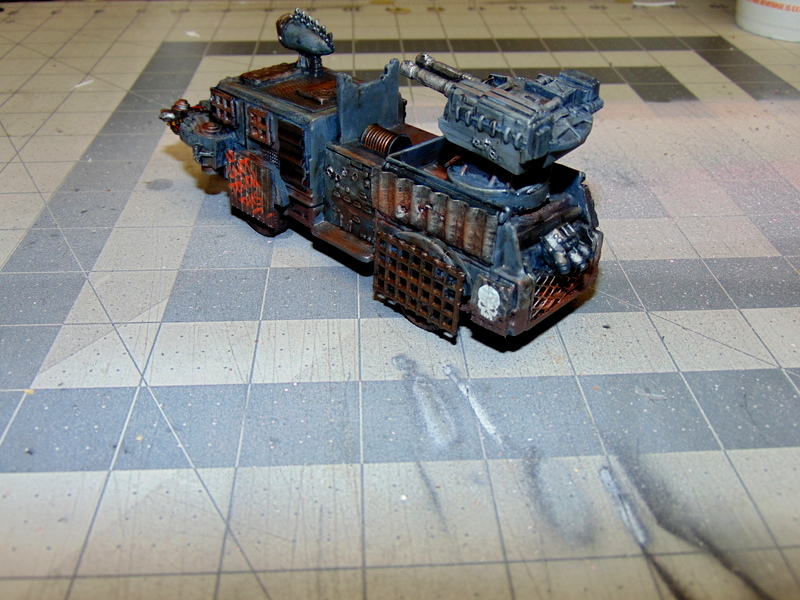
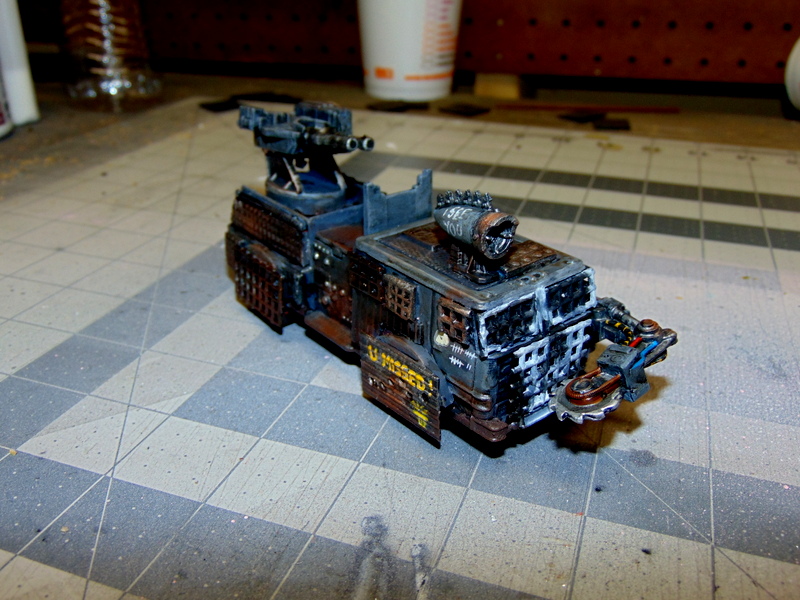
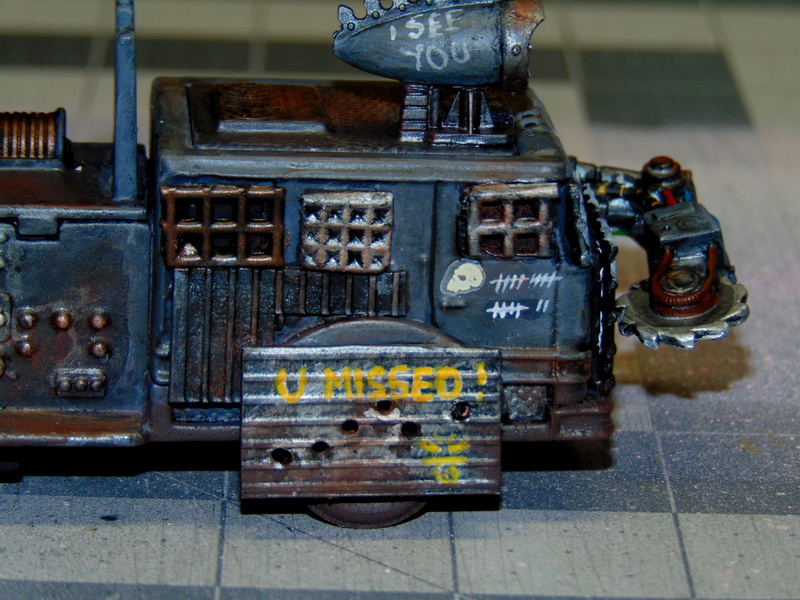
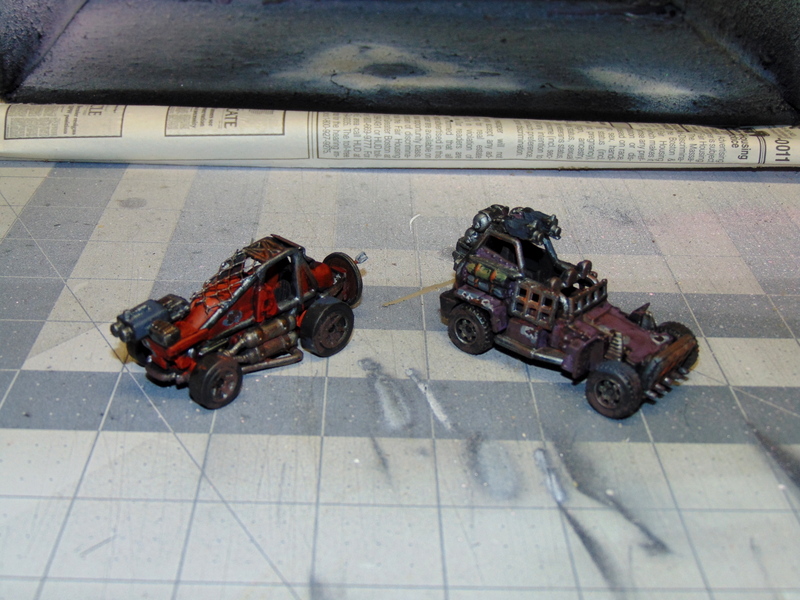
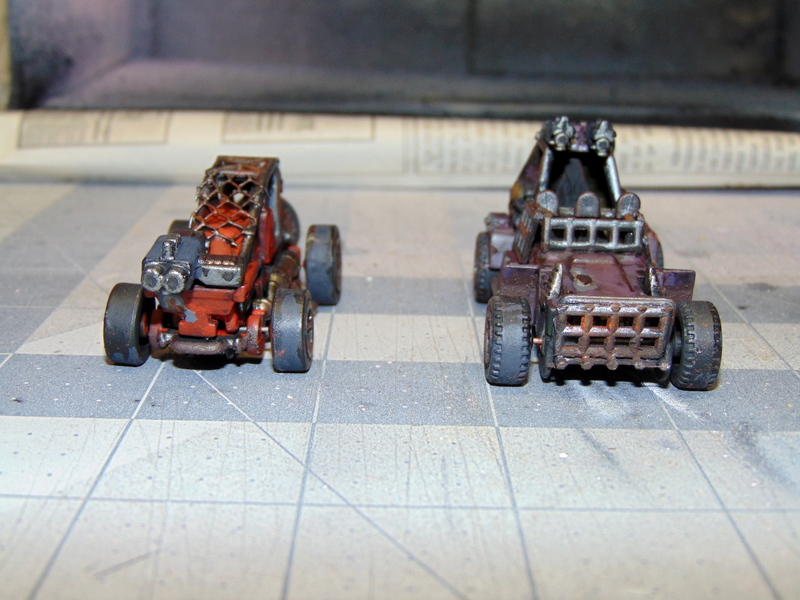
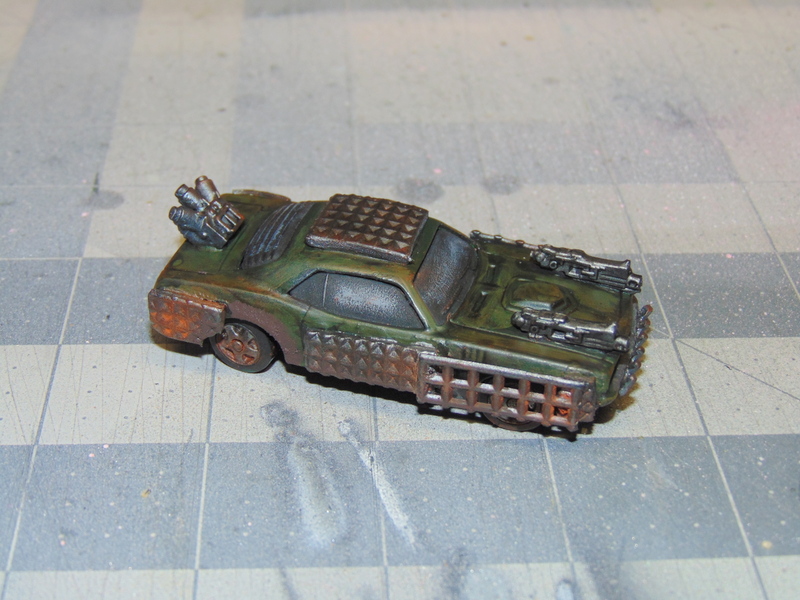
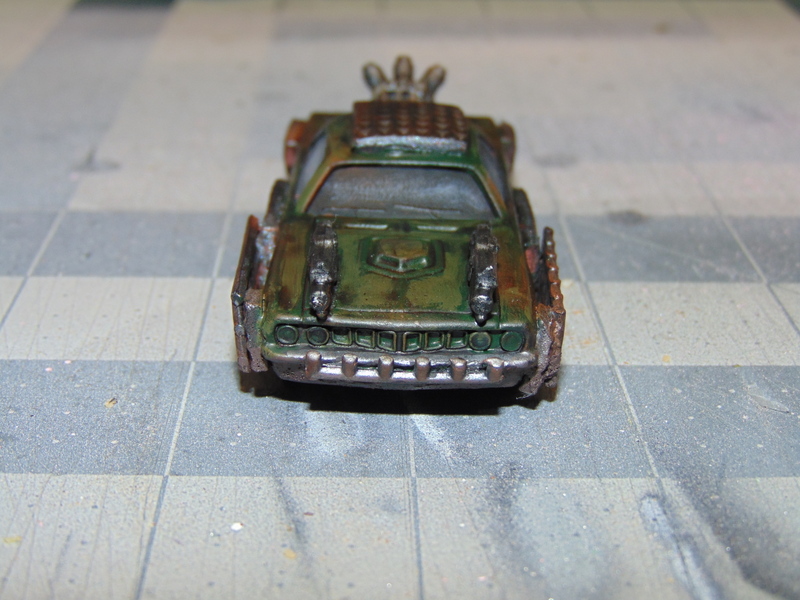
I used a mixture of Vallejo, Cote D’Arms and GW paints. I based the car in Military Green (V) and highlighted it with Cayman Green (V) before giving it a thorough wash in Nuln Oil (GW). I painted the armor plating Gunmetal Grey (V) and the guns and wheel rims with Gun Metal (CD) and washed all the metallics with Armour Wash (CD). Then I liberally applied some MIG rust pigments to the armor sections and the rims. I used some Stirland Mud (GW) on the wheel wells and the front and rear bumpers. A light drybrush of Dawnstone (GW) on the windows, and that was that.And here he is, in all his grimy glory…Coughin’ Joe!

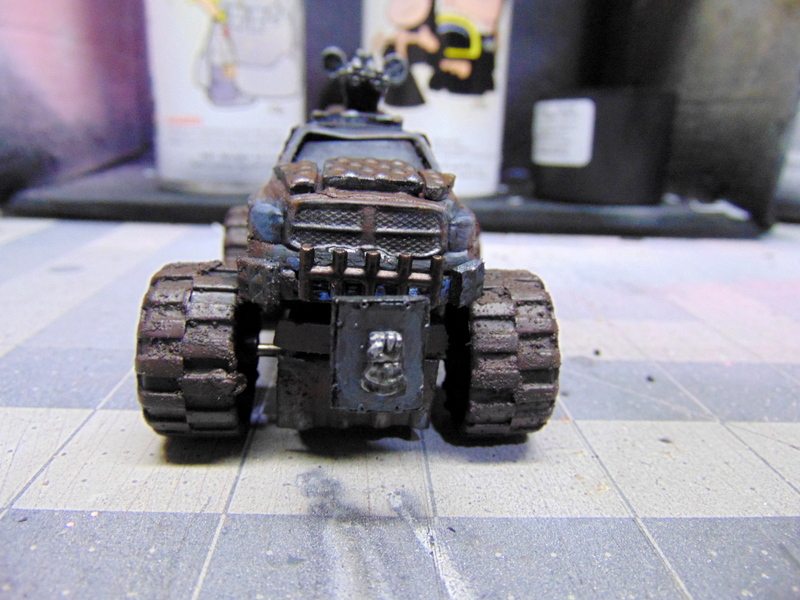
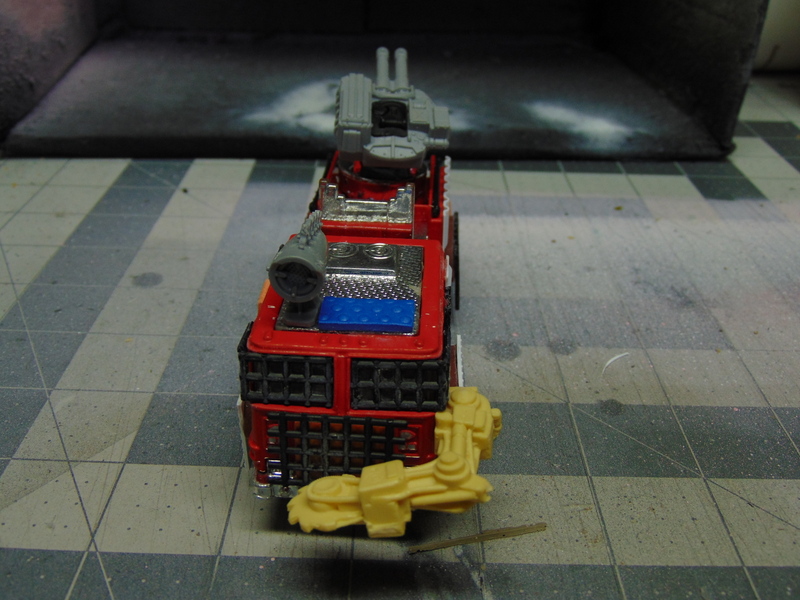
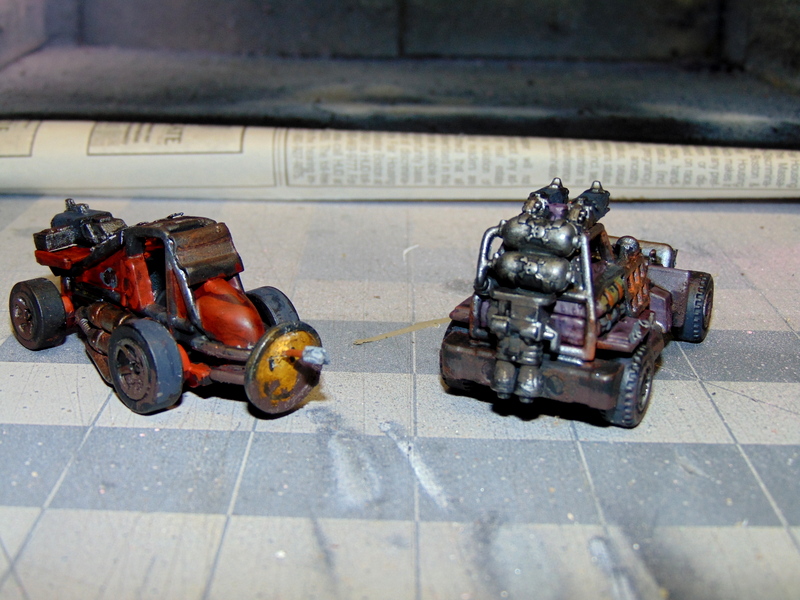
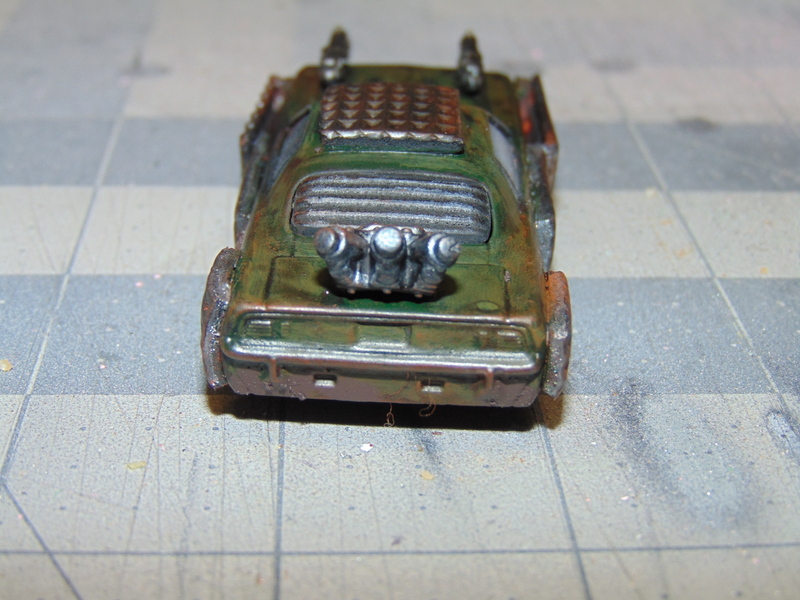
Rear view. Most people never see this on account of the thick black smoke pouring out of those launchers…

If you see this in your rear-view mirror, you’re about to get shot. A lot.

I read somewhere that it’s easy to get addicted to converting cars for Gaslands, and I am already hooked. I have a bunch of toy cars and bits scattered around my hobby space as we speak. More Gaslands conversions soon!


Making a Fighting Arena Board

A couple of weeks ago my region was hammered with about 17 inches of snow, and I got to stay home from work. With blizzard conditions raging outside all day and well into the night, I wasn’t going anywhere, even if I could have. I figured it was a great day to get some painting done! Or it would have been, if I hadn’t lost power at 6:30 am, ten minutes after I woke up.

In such instances, my standby generator powers most of my palatial estate, with the notable exception of my basement, which contains my hobby space. When assigning which circuits would be backed up, I obviously prioritized important things like heat and water over painting space. (It’s nice to be able to flush a toilet when you need to.) Consequently, most of the basement didn’t make the list.  However; since my furnace is located in my tool room, that part of my basement has power. I couldn’t paint without moving everything, so I decided instead to start work on a project I’d been considering for a while: an arena board.

I’ve been toying with an idea for a martial arts skirmish game, something along the lines of the Street Fighter and Tekken video games. I purchased Osprey’s A Fistful of Kung Fu when it came out, but I was put off by the many charts and tables, and also by the fact that it’s a faction-specific game. (The figures by Northstar are admittedly impressive, but I don’t want to have to buy them.)

The “arena” board I have in mind is a 2′ x 2′ board with a fighting circle inscribed in the center. As it will be made of flagstones, the board can double as a dungeon floor, a ruined courtyard, or anything else that would have a stone floor for use in other games. Picture a sumo ring, or the courtyard in Crouching Tiger, Hidden Dragon, and you get the idea.

Designing the Arena

My starting materials are a 2′ x 2′ board made from 10mm thick MDF, some craft foam sheets, some PVA glue, a T-square and a razor knife. I bought a 2′ x 4′ MDF board from Home Depot for about 5 bucks. I had them cut it in half for me there, since their cutting station can make a much straighter cut than yours truly with a jigsaw (I hate jigsaws). I drew a roughly 18″ diameter circle in the center of the board, and then drew a perimeter 10 cm in from the edge all around the square.

As a side note, my brother once told me, while making my gaming table, that there is no such thing as a piece of wood from Home Depot that is truly “square”. The picture above proves this. I didn’t want to fuss with making it perfectly square (I lacked the tools to do so, anyway), so I just went with it. Also, as another side note, there is absolutely no whisky in that coffee cup. Honest.

Assembling the Board

After cutting the craft foam into 1 inch squares, I moved the project upstairs to my living room. While the blizzard raged on, I turned on my TV ( I love having power) and settled down for what I knew would be the most tedious part of building the arena board: gluing the “flagstones” down. I decided to watch a movie while I worked, and I picked Kong: Skull Island. I guessed it wasn’t the type of movie I needed to pay close attention to in order to capture all the director’s subtle nuances, and I was correct. Still, I enjoyed the movie. It’s King Kong, with no real pretensions to anything else, and it’s got a great cast. What’s not to like?

I measured the center point of the circle (and the board) as best I could and started laying down the squares.

I used this piece of wood as a spacer, to ensure the squares were more or less evenly spaced. Due to my own imprecision cutting the foam squares, they weren’t exact; but I thought uneven stones would give the board a rustic, imperfect character for the end result.

I worked from the center of the circle to the inside circumference, then I began trimming the stones so they would not overlap the inscribed circle.

Then, working from the perimeter, I started laying down squares to meet up with the outside circumference. I was careful to make sure that the spaces lined up as best I could with what was already down on the board. Again, I trimmed the pieces so they wouldn’t overlap the inscribed circle.

As you can see, the pattern is taking shape. Once everything is finished, there will be a visible circular pattern in the flagstones. I’m not going to lie, this was pretty boring and tedious work. (I have newfound respect for people who lay tile for a living. It sucks.) I finished Kong: Skull Island and had time to watch another movie about an autopsy subject who is really a dormant witch who starts killing people in the morgue. It was surprisingly watchable, but then again, my attention was split.

Once the board layout was complete, I used a ball point pen to inscribe some cracks on the craft foam flagstones. Hint: don’t do this with a pen you care about, as it will stop writing permanently.

This was also tedious work, but it took much less time than laying out the foam squares. Once complete, the board looked like this.

Adding Texture 

With the squares laid out, it was time to add some texture. I used Elmer’s wood glue and squeezed out a line throughout the gaps, being careful to make sure the circular gap was covered as well. I used an old, shitty paintbrush to spread the glue around.

I did it in sections to ensure the glue didn’t dry before I got to it. Then I dumped sand over the whole section.  I let each section absorb the sand and dry before I moved on, which enabled me to collect surplus sand (be sure to lay down newspaper, folks) from a dry section for reuse.

Once the whole board was covered in sand, I filled in any gaps I had overlooked. I scraped most of the sand that had adhered to the flagstones away, leaving a little bit for added texture. Then I moved on to the first phase of sealing the table: Woodland Scenics Scenic Cement. This stuff has the consistency of milk and brushes on very easily. I used it to soak the “grout” areas and let it dry overnight. Then I added another coat the next morning, before I had to go  outside to deal with the 17″ of snow in my driveway. With two layers of scenic cement on top of the wood glue, the sand wasn’t really going anywhere and should stand up well to painting.

Painting and Sealing

A week later, we got more snow. Not enough to be an issue, but enough for me to have an excuse to stay home again. Time to paint the arena!

I had some Asian-themed terrarium scenery I thought would go well with this board, so I decided to match my color scheme to that. Another trip to Home Depot and I got two small sample pots of Behr paint: Native Soil (basecoat) and Safari Vest (highlight). With the sand pretty well glued down, I applied a thorough coat of the Native Soil to the board. (That swatch there isn’t Safari Vest, it’s a color called Woven Straw. I thought I was going to use it as a highlight, but it’s too bright.)

Unfortunately, this somewhat obscured the cracks I had so painstakingly inscribed into the flagstones. I decided to give the whole thing a black wash, both to reinforce the spaces between the flagstones and to highlight the cracks. I used watered-down black craft paint and applied two coats of the wash over a day or so. (I didn’t really have to wait that long, but I was doing other stuff in the meantime, and it’s not like I was in a hurry.)

Once it was done, I gave the board a drybrush of the Native Soil, followed (once it dried) by another drybrush of Safari Vest. I actually regret buying the Safari Vest sample pot, since I used so little of it. I could have probably got the same effect by using craft paint (and it would have been much cheaper, too).

Anyway, I decided that the board would benefit from some flock in between the flagstones, to simulate  the irregular growth of weeds. Anyone who has ever seen a flagstone driveway, or even a sidewalk for that matter, knows that plants tend to grow in the cracks despite anyone’s best efforts.

Once the flock was down and dry, I decided to apply a coat of matte polyurethane to seal and protect the whole board. And done!

Or so I thought. Something was missing, so I decided to make a viewing platform where VIPs could watch the fights. I used plasticard for the flagstones and insulation board for the body of the platform. A little glue and textured paint (same colors), and it fits right in.

The evil Hai Feng observes the battle between his two lieutenants, each intent upon joining the ranks of his celestial bodyguard…

The beginnings of a tournament of World Warriors. Who will be crowned champion?

At the Shaolin Temple, Master Tsu Kang teaches the Iron Palm technique to his initiates…

The stone board can be used for other games as well:

In a tomb somewhere deep in the jungles of Ceylon, Lara Croft confronts Helmut Von Jurgen and his unsavory henchmen.

In the sacrificial shrine of the Reptile God, a small band of adventurers faces off against a Lizard Man shaman and his minions…

Not a bad way to spend a snow day or two. I’m mostly happy with how it looks, but if I had to do it again, I would make a smaller circle. 18″ is a pretty big diameter for a 24″ board, but I can make it work.

Now I just need to get crackin’ on those skirmish rules!


Poison Ivy

Poison Ivy has become one of my favorite Batman villains, although it wasn’t always so. (Take the movie Batman and Robin, for example; like Arnold Shwarzenegger’s Mister Freeze, the less said about Uma Thurman’s portrayal of Ivy, the better.) I didn’t really start to like her until the Batman: The Animated Series episode “Harley and Ivy”, in which the two ladies team up to take over Gotham’s crime scene, at least until Batman and the Joker find out about it.

Ivy appears in all but one of the Rocksteady Batman: Arkham series of video games, of which I am a huge, obsessed fanboy. And now, with a particularly cold-blooded version of Poison Ivy running amok on the current season of TV’s Gotham, I thought it was a good time to feature her here.

This repainted Heroclix Ivy is from the DC Cosmic Justice set. It’s the classic, early version of Ivy, before she got chlorophyll for blood and became more plant than human. I based her on a small piece of Spanish moss. Behind her are some of her pets: the big monster plants are Dragon Plants, new from Reaper’s Bones collection. The pod plants are also from Reaper Bones; they’re Death Star Lilies.  The big Man-eating Plant in the middle is from Armorcast.


The little plant people are Vardu Sprouts, from Hydra Miniatures’ Primal Dawn range. When I ordered them I thought they would be bigger than they are, but they’re sprouts, after all. I just based them two to a base. I plan on having the pod plants spit them out as a renewable source of plant henchmen.

Lastly, the big guy is an old version of Reaper’s Swamp Shambler. I painted him years ago, and he looks a lot like a certain…bayou-dwelling…Plant Elemental…known for…punctuating…his speech…with lots…of…elipses…but in this context he’s Ivy’s bodyguard, should Batman ever get too close. He’s better than that horrible version of Bane in Batman & Robin, anyway.

Man, was ANYTHING in that movie any good? No. Not a thing.

Anyway, here is my Super Mission Force build for Poison Ivy:

Poison Ivy (Wild Card) Minor: Barrier, Entangle, Summoning, Telekinesis

I can hear some of you already: “Now hold on a second, Angry Piper! Barrier and Entangle, I can see. But since when does Poison Ivy have Summoning and Telekinesis?”

To that, my friends, I would say you must think outside the box a bit. What is Poison Ivy’s main power? Plant control. Unfortunately, there is no plant control power in SMF. Ivy can get plants to do a lot of stuff, like entangle enemies or form barriers…or grapple enemies at range with super strength, bear herself aloft to higher elevations (a’ la Jack and the Beanstalk), or manipulate objects at a distance using plant-y tendrils. (In other words: Telekinesis, only using the plants instead of her mind.) She can will plants to fight for her and pretty much instantly mutate normal plants into killing machines. Kind of sounds like Summoning, no?

Of course, if you don’t like my version of Poison Ivy, you could substitute some or all of these powers with others you may find more thematically appropriate, like Armor, Damage Field, or Enhanced Senses, to name a few. When using Ivy in a scenario, I would let her have a few plant guardians and/or henchmen in place at the start of the game. She’s really not that tough, otherwise; and she would likely be defeated before she could use her powers to summon reinforcements. Just my 2 pesos.


Juggernaut and Black Tom

Juggernaut is a classic X-Men villain, a physical titan who is counterpoint to his brother Charles Xavier’s mental mastery. Unfortunately, he often hangs out with Black Tom Cassidy.

Black Tom is the cousin of Sean Cassidy (not to be confused with Shaun Cassidy, the Hardy Boy), better known as the X-Men’s Banshee. Black Tom was created by veteran X-Men scribe Chris Claremont, a man responsible for many great X-Men storylines and characters. Unfortunately, he’s also responsible for many horrible X-Men characters (like Black Tom Cassidy), as well as the nightmare “alternate-reality/timeline” clusterfuck that characterizes the X-books to this day.

I have mixed feelings about Mr. Claremont. On the one hand, his X-Men work with John Byrne in the late 70’s/early 80’s is iconic. But then, in the 90’s, he created Gambit.

No matter how conflicted I feel about Mr. Claremont, my feelings about Black Tom are crystal clear. Like many of Claremont’s characters (Moira Mac Taggart, for example), Black Tom suffers from ridiculous ethnic stereotyping. He’s all “begorrahs” and “boyos” and “blimeys”.  I get that he’s a comic book villain, but fer Chrissakes, man. Black Tom also channels his powers through a shillelagh, because of course he fucking does. 

In case you can’t glean as much from the tone of this post, I actually hate Black Tom Cassidy more than I hate Gambit (I didn’t know that was possible). Nevertheless, he hangs out with Juggernaut, so….

Here are my Heroclix repaints of Juggernaut and Black Tom. I look at these and while I’m happy with the repaints, I have a slight problem…Juggernaut is way too small. According to the Marvel wiki, Juggernaut is 9’5″. The fact that he’s hunched over (no doubt plodding forward) doesn’t help, but I feel like Juggernaut should be HUGE. Take this screen shot from the Marvel Super Heroes video game:

Yeah. That’s Juggernaut. Not someone slightly larger than Black Tom Cassidy. He can fit his whole hand around Iron Man’s waist! (In the video game, he’s actually bigger than the Hulk.)

There are other Heroclix versions of Juggernaut, but, IMO, this one is the best sculpt. I wish it was bigger, but I’ll live with it.

As far as Black Tom goes, his sculpt is fine, although the flame coming out of his shillelagh (why does that sound dirty?) is made out of that translucent ‘Clix plastic I hate so much. I painted flames over it, for better or worse.

Here are my Super Mission Force builds for Juggernaut and the reviled Black Tom Cassidy:

Juggernaut: (Super) Major: Super Strength, Minor: Armor, Density Increase, Resistance, Tough

Special Rules: Unstoppable: Juggernaut’s Density Increase power is ALWAYS on. He doesn’t have to activate it, nor can he choose to deactivate it. This makes him immune to knockback at all times. It also means he can’t charge, only move at his normal rate. Juggernaut can be Entangled, but only until his next activation. He automatically wins any opposed roll to escape an Entangle. He just plods forward. Juggernaut can be grappled normally. (If you want try grappling Juggernaut, good luck.)

Black Tom Cassidy: (Blaster) Major: Power Blasts, Minor: Clever, Rapport (Juggernaut)

Note: this is the old version of Black Tom, the one I know and hate from a few decades ago. Apparently, Black Tom is now part wood, and can control wood. If you prefer, I guess you could give him Armor and Melee Specialist instead of the minor powers I gave him to reflect his current version. He’ll still suck, though, because he’s still Black Tom Cassidy.


Khelden Josek, Dwarf Brewer

Today, I present to my readers my favorite role-playing character of all time: Khelden.

Khelden is an Ultangen Dwarf, a race from my good friend Owen’s fantasy setting, Gandaria. (Owen used to have a whole website dedicated to this setting and some of his other gaming and writing endeavors, but he took it down a couple of years back, which is a real shame.) Like many dwarfs, Khelden was a soldier for decades, a veteran of countless battles and a formidable warrior. But Khelden left the Dwarflands to start a life elsewhere. A brewer by trade, Khelden set up a prosperous business in the large, mostly human city of Brimshire. His wealth and character allowed him to achieve some status among the merchant class and the nobility.

Khelden is immensely strong; and while he is no deep thinker, he possesses the canniness of one who has lived by his wits and skills for many long years. He is an exceptional fighter, but he considers brewing his profession. While he excels at brewing (it’s his highest GURPS skill, in fact), he is constantly being called away from his brewery to battle monsters or deal with the intrigues of evil beings. Khelden wields Arshavir, a dwarven mace of great power and a relic from many centuries past, long thought to be lost. The mace has an adverse and dangerous effect on the weather the longer it is used in battle. Luckily, Khelden finishes most fights quickly.

This miniature is a perfect representation of Khelden as a Master Brewer in his later years, assuming he ever got to live that long (unlikely, considering the lethality of Owen’s campaign). He has finally settled down and retired, enjoying the fruits and rewards of a life well-lived. At long last, he has perfected his recipe for his dwarven stout, better known as Khelden’s Black. Unfortunately, this miniature does not have a mace, but a hammer instead. Khelden used a hammer in his early years. I imagine that since he is now old, Khelden has passed Arshavir on to a younger, worthy dwarf; and is content to take up the hammer again.

The miniature is the Dwarf Brewer from the Reaper Bones line. The ale casks on the right of the picture are from Deep Cuts, part of the Pathfinder scenics they’re putting out nowadays. Both Bones and Deep Cuts claim they do not need primer and that paint can be applied directly to the model, but I primed everything with Vallejo surface primer and I’m glad I did. I like the ale casks. At $3.99 for the three pack they’re priced nicely, but they don’t sit levelly. It’s a minor quibble, but it’s there. The Reaper dwarf miniature was only $2.50! I’m starting to find a new appreciation for Reaper Bones…

If you’re interested in yet another of my old characters, I posted a short write-up of my monk, Brother Jerrod, way back in March 2015.

The Dwarves Are Upon You (again)!

Just in time for 3 years after the Age of Sigmar destroyed the Warhammer Fantasy universe, I have finally finished my dwarf army. Well, mostly finished. I firmly believe that you can never have enough dwarfs. But for now, I am content.

This was definitely a labor of love. It has been over a decade since I played a game of Warhammer Fantasy, and I have no interest whatsoever in Age of Sigmar. It is unlikely that these stalwart dwarfs will ever see battle, which is a real pity. Nonetheless I did my best to paint them in a manner most glorious, limited only by my shortcomings of  painting skill.

Some of these miniatures and units have appeared before on this blog, back when I was zealous enough to think I could complete a project in a reasonable amount of time. Now that the army as a whole is finished (mostly), I decided to present them once again, this time with the rest of the army. My dwarfs are from several different manufacturers. I have no brand loyalty when it comes to good-looking miniatures, and I don’t play in tournaments where “official” miniatures are required. To that I say most vehemently: “Fuck that shit.”

First up, the Thunder from Down Under(ground), my missile troops!

This is the small unit of Thunderers included with the Battle for Skull Pass (BFSP) boxed set. Ten stalwart gunners, led by a Hero (more on him later). I really like these one-piece plastics; even though they’re not poseable, it’s still possible to achieve enough variation with the paint jobs to make them all appear different.


Up next is a group of ten Quarrelers, produced by Mantic. Mantic definitely has a unique look that you either love or hate (I like these guys), but the price can’t be beat. Not as detailed as some of the other manufacturers, but they certainly do the job for rank-and-file troops. These dwarfs could have been build as Ironwatch, which is Mantic’s equivalent of Thunderers, but I chose to give them crossbows rather than rifles because crossbows are cool.

Finally, my favorite unit of missile troops: my Dwarf Gunners, manufactured by Black Tree Designs. Let me be clear: I LOVE BLACK TREE MINIATURES.These guys are all metal, and hearken back to the glory days of GW and Citadel metal miniatures. They have the same “chunky” look to them and the same weight in the hand. They’re priced fairly well, especially since Black Tree seems to have constant 40%-50% off sales going on at any given moment. These guys were a joy to paint, and although 18 is quite a lot of dwarfs for a unit of Thunderers, I really like them!

Next up, the foot troops. First is the small unit of Dwarf Warriors from the Battle for Skull Pass set. Ten dwarfs does not a unit make, IMO, but they’re what I had. They’re positioned behind one of the King’s Wall obstacles, also from the BFSP set. I acquired a few more of these dwarf walls over the years.  These warriors are positioned next to a Flame Cannon (more on that later).

Up next, a group of 16 Dwarf Rangers. These guys are GW plastics, and they lack a command group because I couldn’t find a dwarf command group that looks the same as the unit. I’d still like to get one, though…so if anyone has dwarf plastics from this set that could be made into a command group, contact me and let me know.  Although they are ubiquitous in Fantasy, especially with Dwarfs, I’ve never been a fan of double-bladed axes (they look dumb to me), so I took the liberty of modifying some of axe-heads by removing one of the blades. I like the way it looks much better. They’re standing next to an old -style GW Dwarf Organ Gun (see below).

A unit of Black Tree Dwarf Warriors. Now this is more like it! A small unit at 18 models, but a solid enough brick on the table. Red is my least favorite color, and I loathe painting yellow, so why I chose this color scheme I couldn’t really tell you. The standard bearer had a miscast axe, so I just clipped it and replaced it with a Mantic hammer head.

This unit is a unit of Black Tree Miners. Note the shiny headlamps and the hammers. I love the look of these guys, and there’s 20 of them, so it’s a decent sized unit. But I’ve decided to use these guys as warriors rather than miners; I am a big proponent of core troops over special or elite choices, and these guys can serve as warriors just as well…

…especially since I already have a unit of Miners. These guys are mix of the GW BFSP miners and a GW miners regiment, for a total of 18. The one-piece BFSP sculpts blend pretty well with the poseable regiment dwarfs. The command group is from the BFSP set, so I was free to make the entire regiment box rank-and-file miners.

These Mantic Shield-Breakers are proxy Hammerers. Since there’s only 10 of them, I figured I would use them as a bodyguard for my army general. To be blunt, I hate half of these miniatures. The ones that have smooshed-down helmets annoy me, as it can’t possibly be that difficult to cast a miniature headless instead. This would give you the option of adding whichever dwarf head you prefer. Any of them would look better than these lazy, one-piece castings. The other dwarfs actually look pretty cool. And once again, the price can’t be beat (I guess you get what you pay for). This was the most recent unit I painted, completing it just last week, even though I bought it at Gen Con in 2012.

Lastly, my elite unit. These are 20 Black Tree Dwarf Ironclads; in other words, proxy Ironbreakers. I love these guys, and they’re pretty much the best dwarf unit you can field. I once had a unit of Savage Orc Boar Boyz charge a unit of my friend’s Ironbreakers, only to get decimated on the charge and routed. That’s right: my unit of Savage Orcs charged the dwarfs and got their asses kicked so hard they ran away; and somehow I rolled so badly that the dwarfs were able to run faster than my boars and cut the entire unit down like ripe wheat. Oh, the humanity.

Next up: the artillery! Here is a standard cannon. Note the crew is being kept well-hydrated by the Dwarf Brewmeister and his team. The cannon is a metal GW piece, the beer guys are from Reaper and serve no purpose other than to look cool.

Another cannon, this time the plastic one from the Battle for Skull Pass boxed set. I’m a fan of the models, especially the Dwarf Engineer. Note the Dwarf bagpiper in the background. He’s from Bob Olley’s Dwarf World line, and he’s playing the only instrument loud enough to be heard over cannon fire. Hell yeah!

Here is a close-up of the old-style dwarf Organ Gun from Games Workshop. I’m pretty sure I have the wrong crew miniatures for this artillery piece (I think these are technically cannon crew), but they came with the gun and I got the whole kit on the secondary market. I like the newer GW model better. In fact, I like the Mantic version better, too…but the spiky front on this one has some charm. Kind of superfluous, though…I mean, wouldn’t the five loaded guns deter a frontal assault just fine without all the spikes?

This trebuchet is from Black Tree Design. You may ask: who needs a stone-thrower when you have cannons? Well, I do. My cannons almost always misfire. I have better luck with rocks. And dwarfs are pretty traditional…rocks have been around forever, and if there is one thing dwarfs have no shortage of, it’s rocks. They served well enough in the past…why change things? Rocks are obviously made for hurling at greenskins or those annoying elves. AS IT SHOULD BE!

Here is a shot of the Flame Cannon, also by Black Tree. Sadly, since I will probably never play this army in a game, I will not be able to see the flame cannon in action. Burning things seems like a lot of fun. Like all my Black Tree dwarf models, I love this gun. As a bonus, here’s another look at the Dwarf Warriors from BFSP.

Confession time: Although love dwarfs, I hate Dwarf Slayers. I think they’re stupid. That’s why I will never field a unit of them. Although GW has made them iconic, I refuse to buy into their bullshit. Nonetheless, one of them came with the BFSP boxed set, so I painted him up. There he is.

And finally, a closeup of my Lords. The army general on the left came with BFSP. I painted him up a couple of years ago as part of Dwarvember, along with those GW warriors and miners. You can see more pictures of him here. On the right is a GW Dwarf Hero. Since he has a cool pistol,  I placed with my small unit of Thunderers.

As I said, the army is mostly done. Astute viewers may have noticed bare banner poles on some of my standards. That’s because I suck at freehanding banners, but hopefully I’ll get around to it. Also, the Mantic units do not come with command groups (it’s not necessary for their game, Kings of War), and neither do I have a command group for my Rangers. I’d like to get command groups painted for all my units. Perhaps it’s because I played so much Warhammer Fantasy, but units without command groups look incomplete to me, and are therefore irksome.

I’m just glad I completed this project (mostly) after talking about it for so long. The army may be complete, but I still have plenty of dwarfs to paint. Watch this space soon!

“Asteroids do not concern me, Admiral…”

I really like the new direction of Miniature Wargames magazine, particularly the monthly “Darker Horizons” fantasy and sci-fi feature. I’m also a fan of Diane Sutherland’s monthly scenery-building articles, as I like any good scratch-building tips. A couple of months back, John Treadaway penned an article on how to make cheap and easy asteroids for space combat games. The article is well worth a read, and John’s method couldn’t be easier. I encourage anyone in need of asteroids to track down the issue above.

I’ve been looking for a good method of asteroid construction for some time, and like many folks, I’ve considered everything from wood chips to lava rocks to just breaking down and buying some manufactured scenery, such as those offered by Battlefield in a Box. Then I saw what John did and I practically facepalmed myself at its simplicity. Put simply, John uses sponge chunks soaked in a mixture of paint, glue and sand. Let dry, drill holes, insert the flight stands of your choice (mine are from Litko), drybrush and done!

Here are the results. Lightweight, nigh-indestructible and pretty darn good-looking asteroids. I followed John’s method, including his idea for using a purple wash to add a bit more tone than mere drybrushing can achieve. I also added a few metallic streaks here and there to simulate metal veins, but that’s just me. My asteroids had a bit more time to dry than John’s, since I had to order the flight stands and wait for them to come in (about a week or so).

Here’s how they look with some War Rocket and X-Wing miniatures.

Imperials vs. Galacteers


“NEVER tell me the odds!”


Sure beats the crap out of cardboard templates. And it only took a couple of hours (not including drying time). Thanks, John!


Cowabunga, Dude!

I first discovered Teenage Mutant Ninja Turtles when I was a freshman in high school. It was 1986, a pretty amazing year for comics as a whole. That year would see the publication of Batman: The Dark Knight Returns and Watchmen, two pivotal and iconic stories that would rock the foundations of the comics industry and change comic books forever.

Up until then I only collected Marvel titles, and all of those were in color. Black and white comics, i.e. small press titles,  were unknown to me. Then my friend introduced me to TMNT #7, and I was immediately hooked. I hunted down as many back issues as I could find. They were surprisingly scarce and first printings of the first 3 issues were well above anything I could afford even if I could find copies. I managed to get everything from issue 4 and up, but even to this day I do not own copies of the first three issues. Instead I had to content myself with the First Comics graphic novel, which reprinted all three issues in color. (Prior to this reprint, the only TMNT color material was in a Munden’s Bar story in Grimjack #26. I bought that for the turtles, and ended up becoming a much bigger fan of Grimjack than of TMNT!)

The original turtles, by which I mean the version as presented in the comics prior to the first (1987) animated television series and the (1990) live-action movie (featuring the great Corey Feldman as Donatello), were a bit different than what we know today. The comic, although a parody of Daredevil (among others), was kind of dark. It managed to take itself somewhat seriously even in the midst of its absurd premise. For example: the turtles killed people. Lots of people. Ninja henchmen, mostly, but still people (I guess). When Leonardo slashed with his swords, someone bled. Obviously, this kind of thing didn’t make it into the cartoon, which was unsurprisingly targeted towards children. Also (as we knew from their early colorized appearances) the original turtles all wore red bandannas. The only way to visually distinguish which turtle was which was by the weapons they carried. Among other changes, the cartoon toned the turtles down, outfitted them in different colors, created a catchphrase (“Cowabunga!”) and inexplicably made them go crazy for pizza.

TMNT’s success spawned many imitators and started a “funny animal” comic craze, giving rise to the likes of such mercifully-forgotten titles as Pre-Teen Dirty-Gene Kung-Fu Kangaroos, Geriatric Gangrene Jiu-Jitsu Gerbils, and the Adolescent Radioactive Black Belt Hamsters.  None of these were any good. All of them were pretty blatant ripoffs. Nonetheless, the Hamsters seemed to enjoy the most success as a poor-man’s Band-Aid in between the irregular TMNT publishing schedule.

My friends and I got so hooked on TMNT that we played many hours of the Palladium RPG: Teenage Mutant Ninja Turtles and Other Strangeness (see above). This, in turn led us to Heroes Unlimited and later, briefly, RIFTS, before we abandoned the Palladium system altogether in favor of other games.

Before we did this, though, I managed to get my hands on these TMNT miniatures, released in very limited numbers from Dark Horse (yes, THAT Dark Horse). These figures go for a pretty penny nowadays, especially the other releases in the line (like the Mousers). I remember I bought this pack on Martha’s Vineyard on a day trip. Retail space isn’t cheap on the Vineyard, so who would have thought that Martha’s Vineyard would have had a comic shop, never mind one that sold miniatures, too? (Aside: even though I live on the South Coast of Massachusetts, I haven’t been back to the Vineyard since I bought these, mainly because I hate boats.) They’re supposedly 25mm scale, but they’re more like 15mm. Between my awful paint job, Donatello’s miscast staff, and Leonardo’s broken sword, they’ve seen better days…

And so, when I heard Wizkids got the license for TMNT Heroclix, I was happy. When I saw this set marked half off at the FLGS, I didn’t hesitate. Here’s what they looked like out of the box:

It appears I’m unlucky with turtle miniatures. Brand spankin’ new, both Leonardo and Donatello suffered from bent weapons that can’t be fixed. Bummer. They’re also all a  bit too bright and cartoony for me. I knew I wanted to repaint them as the original badass turtles of my youth.

Here is the result:

To continue my run of bad luck, somewhere in the painting process I appear to have broken one of Raphael’s sai. Drat! I based them on Armorcast sewer bases that I purchased specifically for this project. I don’t know if I will ever use them in a scenario, or what system I would use if I did; but, since Super Mission Force is my current favorite gaming system, here are my SMF builds for the Teenage Mutant Ninja Turtles:

Aside from the weapons they favor, the turtles aren’t much different. The easy way to build them for SMF is to make them all the same.

All Turtles: (Brawler) Major: Scrapper;  Minor: Armor, Super Agility

Of course, that’s not much fun. The other way I would do it is to make them all Wild Cards. Yes, I know that is against the “two wild cards per team” rule, but who really gives a shit? In this case the turtles would lose the Scrapper power (which is one of the best major powers in the game, IMHO), but would gain powers that would represent their personalities; in other words, make them different from each other in tangible ways. All of them are turtles who can kick ass, but they fill certain roles within the group: Leonardo is the leader, Donatello is the brain, Michelangelo is the clown, and Raphael is the hothead.

Leonardo: (Wild Card) Minor: Armor, Melee Specialist, Super Agility, Enhance

Donatello: (Wild Card) Minor: Armor, Melee Specialist, Super Agility, Savant

Michelangelo: (Wild Card) Minor: Armor, Melee Specialist, Super Agility, Clever

Raphael:  (Wild Card) Minor: Armor, Melee Specialist, Super Agility, Rage

(I couldn’t really think of a fourth minor power that would “define” Michelangelo, so I chose the “Clever” Boost purely for the team initiative bonus, since the turtles are rarely caught flat-footed). Mike has a tendency to ride around on a skateboard, so I guess you could substitute the “Fast” Boost instead, which would increase his movement by 4″.)

This little rush of nostalgia was so much fun I reread the first three issues of TMNT last night. And….well…let’s just say some things are better left in the past.

“Yesterday’s Lead”

It seems I took the month of January off from blogging, quite accidentally. For Christmas I was gifted with Mass Effect: Andromeda for PS4. It was released back in March of last year, but I’m not the kind of (video) gamer that needs to get a game as soon as it’s released. Thus I tend to spend less money on video games overall, as I can wait until the price drops. I am a huge fan of the Mass Effect series, and although this latest game was (unfairly, IMO) derided,  at least in comparison to the previous trilogy, it has accounted for my free time throughout January.

Anyway, it’s nice to be back.

I rarely pick up Wargames, Soldiers & Strategy magazine these days. Although it’s a fine publication, it’s not for me, as it is primarily geared towards the historical wargamer, and even casual visitors to this site will know I don’t fall into that category. The other day I found myself at my newsagent (see what I did there? I used a British term) by complete happenstance ( I was purchasing coffee and donuts for a work meeting at the Dunkin’ Donuts next door), and, since the latest issue of Miniature Wargames magazine hadn’t arrived yet, I gave in to whimsy and purchased WS&S #92. As expected, it had little to interest me as far as gaming goes. I am unfamiliar with most of the historical periods and battles covered throughout the issue. But what issue #92 did have was a worthy article by the great Rick Priestly, entitled “Time, Tide and Yesterday’s Lead.”

You might think Mr. Priestly waxes nostalgic for the early days of Citadel and Warhammer miniatures, but he quickly sets the record straight. Despite his involvement in Warhammer’s development, his particular enthusiasm is the Minifigs line of the 70’s, as those are what led him down the garden path to wargaming.

I must confess that since I live in the United States and I was born a good decade or so after Mr. Priestly, I am unfamiliar with Minifigs. Like so many others, I started gaming through Dungeons & Dragons, circa 1983 or so. I’m pretty sure I got the red box for my 10th birthday and it took me a year or two to start running “The Keep on the Borderlands.” I never played a miniature wargame until I was in college in the early 90’s. Predictably, my first introduction came through Warhammer 40K, then quickly moved to WFB. But I had already been collecting and painting miniatures before then. Despite all my failed attempts to introduce them into my roleplaying games, I found them really cool (an obviously still do). I certainly share nostalgic feelings for the miniatures that got me started down my own path, some 35 years ago. And those miniatures, primarily, are Grenadier and Ral Partha fantasy figures.

The first set of miniatures I ever bought was the often-reissued Grenadier Tomb of Spells set. It’s the second one down in the left column. Starting from the top left and continuing clockwise, we have Specialists, Hobgoblins, a Dragon Lords set that once included paints, Thieves, Denizens of the Swamp, Orc’s Lair, and Wizards. The Wizards set was the second set of miniatures I ever bought, and I repainted the set a couple of years ago. You can see the results here, if so inclined.

With the arrival of AD&D 2nd Edition, TSR started packaging miniatures under their own name. The above sets are examples of this era. I bought the Marvel Super Heroes and Dragonlance sets when they came out, and a friend gave me the Magic-Users set long ago. The remaining sets were all recent eBay acquisitions.

I probably paid too much for the Indiana Jones set (it’s rare). I paid less than I thought I would for the Star Frontiers and other AD&D sets, but again, probably more than I should have considering the quality. I’ve said this elsewhere: this era of miniature manufacture leaves a lot to be desired. The sculpting is pretty sub-par across the board. Scale is pretty much an afterthought, even between models within the same set (Star Frontiers is by far the WORST for this). I have been painting some of the Marvel miniatures for use in my supers gaming alongside Heroclix models, which should give you a idea of how random the scale is. Some are compatible with Clix models while some are on the small side of 25mm. To top it off, I have no idea what metal was used to cast this line of miniatures, but for some reason, they do not take paint well. Prior to sealing them, even casual handling can cause the paint to rub off, which is kind of a pain during the painting process.

The last of my old sets are above. The Grenadier Secret Agents set is really good, containing lots of mercs and soldiers for use with Top Secret or any other skirmish wargame. Grenadier released two sets of these. I know I had both at one time, but I can’t remember what happened to the other set. (As an aside, the box art above was painted by famous Grimjack artist Flint Henry!) Below them is an exceptional set of ninja by Ral Partha. I recently bought a second set, because as everyone knows, you can never have enough ninja. The bottom row contains dragon models; a Ral Partha T’Char (one of the best dragons produced, IMO) and a couple of Julie Guthrie Grenadier Dragons. I painted up her Red Dragon a while back. You can see it here.

Nostalgia, as Mr. Priestly aptly observes, exerts a powerful force that drives one from affection for times gone by to collector’s obsession. All of the above boxed sets were purchased either on eBay or at a flea market over the last couple of years. With the exception of the Skeleton King’s chariot (top right), all these sets are complete and pristine. (I even managed to replace the 54mm Batman set with one that included a Joker this time.) The DC Heroes sets were a real find at $10 apiece, all bare metal! I painted up the 54mm Batman a few years ago, and recently painted the Grenadier Halfling set above. Batman is here; the Halflings are here.

Which brings me to painting, or rather, repainting. In his article, Mr. Priestly mentions that most Minifigs of the time were likely “favored with a hefty coat of Humbrol Enamel…and then gloss varnished to within an inch of their little metal lives.” Again, I can relate. Here in the States, Testors enamels were the model paints of choice, and I laquered many a miniature in them before “discovering” acrylics right around the time I started playing 40K. Prior to that, every miniature I painted, including many from the sets above, were done with Testors enamels and gloss coat. I shudder to look at them now, but if you’d like to see some before and after shots, look no further than here.

The question then becomes “To strip and repaint, or not to strip and repaint? I am a big advocate of repainting. I’m not the best painter in the world (not even close), but I am exponentially better than I was 35 years ago. I thoroughly enjoyed revisiting the old miniatures I have repainted recently, and I think they are the better for it. But, if even if I were to strip and repaint one miniature every day for the rest of my life, I would likely never finish what I already own, never mind any future tempting purchases. A somewhat sobering and morbid thought, but true nonetheless.

What do you think? Do you get dewey-eyed for a certain manufacturer or era of miniatures? Do you advocate repainting, or are you content with (and perhaps comforted by) viewing your early efforts for what they are?


Terror of the Toyman! Conclusion

Quick synopsis: The Toyman is attempting to detonate a bomb during the Christmas celebration in the town square. Superman is attempting to thwart his nefarious scheme and protect the civilians that have been drawn to the square by the big stacks of presents Toyman dropped to lure them there. For more detailed scenario information and special rules, please refer to my last post.

At the start of the game, here is the board setup:

There are 7 possible locations for the bomb.  Clockwise from the top right corner, they are: stack of presents 1, the fountain/Christmas tree, stack 2, the house, stack 3, stack 4, and the church.

Superman sets up in the middle of the board, while 6 civilians are scattered around the board.

ROUND 1

Toyman won’t arrive until the end of round 3, so no initiative roll is necessary. Superman has a few rounds to get a jump on finding the bomb’s location. First, though, the civilians randomly meander around.  Then, I draw from the location and hazard decks. I get stack of presents #3 as the location, but draw a “nothing happens” as an event. An early lucky break for the Man of Steel!

Superman moves to the closest possible location, which is the fountain and Christmas tree. He takes a Special Action to scan for the bomb. The secret counter underneath the tree reveals there is no bomb here (good thing, or this would have been a short game indeed). Superman uses the remainder of his Move action to fly to stack #1. Although he can easily reach it, he can’t take any further actions this turn, so the round ends!

Score: 0-0

ROUND 2

Once again, the civilians move around randomly. My deck draws indicate that the Santa Bot appears at stack #1, which just so happens to be where Superman is at the moment. And it’s a good thing, too, considering that 2 civilians are within range of the Santa Bot’s machine gun (Power Blasts) and would have certainly been easy targets if the Man of Steel wasn’t around to draw the Bot’s fire.

Since Toyman isn’t around to direct his toys yet, Superman automatically has initiative. Superman now has to decide whether to fight the robot or scan the stack of presents for the bomb; he can’t take both a Special Action and a Combat Action in the same turn! Being Superman, he decides the most immediate threat to the civilians is the Santa Bot, so he charges the Bot and attacks! He does a measly one net goal’s worth of damage, not enough to drop the Santa Bot. The Bot fights back, but fails to hurt Superman at all. The round ends!

Score: 0-0

ROUND 3

“Great Caesar’s Ghost!”

Once again, the civilians wander without purpose. My deck draws indicate that at stack #2, Teddy appears! Teddy is a big robotic teddy bear that isn’t very friendly. Unfortunately there is a civilian who looks an awful lot like Daily Planet editor Perry White standing right next to present stack #2. Perry White threatens the bear with a rolled-up copy of the Planet, but Teddy doesn’t seem too impressed.

Now Superman has a real dilemma: protect the civilians nearest him, protect Perry White on the other side of the board, or scan for the bomb??

Superman attacks the Santa Bot with a haymaker, flooring the robot with a net 7 goals of damage! That takes care of the civilians nearest to him, but should he scan stack #1 for the bomb next turn, or leave to protect Perry White from Teddy?

It’s no choice at all. Superman uses his Move action to fly across the board into base contact with Teddy, thus ensuring the big robotic bear has his full attention.  Teddy attacks Superman (leaving Perry White alone for now), but fails to do any damage.

At the end of round 3, the Toyman arrives in spectacular fashion by parachuting onto the middle of the square inside a huge Christmas present!

Score: 0-0

ROUND 4

The civilians move randomly, as usual. One of them takes the opportunity to get the hell out of the square and moves off the board, thus ensuring he lives to celebrate Christmas at all! Perry White’s random movement actually moves him closer to Teddy, but I decide that Mr. White is probably a lot smarter than that and move him in the opposite direction. The deck draws indicate that the house is the location for this round’s event, which is that the clockwork soldiers regenerate or that nothing happens. Since the soldiers aren’t in need of regeneration, nothing happens!

This is the first turn Toyman is on the board, and so initiative has to be determined. Toyman beats Superman’s roll. The huge present opens, and Toyman and his clockwork henchmen emerge!

Superman attacks Teddy, inflicting 2 net goals of damage and knocking Teddy back 8″.  Teddy is knocked down and can’t reach Superman to fight back on his turn.

Score: 0-1, Superman

ROUND 5

The civilians move randomly. The deck draws indicate that the 2 rock’em, sock’em robots burst out the front door of the church! Unfortunately, there are 2 civilians directly in the path of these clanking, metallic pugilists, and the Man of Steel is all the way across the board! What can he do?

Well, nothing yet, because Toyman keeps initiative this turn. He moves himself and his clockwork henchmen within firing range and open fire on Superman! They manage to inflict 2 net goals of damage. Ouch!

Superman is once again faced with a dilemma. Two civilians are in danger from the robots at the church, and Perry White is stuck between Teddy and the Toyman. Plus, there’s that pesky bomb to find…

Superman does the best he can. He flies over to Perry White and grabs him up, continuing to the nearest board edge and moving his boss to safety. Since this doesn’t count as an action, Superman returns to stack # 2 and uses his Special Action to scan it for the bomb, ignoring both Toyman and Teddy for now. Unfortunately, his gamble fails. Stack #2 doesn’t contain the bomb, either!

Teddy charges Superman, but Superman shrugs him off, and can only watch helplessly…

…as the robots move to attack the closest civilian and quickly pummel him into unconsciousness. Poor guy! Where’s Superman when you need him?

Score 1-2, Superman

ROUND 6

It’s halfway into the game, and Superman has only been able to scan 2 of the possible 7 bomb locations. That bomb could go off at any moment! He better get moving!

Of course, the civilians move randomly first. Another moves off the board to safety. The deck draws indicate that stack #4 is the location, and the event is once again that the clockwork soldiers regenerate or nothing happens. The soldiers have not been damaged, so nothing happens.

Superman gains initiative. A quick look at the board shows that there are only 2 civilians left to protect. One is all the way over by stack #1 and is in no immediate danger from anything, and the other is right next to the rock’em, sock’em robots. Superman leaves combat with Teddy to race across the board to the civilian near the robots. (Teddy gets a free attack on Superman as he flies away, but does no damage.) He flies the civilian off the board to safety and then lands next to the church, where he uses his Special Action to scan the church for the bomb.  Once again, there is no bomb.

Toyman marshals his henchmen and moves towards Superman. The robots move towards him, too; and Teddy moves as fast as he can in Superman’s general direction. That’s about all they can do.

Score: 1-4, Superman

ROUND 7

Civilians move. The Toyman’s deadly squadron of toy planes activates near stack #3.

Toyman gains initiative. He sends his planes over to attack Superman. They open fire, but fail to harm the Last Son of Krypton! Superman returns fire with his heat vision, destroying all but one of the planes. The robots charge into combat with Superman and mange to inflict one net goal of damage. (I probably should have moved Superman somewhere else and scanned another location, but instead I attacked the planes and forgot to move him at all! Dumb!) Toyman, his henchmen and Teddy all move towards Superman, but none of them can do anything else.

Score: 1-4, Superman

ROUND 8

The one remaining civilian on the board moves around, but she’s so far away she’s in no danger unless something activates at stack #1 this turn. Instead, nothing happens at the fountain and Christmas tree this round. That bomb is still out there, and there are not many turns left. There are still 4 possible locations that bomb could be: stack #1, stack #3, stack #4 and the house!

Superman keeps initiative and leaves combat with the robots,taking 1 goal of damage in the process. He moves to stack #4, directly in front of him, and scans the stack for the bomb. No luck! he still has plenty of movement left, so he speeds over to stack #3. He can’t do anything else on his turn, but at least he’s in position for next round…if it’s not too late!

Toyman’s group and the one remaining plane move into firing range and open fire, but Superman takes no damage. The robots and Teddy both chase after Superman, but they pose little threat to Superman at this point. There’s only one civilian left and she’s safely out of harm’s way. The main concern is the bomb!!!

Score 1-4, Superman

ROUND 9

The civilian wanders around stack #1. Holding my breath, I draw from both decks. Stack #2 is the location…and nothing happens!!!! Whew!

Superman keeps initiative. Superman immediately scans stack #3, hoping to find the bomb, but there is no bomb! There are only 3 rounds left in the game, and the bomb could go off on any one of them! Since one civilian has already fallen, if the bomb goes off, there is no way Superman can win this scenario.There are only 2 places it could be: stack #1, or the house. The house is closest…

Superman makes another calculated risk and flies across the board to stack #1., where he will scan for the bomb next turn. Even though the house is closer, he could get bogged down in combat with the Toyman’s toys, as they will all be in the same table quarter as the house by the end of this turn. It’s a gamble to be sure…

Toyman and all his toys consolidate near the house.

Score: 1-4, Superman

ROUND 10

The remaining civilian moves. Convinced I’m about to draw the Joker, I pull from both decks. The location is the church…the event is…the presents shuffle positions! Lucky for Superman, the stacks that switch positions are stack #3 and stack #4, so he doesn’t have to worry about chasing stack #1 around the board…

Superman keeps initiative. He scans stack #1, and discovers the bomb. And not a moment too soon! Victory for Superman!

Score: 1-9, Superman.

Analysis

Well, this game was the most fun I’ve had playing with myself since…well, never mind.

Despite going for 10 rounds, this game played very fast (about 30 minutes). The ending score was not as much of a runaway victory for Superman as it appears. If the bomb had gone off, there was no way Superman could have won the game, as he had already lost a point for the wounded civilian in round 5.  Even if Superman saved all the other civilians, had the bomb exploded, the final score would have been 5-6, Toyman.

The game went down to the final 3 turns. The last 3 cards were the 10, Jack and Joker; the two “present shuffle” events and the bomb going off. I really did shuffle the cards pretty well, or so I thought. In any event, despite all hazards being activated, Superman got really lucky by drawing all the “nothing happens” events during the game. This gave him the breathing room he needed to try to be everywhere at once.

Well, almost everywhere. This guy will be spending Christmas in the hospital.

I think the scenario works well. The random position of the bomb, and the randomness of the locations and hazards really makes the game difficult to predict, which is what I was going for. After all, what else can Toyman really do to Superman but keep him occupied and distracted? Superman has to do his best to balance getting the civilians to safety with finding the bomb before time runs out. The hazards work to delay him, as Superman really only has to engage them if they threaten civilians. If no civilians are threatened, he’s free to fly around the board and search for the bomb.

Ironically, the bomb was in the second location Superman visited, but he had to leave it to go protect Perry White from Teddy back in round 3! He didn’t have time to scan the location after destroying the Santa Bot, because if he did, that would have allowed Teddy to attack Perry White if the bomb wasn’t there. He never made it back to stack #1 until the very end of the game.

Here are my Super Mission Force builds for the characters:

Superman (Powerhouse) Major: Speed, Super Strength, Minor: Armor, Enhanced Senses, Flight, Power Blasts, Resistance, Tough

Toyman (Mastermind) Major: Enhance, Minor: Gadgets, Savant

Note: Toyman DID make use of his Gadgets power to gain re-rolls each round, but either he failed to do so or they were used without any real effect on the overall game.

Merry Christmas everyone!