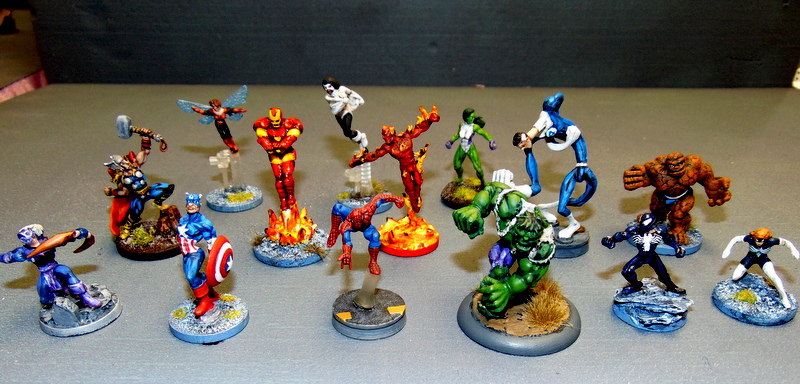
The Good:
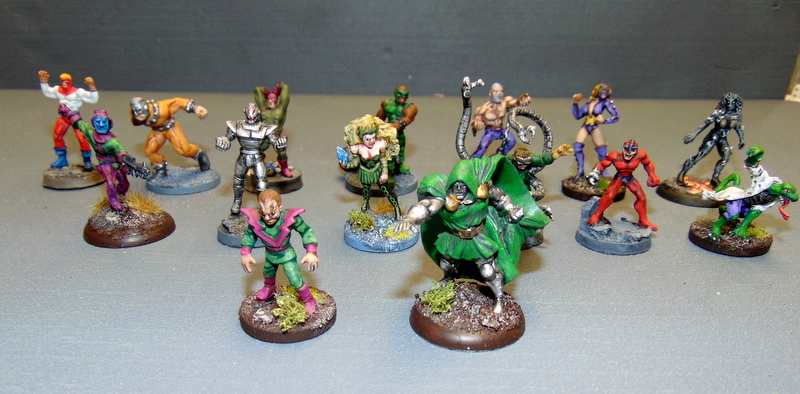
The Bad:
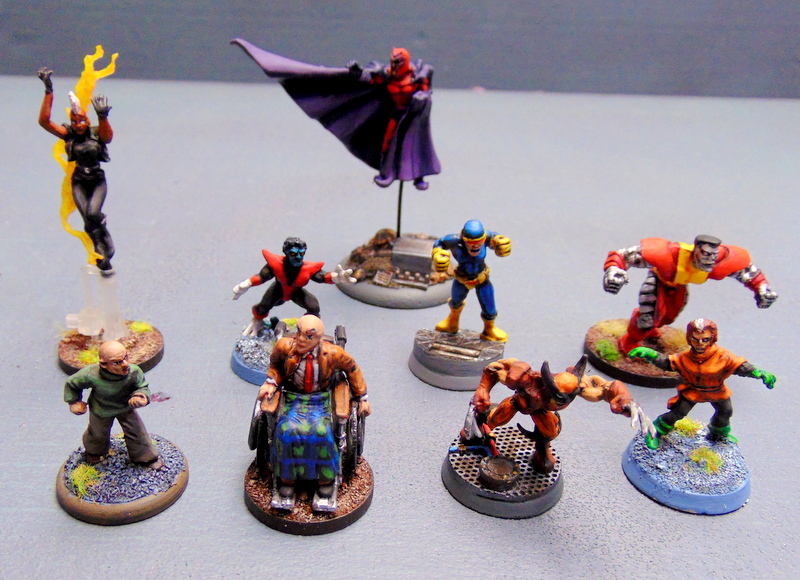
and the Mutie!
Oh. yeah… I almost forgot…
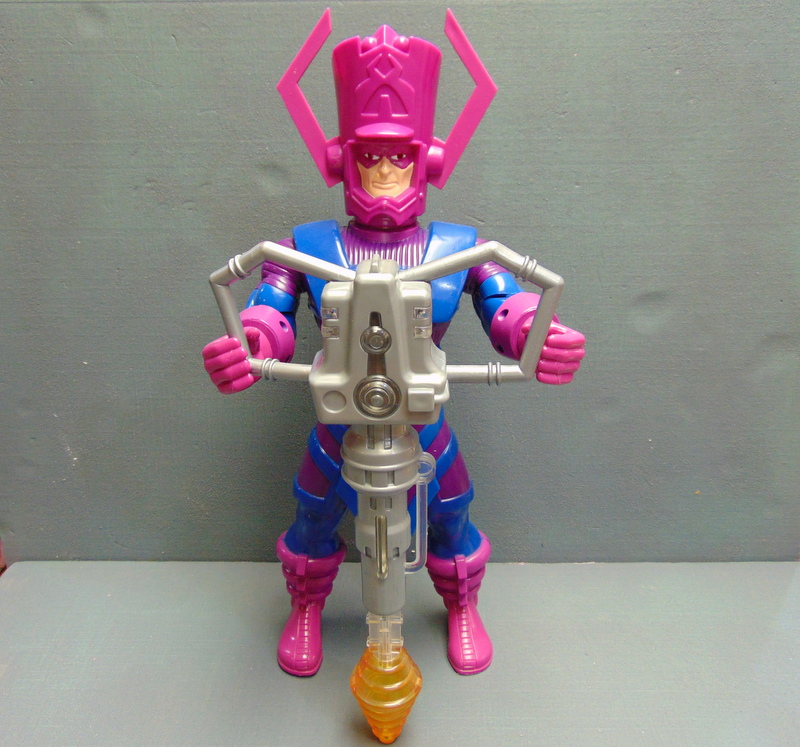
and HIM:
Coming soon.

The Good:
The Bad:
and the Mutie!
Oh. yeah… I almost forgot…
and HIM:
Coming soon.
Well, it’s officially Saga’tember, and I’m the last of the three caballeros (the other two being Dick Garrison and Blax the Kleric) to post my progress in painting Dungeon Saga: The Dwarf King’s Quest by Mantic Games.
I decided to keep things simple for my first outing. I concentrated on the skeletons and the ghosts, two of the easiest groups to paint.

As a lifelong fantasy miniatures painter and a former Warhammer Undead player, I’ve painted many a skeleton in my day. I figured I had this in the bag. But I am far from happy with how these skellies came out.

I love Mantic dwarfs, but Mantic skeletons and elves are really skinny and small, or as my British friends would say, weedy. My eyes aren’t getting better with age, so they were tougher to paint than I thought they would be. Also, I decided to try a different skeleton painting method than is usual for me. Typically, I prime my bonies black, then highlight using Reaper’s bone triad (Bone Shadow, Aged Bone and Polished Bone) before giving it a very light drybrush of white. Works great.
This time, I used GW’s method, which is to prime white, wash with Agrax Earthshade, and highlight up with Ushabti Bone and white. I hated how this turned out, so I ended up using my method after all, which resulted in about 3 unnecessary layers of paint on the models. I mean, they don’t all have to be masterpieces, but it just irks me…
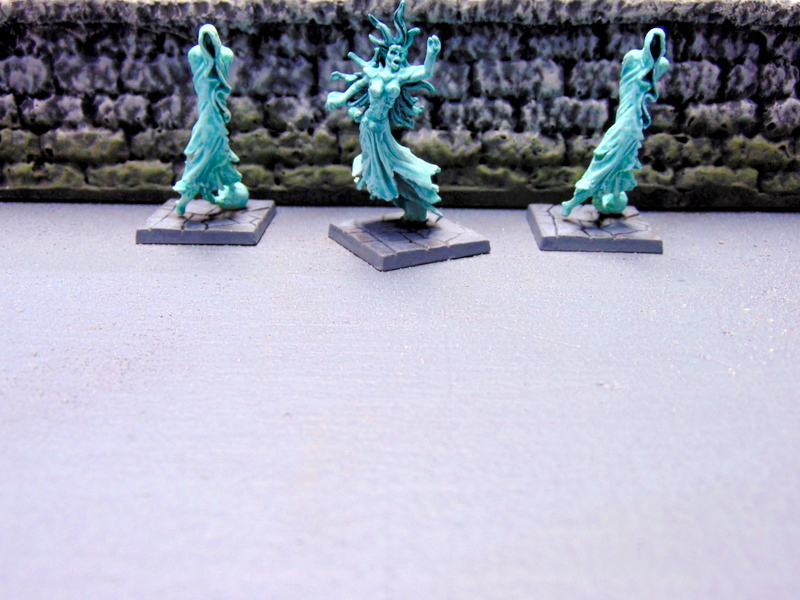
Unlike my comrade Dick Garrison, who is painting his models to match Mantic’s paint jobs (and doing an amazing job of it), I have no such desire to do so. I want to paint as many of these models as I can in September, however; so I decided to go with GW’s quick and easy method of painting ghosts: prime white, coat with Nihilakh Oxide, wash the recesses with Coelia Greenshade, and drybrush with white. I did both ghosts and one of the bosses, Elshara the Banshee, in about 30 minutes.
Also, this is the first time in months I have painted something that isn’t a Gaslands conversion or a Heroclix repaint, so it marks the return of my Painting Progress queue. I have been VERY good, and I haven’t bought any new miniatures in months…until last week, when I had to buy a miniature that was too good to pass up…but I’ll be painting it very soon. Anyway, the updated progress for this year is:
Insanity Pile Progress
Miniatures Painted Thus Far: 19
Miniatures Purchased: 1
Total: +18
Up next: “BRAAAAAAAIIINSSSSSS…..”
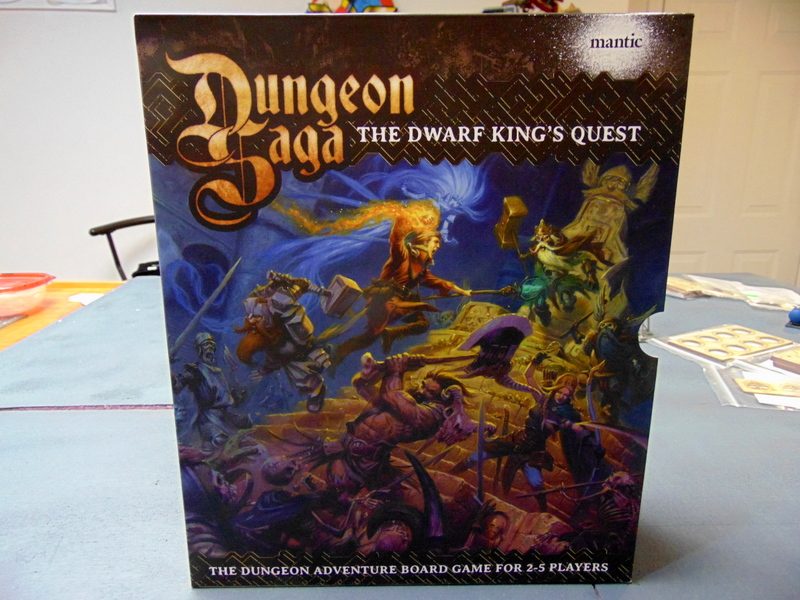
Behold Dungeon Saga: The Dwarf King’s Quest by Mantic Games. It’s a fairly well-reviewed dungeon crawler board game in the vein of Fantasy Flight’s Descent. Like Descent, it comes with a bunch of plastic miniatures that you can paint, or not, as is your wont. I’ve owned the game for a while now, but I’ve never played it; much like Imperial Assault, I wanted to paint all the miniatures before actually playing the game.
Unlike my experience with Imperial Assault, I want to paint the game miniatures in less than two years and play it more than a few times.
A couple of months back, in the midst of Forgotten Heroes, Dick Garrison, Blax the Kleric and I donned our dark robes, intoned our mysterious chants, invoked names any sane person would never speak aloud, and made a solemn pact that we would all three try to paint as much of the game as possible during the month of September, or, as Mr. Garrison has aptly dubbed it: Saga’tember.
Saga’tember is nigh! This coming month will be devoted to painting the Dungeon Saga game, with the ultimate goal (one I share with Dick Garrison), of having the whole thing complete by Christmas. That means I’d best get cracking, because I already have a project lined up for October, and I’m seriously considering hosting Dwarvember again this year. (No promises on that, we’ll have to see.)
Did I mention I have some long-lost friends dropping by in September for some Super Mission Force and/or possibly Gaslands? That’s right: I’m actually going to play a game or two with OTHER people for a change. Looking forward to it, but it means I have to do a little work for those games prior to their visit.
Tonight: I prime!
Those of you who drop by Dead Dick’s Tavern may know that lately, I’ve been playing Mad Max on the Playstation 4, which, in turn, has made me want to play Gaslands very much. With the end of my Time Trap Super Mission Force campaign, I only have a couple of weeks before September, when I, Dick Garrison and Blax the Kleric are all committed to a painting project soon to be revealed here.
At least I hope we’re all still committed. We are still committed, right guys?
Anyway, I have a short amount of time for other projects, so I decided to do something Gaslands-themed in honor of Mad Max. However, it’s a different movie, and one of my favorite movies of all time, that gave me the inspiration for this quick project: Escape From New York.
I decided to make the Duke’s car.
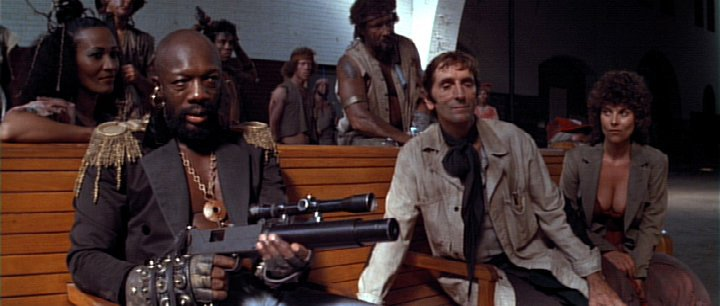
If you aren’t familiar with this movie, I’m not going to summarize it here. Just see it as soon as possible by whatever means necessary. That’s the Duke of New York above, played by the late, great Isaac Hayes. The late, great Harry Dean Stanton is next to him, as is Adrienne Barbeau. She’s not late, or great. She’s fucking amazing, and I was, and still am, madly in love with her.
One look at that picture above and you notice two interesting things. And no, I’m not talking about the two things you think. I count those as a pair and therefore one thing. The other thing is the Duke’s gun. I’m no gun expert, but I have to wonder why you would put a long-range optical scope on an Ingram Mac-10 submachine gun. I doubt you’d be doing much sniping with that…but I guess it looks cool.
Anyway, this is the Duke’s car:
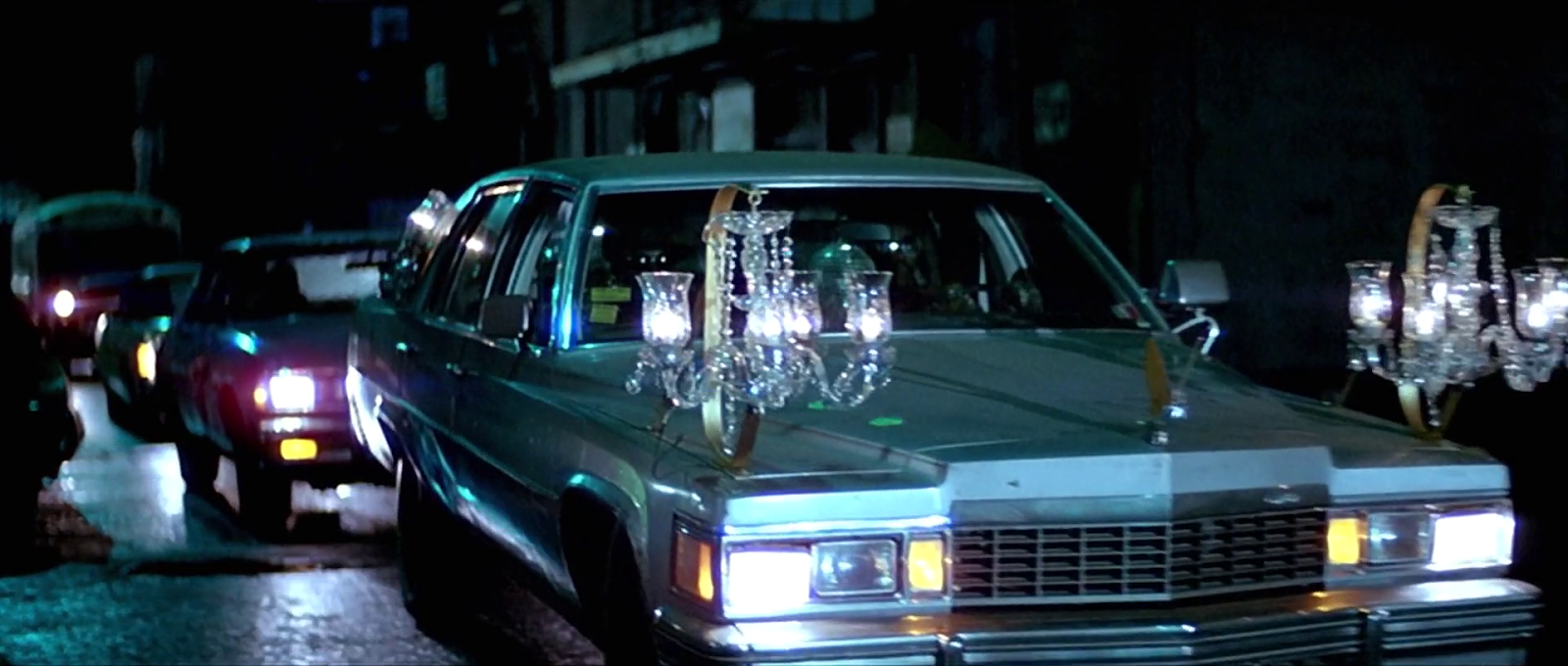
A 1977 Cadillac Fleetwood Brougham. The Duke pimped it out with some hip chandeliers on his hood, because hey, he’s the Duke of New York. He’s A #1.
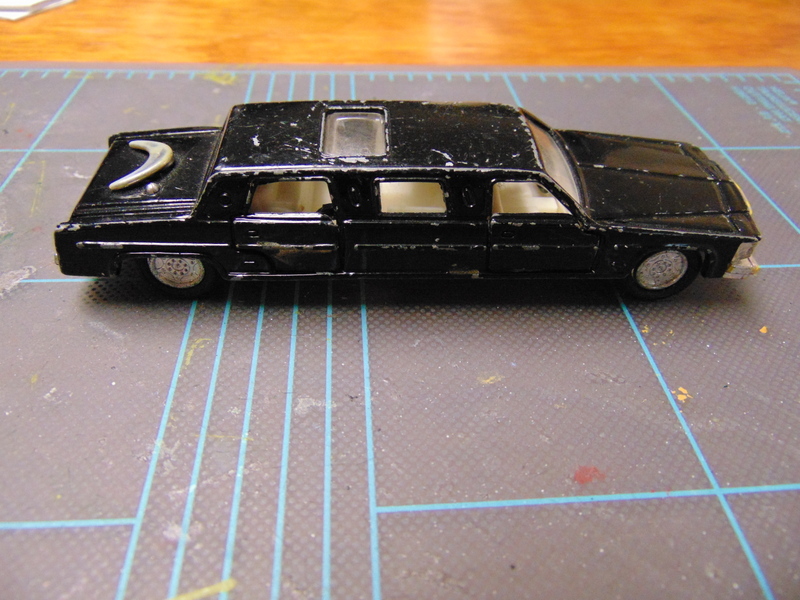
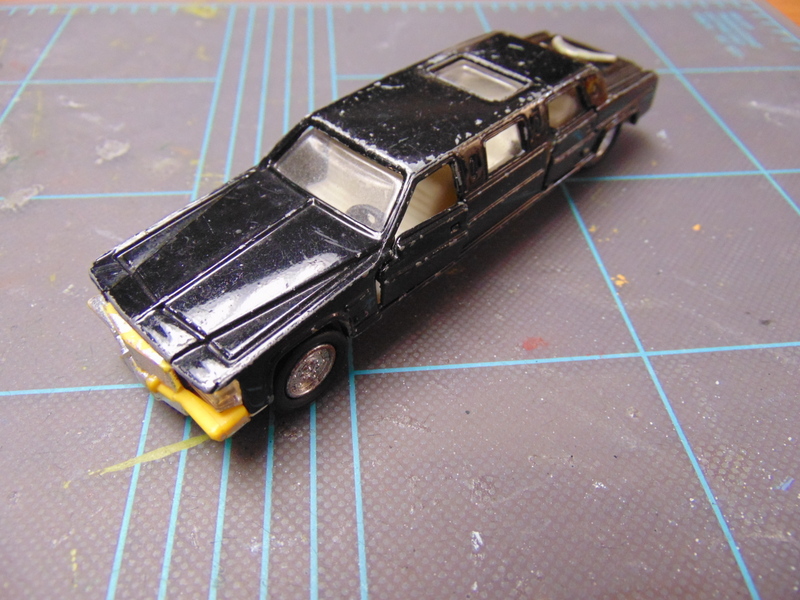
I had this. It’s a limousine, not a Cadillac Fleetwood, but I immediately thought of the Duke’s car when I got this in a bag of toy cars from a thrift store. Some of those have since become other Gaslands conversions, but this one…well, this one was put on hold. After all, the Duke’s car is far from the wasteland rustbuckets I’ve converted thus far.
The Duke has class. He’s A #1.
Of course, this all but requires the Xzibit “Yo, Dawg” treatment…

One look at the chandeliers on the hood and I knew that duplicating them would be beyond my meager modeling skills. So, I tried to find dollhouse furniture that would be in scale, but believe it or not, Matchbox cars are way smaller than standard dollhouse furniture. Also, dollhouse furniture is fucking expensive, so I resolved to make my own.
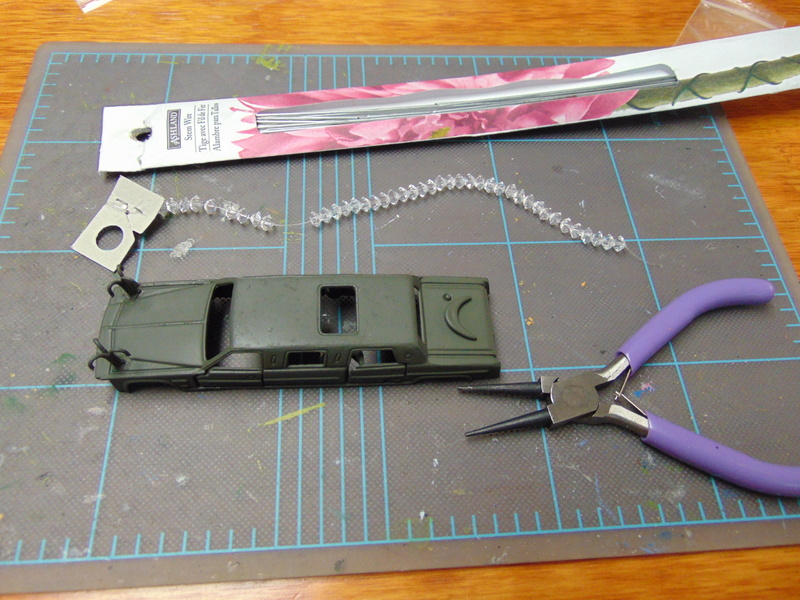
I took the car apart and primed it with some Rustoleum camo paint. I drilled some holes in the hood, then used these bead pliers, which I didn’t even know I had, to bend and crimp some floral wire for the frames. I used these cheap glass beads for the lights. (As a side note, I also make lovely bracelets in my spare time. Not really.)
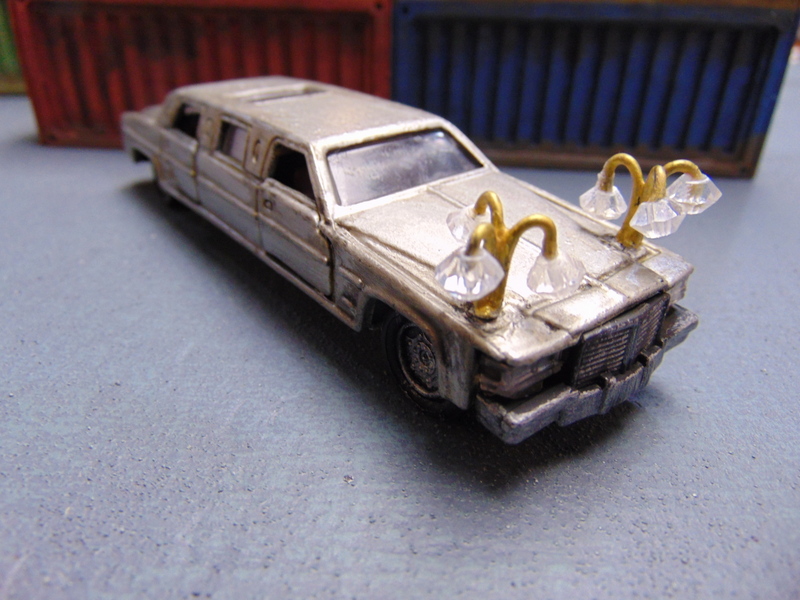
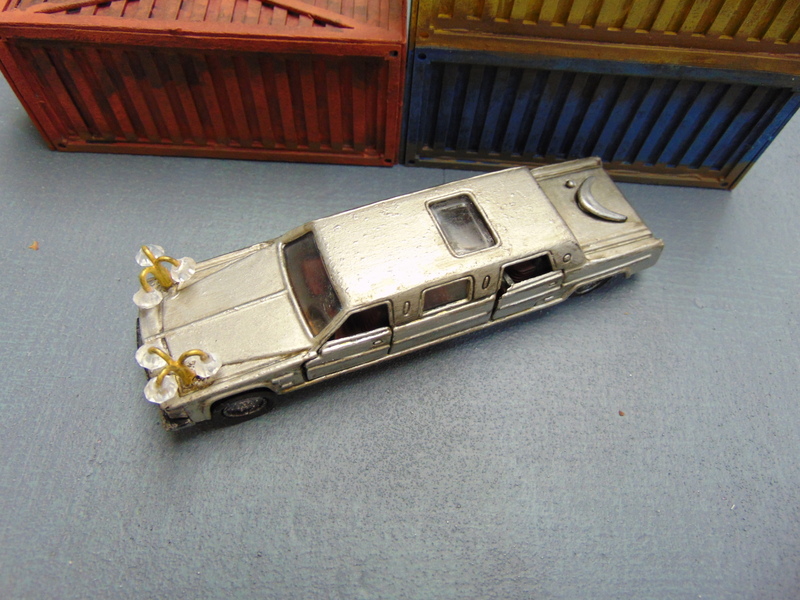
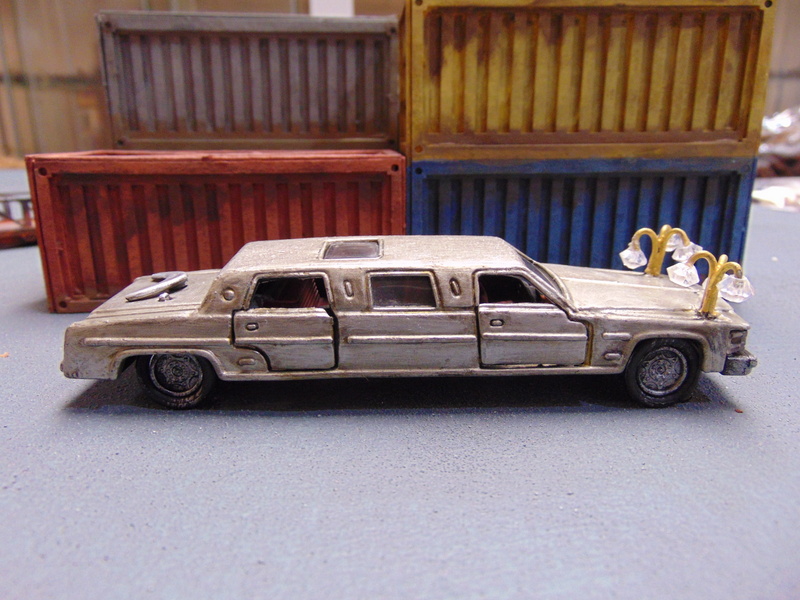
One look at these light fixtures and you can see they’re not 100% accurate replicas of the Duke’s hood ornaments, but as I said above, those are beyond my skill. Then again, this limousine is bigger than the Duke’s caddy, so I guess it doesn’t matter. Let’s just say this car was “inspired” by the Duke’s car.
You may ask me, “Hey, Piper, why did you go through all that bullshit when you could have just used a three-prong fishhook for the lamp frame?” To that I say: I thought of that. But I couldn’t find a small enough fishhook without buying a lure (I am not a fishing enthusiast and I don’t own any fishing tackle), and I didn’t want to do that, considering I already had the floral wire. So that’s why.
If anyone cares, I painted the car with a base of Vallejo Bronze before giving it a wash of GW’s Nuln Oil, then I highlighted the whole body with P3 Radiant Platinum. The chrome fixtures were painted with GW’s Mithril Silver, and the lamps were done with Auric Armor Gold.

I don’t know how it would fit into Gaslands, because there are no limos in Gaslands, and this one looks particularly vulnerable, having neither weapons nor armor. I’d probably just call it a bus. Maybe it’s the ride of a wealthy race patron.
“I am the Duke of New York! I am A #1!!!!”
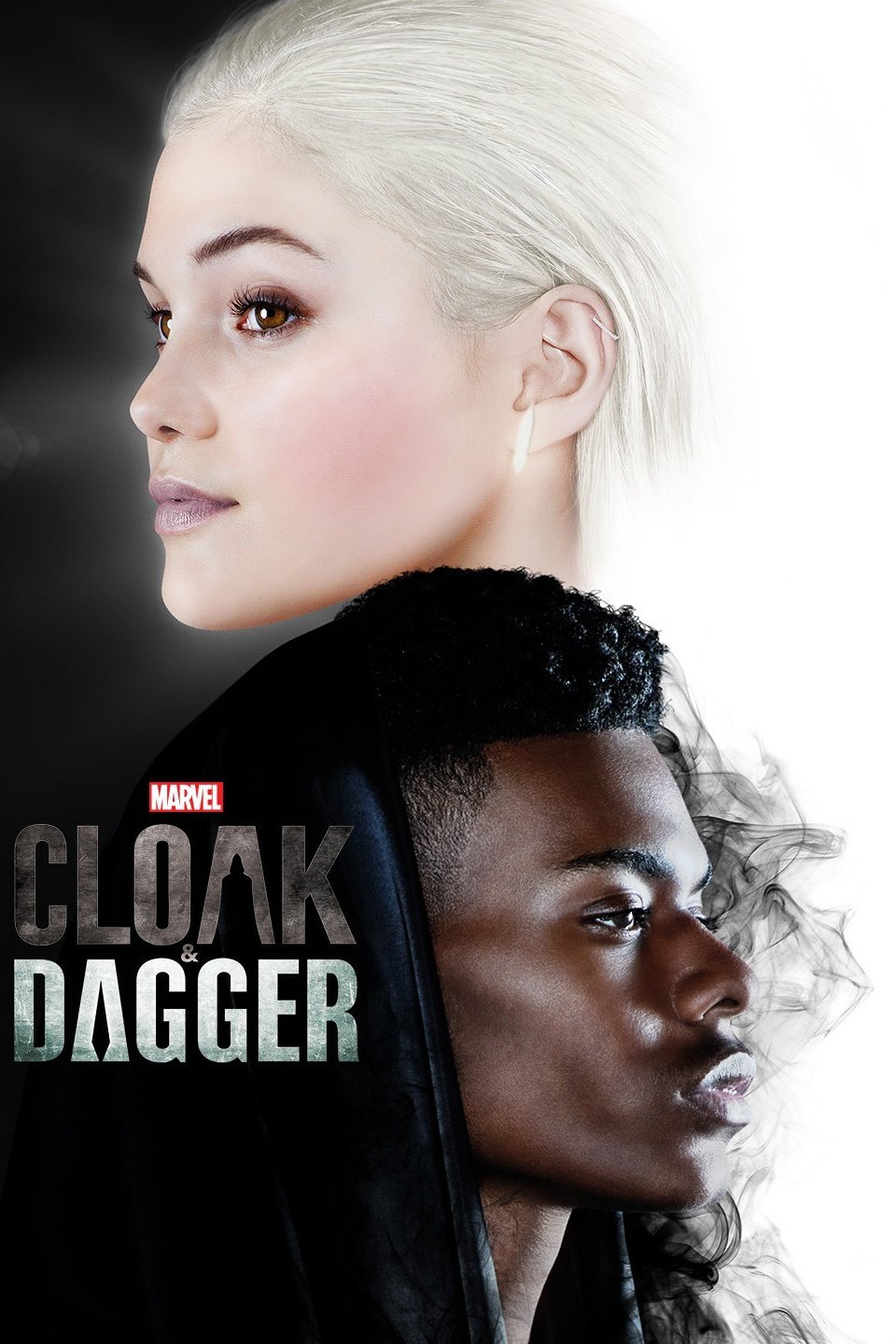
A brief interlude from my Time Trap campaign: a while back I saw an advertisement for a new TV series set in the Marvel Cinematic Universe based on third-string teenage duo Cloak & Dagger. Because the show was hyped pretty early, I forgot about it until I stumbled across it by accident. Apparently, it’s on the Freeform network, which is a network I didn’t even know I was paying for as part of my cable package. Sometimes surprises can be good.
By the time I found it, the first 2 episodes had already aired. I’ll watch anything that’s comic-related, so I watched these episodes on demand and started recording all the new ones. Tonight is the final episode of the first season.
Now, I was already familiar with Cloak and Dagger, by which I mean I knew their identities and their powers; but I wouldn’t say I was a fan by any means. In fact, I don’t own any Cloak and Dagger comics, and I own a shit-ton of comics. They never really piqued my interest. They were just kinda…there, sometimes, as guest stars in other comics.
Which is why I guess I was pleasantly surprised by Marvel’s Cloak and Dagger on Freeform. It’s actually pretty good. It could use a bit of help in the pacing department, but it’s still interesting enough to keep my attention, despite it taking 4-5 episodes to start really making things happen. The cast is great; both Cloak and Dagger are well-represented, as are their respective family members. I’m particularly impressed with Aubrey Joseph, who plays Cloak. It’s tough to pinpoint why, but I think it may be because he has a unique voice, which is an attribute I’ve always imagined Cloak would possess.
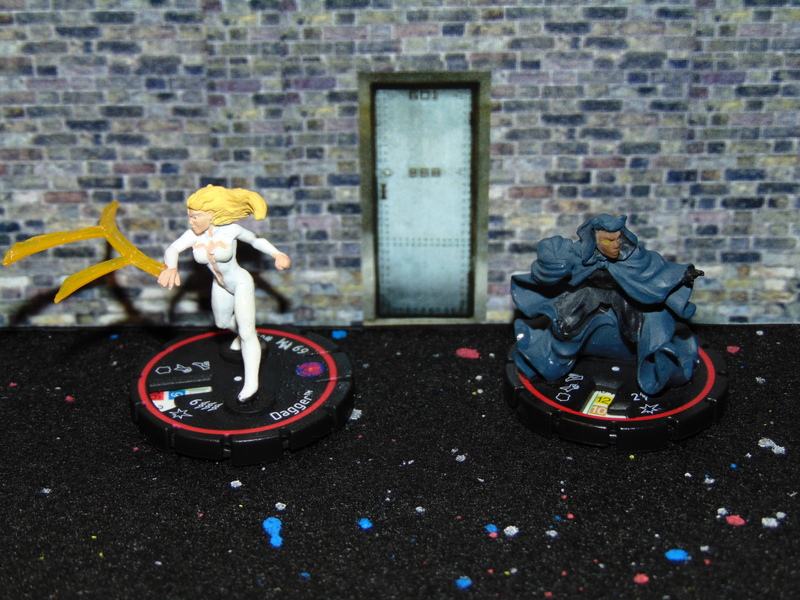
Anyway, in honor of this new show that I like, I’ve decided to paint up Cloak and Dagger for my supers collection. Both are repainted Heroclix, of course. Above is the factory paint job.
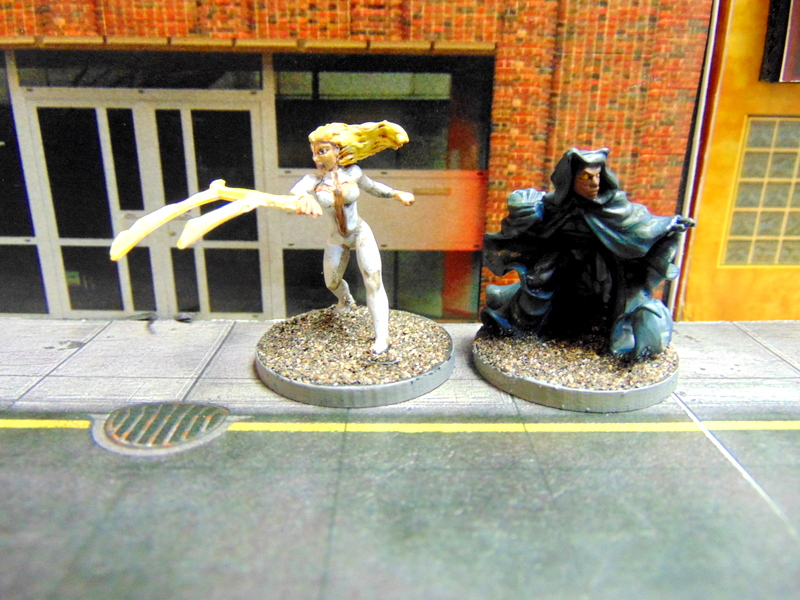
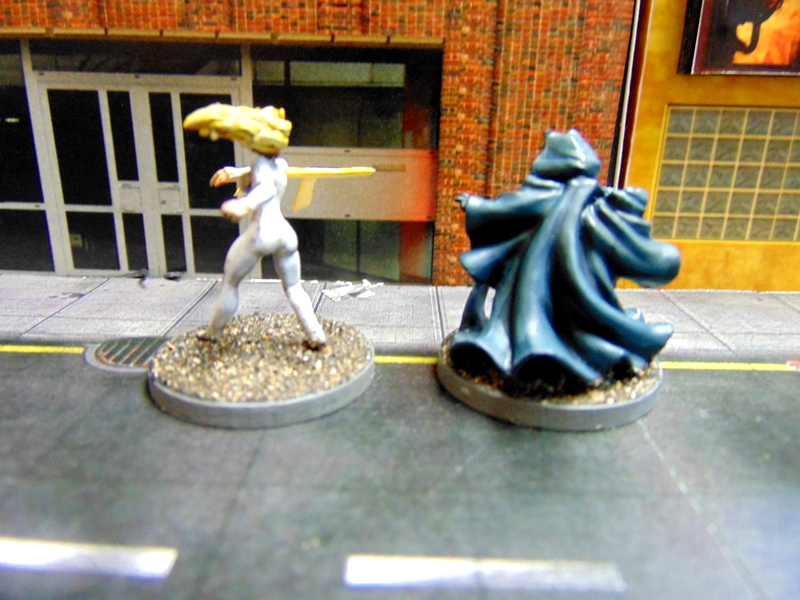
These are my repaints. Their costumes are so basic this really didn’t take very long at all. Just a bit of shading and highlighting for Dagger, mostly just highlighting for Cloak. I really hate Dagger’s daggers, which just won’t stay level no matter how many times I try to bend them into shape with hot water/cold water. I’m almost at the point where I might just clip them off. I really hate these “energy effect” things some Heroclix have.
Like I said above, I’ll watch anything comics(especially supers)-related and give it a shot; but I watch enough good TV to not have time for bad shows. I stuck with Agents of SHIELD, Flash, Preacher, Arrow and Gotham; I bailed on The Gifted, Supergirl and Legends of Tomorrow. I missed out on Black Lighting and Legion (I’ll probably watch Black Lightning, but I haven’t heard anything great about Legion, so I’ll pass). I loved Constantine (Matt Ryan was awesome as John); sadly it ended before it really got started. And of course I watch all the Netflix series, even Iron Fist, which is a huge disappointment to me as I’m a rabid Iron Fist fan. But, oh well. Hopefully Season 2 will be better…

Marvel’s Cloak and Dagger has earned another season already, so they must have decent enough ratings to justify one. I’ll be back next season; this is the most interesting Cloak and Dagger have ever been for me.
PROLOGUE
The smoke clears, and the Avengers stand reunited in their mansion before Immortus, Lord of Limbo!
“Both your groups achieved success,” says Immortus. “This is good, but there is still another task ahead, and it is by far the most important.”
“Hold on a second,” interrupts Captain Marvel. “I think we’re entitled to some answers, friend. A child was almost seriously hurt or killed, and we still don’t know the whole story.”
“And yet because of your quick actions, the child was unhurt. He grew up to be a postal clerk, if that is of importance to you,” says Immortus. “More importantly, Rankin was prevented from his path, which would have led to the formation of the solar flare.”
“We have only your word on that,” says Scarlet Witch.
Immortus scowls. “I will try not to take that as the insult you so obviously intend. I seek only to prevent disaster.”
“Sorry to hurt your feelings, but Drax did not know about the satellites you claim he was on his way to destroy, either,” says Wasp. She looks at Captain America. “And Vision says there’s no record they ever existed.”
Cap glances at Vision. The android nods. “Well, that’s sure strange, Immortus,” says Captain America. “Any explanation?”
Immortus sighs with impatience. “Again, because of your quick actions, the aliens likely never even got a chance to tell Drax about the satellites. Rest assured, that is a good thing. As for your computer’s deficiencies, I am sure I am not the person to ask. Now, enough of this nonsense! There is an important task that will require all of you, and it must be done presently! I have used my mastery of the time streams to heal all your injuries for those who have sustained harm. Hardly the actions of one with ill intent.”
Starfox folds his arms. “All right. We’re listening.”
“You must go back in time again, but not far; only yesterday,” Immortus says.
“Yesterday…” says Starfox, “…when all our troubles seemed so far away…” He smiles, looking around at the others. “You all see what I did there, right? Right?”
“Why yesterday?” asks Vision, ignoring Starfox. He subtly increases his density, rooting himself to the spot lest he lunge at Starfox and punch him in the dick.
“Because that is when Reed Richards launched a solar probe into space from the top of a building here in Manhattan.”
“That’s quite simply impossible,” says Vision. “Our computers would have detected such a launch, and Dr. Richards would have certainly informed us of his plans.”
“The launch was secret,” snaps Immortus. “Do you doubt Reed Richards could launch something into space undetected?”
“No,” says Captain America. “Only that he would.”
“Well, you can ask him about it yourself when you see him. If the launch is allowed to happen, the probe becomes the very catalyst that sets in motion the flare. You must convince him to abort the launch. Richards miscalculated a key equation, and has inadvertently doomed the solar system.”
“Mr. Fantastic doesn’t make mistakes like that,” says Scarlet Witch.
“Does he not?” Immortus scoffs. ” Have you forgotten how the Fantastic Four came to be, Ms. Maximoff? How Reed Richards became “Mr. Fantastic” in the first place? Now prepare yourselves!”
“Well, this should be interesting,” says Wasp, as the temporal energies gather around the team.
Captain America raises an eyebrow. “In what way?”
Wasp grins. “I can’t wait to see the look on his face when you tell Reed Richards he needs to check his math.”
The Scenario
Surprise! Kang is lying. While the heroes were off dealing with Mimic and Drax, Kang made arrangements for them to be ambushed in the past by two powerful enemies: Blastaar, the Living Bomb-burst, and the Super-Skrull! He’s not sending them back to yesterday, he’s sending them back years, shortly after the Super-Skrull first got his powers. Kang doesn’t care whether the Avengers beat the Super-Skrull or not; it really doesn’t matter. If the Super-Skrull wins, the Avengers are wiped out before they become a team. If the Avengers win, the Super-Skrull reports back to the Skrull emperor that Earth is better defended than the Skrulls thought. They never attack Earth and the Fantastic Four is the only super-team that is really needed, so the Avengers never become a permanent team. Either way, when Kang’s future rolls around, he’s ensured himself an easy time conquering Earth.
The Avengers need to defeat the Super-Skrull, his Skrull soldiers, and Blastaar. Anything else is complete failure!
Setup
I used two 2′ x 2′ boards, representing the tops of two skyscrapers in Midtown Manhattan. At their closest point, the rooftops are 8″ away from each other. Both rooftops contain scatter terrain, such as ventilation ducts, elevator motors, water tanks, AC units, etc. One of the rooftops contains a strange-looking spacecraft.
The Avengers deploy on the roof without the spacecraft. Blastaar and two groups of elite Skrull henchmen deploy on the same roof, surrounding the Avengers. The Super-Skrull and the last group of elite Skrull henchmen deploy on the opposite roof, close to the spacecraft.
Special Rules
Moving Between Buildings: With the exception of Scarlet Witch, all the heroes have no problem moving between the two buildings. Starfox, Vision, Wasp and Captain Marvel can all fly, and Captain America’s Super-Agility makes an 8″ leap child’s play. Unfortunately for the Scarlet Witch, if she wants to move from building to building she’ll have to hitch a ride with Starfox, Vision or a non-shrunken Wasp. Captain Marvel can only fly while intangible, so she can’t carry a passenger, and Captain America’s Super-Agility doesn’t allow him to carry passengers, either. On the villains’ side, Blastaar and Super-Skrull can also easily fly (or stretch) between buildings, but the Skrull henchmen groups are stuck on whatever building they deployed on at the start of the game.
Attacking Between Buildings: Both buildings are roughly the same height, so models can make ranged attacks at one another from building to building. The Super-Skrull can also attack between buildings in melee if he uses his Metamorph power to stretch and increase his reach.
The Spacecraft: The spacecraft functions as a constant source of cosmic energy. It has a directional antenna that constantly beams cosmic energy to the Super-Skrull, making him stronger than normal. In game terms, this gives the Super Skrull the Regeneration power in addition to his already considerable power list. Destroying the spacecraft should be a high priority for the heroes; unfortunately it’s not easy. The spacecraft is enveloped by a standard force field (4D) and is made of steel (or the Skrull equivalent), which is TN5 and Body 4. It’s also surrounded by an elite group of Skrull henchmen, and is protected by a blaster turret (see below).
If the spacecraft is successfully destroyed, the Super-Skrull immediately loses the Regeneration power and takes a 6D attack as the beam is disrupted. He resists this normally, but his Force Field cannot protect him against this attack.
The Blaster Turret: The Skrulls have set up a sentry gun to protect the spacecraft. At the start of each round, it opens fire on the closest model that is not a Skrull. Note that this could be Blastaar! The Skrulls haven’t had time to configure it to ignore Blastaar yet. It can be targeted and destroyed (TN5 Body 4).
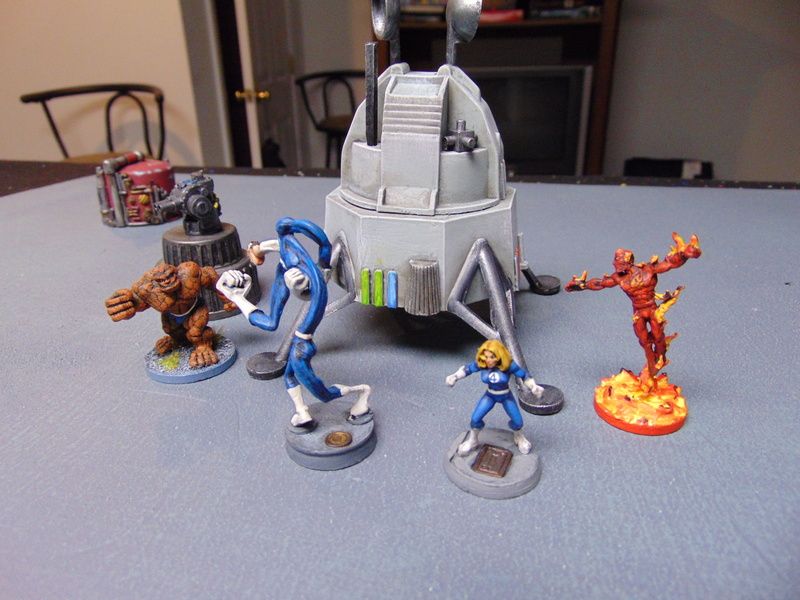
The mists of time part, and the Avengers find themselves on the roof of a tall building in Manhattan, just as Immortus said they would. On an adjacent rooftop they spy the Fantastic Four, gathered around a strange-looking device.
“Good. They’re here, and so is the ship,” says Wasp. “Let’s go tell the FF they have to stop their science project for now.”
The Avengers walk towards the rooftop where the Fantastic Four are tinkering with the device. The Thing catches sight of them immediately and says something to the rest of the team, who turn to watch the Avengers approach.
“That ship…” says Starfox, trailing off. “It almost looks like—”
“Something’s wrong here,” says Captain America, as diabolical grins spread across the faces of the Fantastic Four.
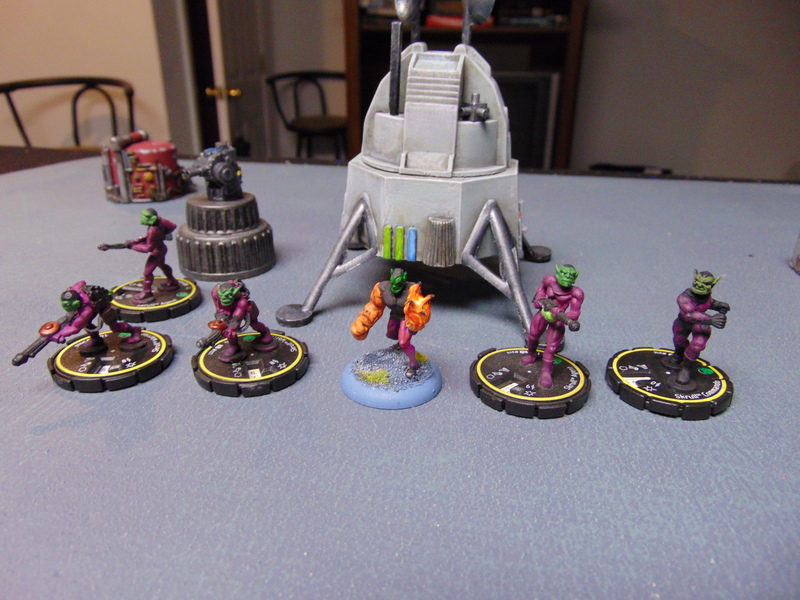
Suddenly, the familiar forms of the FF waver and fade, only to be replaced by…
“Skrulls!” says Vision. “It’s a trap!”
All around the Avengers, Skrull soldiers suddenly appear, until that moment hidden by the Invisibility powers of their leader, The Super-Skrull! A harsh, booming laugh comes from behind the group. They whirl, only to see Blastaar of Baluur, the Living Bomb-blast!
“Immortus set us up!” exclaims Captain Marvel. “It’s an ambush!”
“Avengers, Assemble!” cries Captain America, unslinging his shield from his back. “Formation Alpha 2-3, on me! Let’s end this quickly, team!”
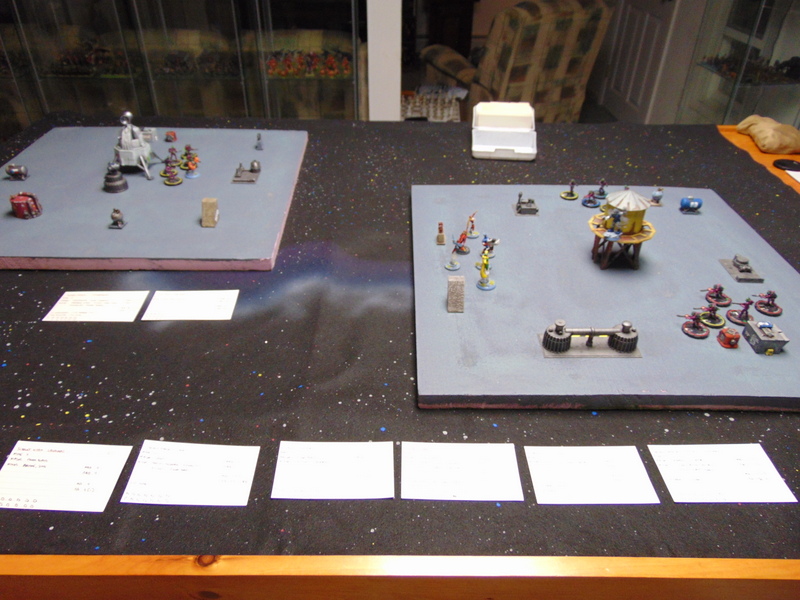
The start of the game. Board 1 on the left, Board 2 on the right.
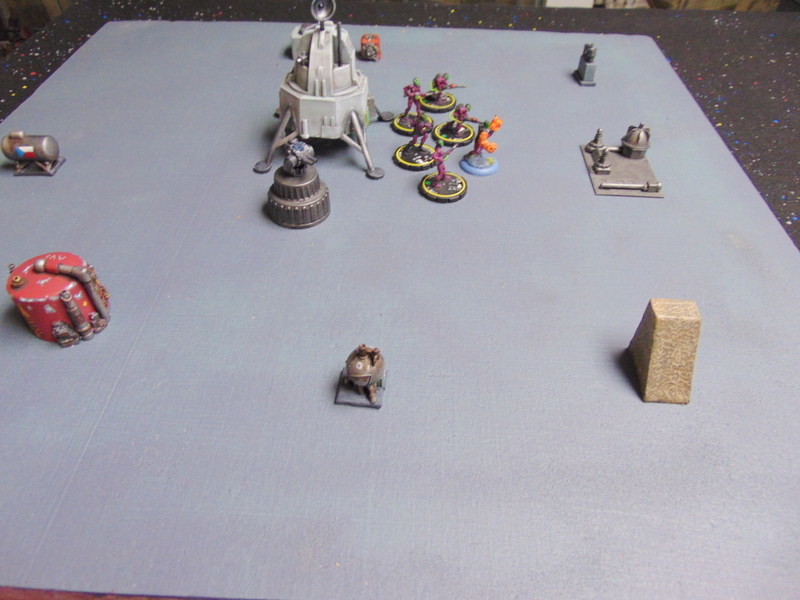
Board 1 Deployment

Board 2 Deployment
ROUND 1
Before initiative is rolled, the blaster turret opens fire on the closest non-Skrull model: Wasp! This surprise attack hits her for 3 damage, half her Body! Ouch!
Also at the start of the round, the Super-Skrull has to pick what Metamorph form he will use for the round. I picked form #1, which gives him +6″ to Move, Melee Specialist, and +10″ reach. This pretty accurately represents his elasticity and he will stay this way throughout the whole game; I see no reason to change it.
The Avengers gain initiative. Captain America wastes no time. He activates his Enhance power and says some inspiring words. He manages to give Scarlet Witch one re-roll she can bank until she needs it. Then he takes the fight straight to Blastaar by charging the warlord of Baluur! He leaps atop the water tower with an Acrobatic Attack (a Brawler special maneuver); when all is said and done, Blastaar takes 4 Body worth of damage and gets knocked off the tower! He manages to keep his footing, but he just lost 2/3 of his health! Blastaar only has 2 Body left!
In response, Blastaar does what he does best, he blasts Captain America with concussive kinetic energy, scoring 6 net goals worth of damage, dropping Cap’s Body from 7 to 1!! Blastaar uses the Blast Back maneuver (a Blaster maneuver), and knocks Captain America off the water tower and onto his star-spangled ass. Cap fails his knockdown check and is back to where he started the round. How embarrassing!
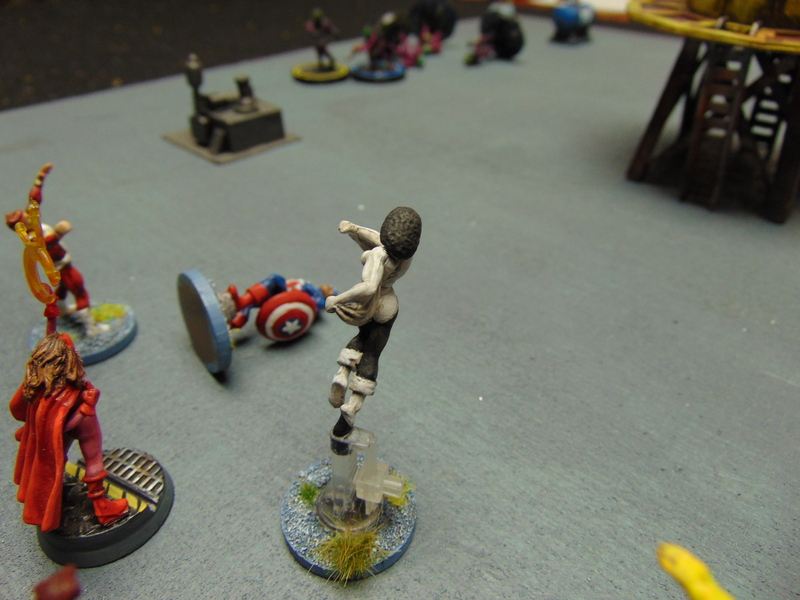
Captain Marvel activates her Density Decrease and Invisibility powers, then Power Blasts Skrull group #2, taking 3 of their number out of the action. Then she uses her Flight and Speed to head over to Board #1, close to that Skull spacecraft and the Blaster Turret.
Skrull group #3 moves up and concentrates their fire on Vision. He rolls poorly to resist and takes 5 Body worth of damage, dropping from 9 to 4!
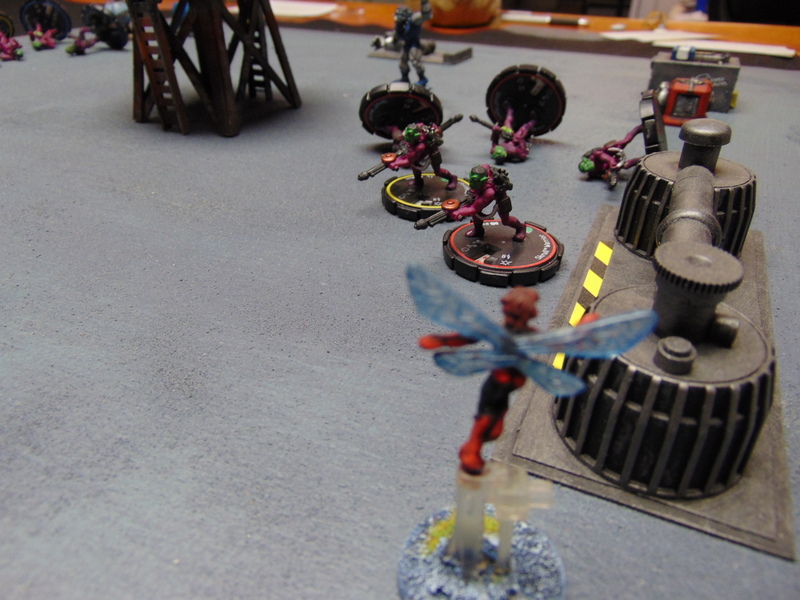
Wasp activates her Shrinking power and flies towards Skrull group #3, Power Blasting them and taking out 3 of their soldiers in a mirror image of Captain Marvel’s attack! Both henchmen groups on board 2 are down to 2 members each! Wasp continues the rest of her movement, putting her closer to Blastaar.
Skrull group #2 opens fire on Captain America, managing to inflict 1 more Body worth of damage, dropping Cap to zero health and forcing him to make a KO check. He passes! Cap is still in the fight, but he has lost all his Body in the first round of the game!
Vision charges into combat with Blastaar and delivers a Haymaker. He only scores 1 damage, but that knocks Blastaar back 3″ and he fails to remain on his feet.
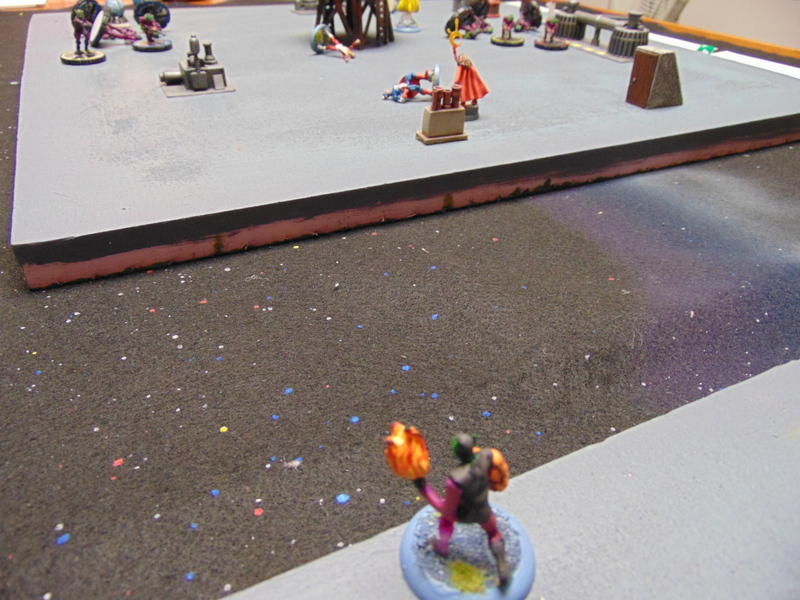
Meanwhile, over on Board #1, the Super Skrull makes good use of the Fantastic Four’s powers. He activates his Damage Field and Invisibility powers, then moves to the edge of the building. With his 10″ reach, he can just barely hit Starfox by stretching across the gap between buildings. Using a combination of the Human Torch’s flame, Mr. Fantastic’s elasticity (and the Melee Specialist ability from Metamorph form #1), the Thing’s strength and Sue Storm’s invisibility, the Super Skrull is rolling and re-rolling a shit-ton of dice on this one attack. He does 4 Body worth of damage on the unsuspecting Starfox, enough to knock him back 12″ into the water tower. Starfox fails his knockdown check and wonders what the hell just happened.
Starfox uses 2″ of his movement to stand up and look around, but he doesn’t see the invisible Super-Skrull. Instead he charges Skrull group #2 and vents his frustration on them, wiping out the remaining two members.
Skrull group #1 fail to spot Captain Marvel, so they move towards the edge of their roof. No one is within range of their attacks, however; so they just sneer at the Avengers on the other rooftop.
Scarlet Witch moves forward and Power Blasts Skrull group #3, taking out the remaining 2 Skrulls.

Board 1: End of Round 1.

Board 2: End of Round 1
HOLY SHIT! That brings Round 1 to a close: one of the bloodiest Rounds in Super Mission Force History, at least in my experience. In the span of about 10 minutes, the results are staggering: Captain America, at zero Body! Wasp at half Body! Vision and Starfox, both at less than half their starting Body! Skrull groups #2 and #3 wiped out! Blastaar at 1 Body! In the immortal words of Charlton Heston: “It’s a madhouse! A maaaaaadhouuuusse!!!!”
ROUND 2
Both Captain Marvel and Super-Skrull maintain their Invisibility.
The Blaster Turret can’t see Captain Marvel, so it fires at the next closest non-Skrull: Scarlet Witch. After an impressive shot, Scarlet Witch manages to only take 1 damage (she had Cap’s re-roll and her Fortune power to thank for that).
Captain America stands up and moves into position where his Enhance power can do the most good. Unfortunately, he only manages to impart one re-roll to the group. He gives it to Vision. Then, because he’s close enough, he throws his shield at the prone Blastaar, but he misses!
The invisible Super-Skrull charges at Starfox, who, at the last moment, makes his Perception roll and notices something is attacking him. Nonetheless, the Super-Skrull clobbers Starfox right in the dick, dropping the Eternal to zero Body and knocking him back 9″. Starfox manages to stay both conscious and upright, but (as anyone who has ever been punched in the dick can attest) his mood immediately suffers.
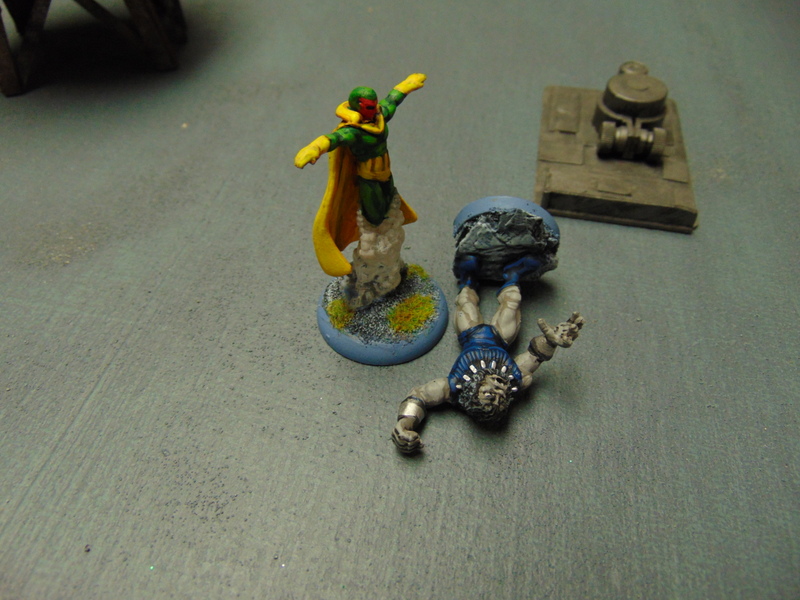
Vision activates his Density Increase power and charges Blastaar. He makes use of Captain America’s gifted re-roll and pummels the Living Bomb-burst into next week. Blastaar fails his KO check and is out of action!
On Board 1, Skrull group #1 makes their Perception check and notices Captain Marvel. They concentrate their fire on her, and she loses 2 Body, dropping her from 6 to 4.
Starfox tries to get some payback. He charges Super-Skrull, using the Wild Card maneuver Power Attack, which gives him a couple of re-rolls. Despite rolling 6 dice with 2 re-rolls, Starfox fails to damage the Super-Skrull. Not really surprising; his recent experience is probably quite distracting.
Captain Marvel decides to attack the Skrull spacecraft, and Power Blasts it hard enough to penetrate the Force Field and do 3 Body worth of damage to it. It starts to spark and smoke, and on the other rooftop, the Super-Skrull feels a shudder in the cosmic force beam supplying him with power…
Wasp flies over to the edge of rooftop #2 and fires across the way at Skrull group #1. She only manages to pick off 1 Skrull, but that’s ok. Scarlet Witch moves up alongside her and shows Wasp how it’s done. She Power Blasts Skrull group #1 and wipes out the remaining four Skrulls.
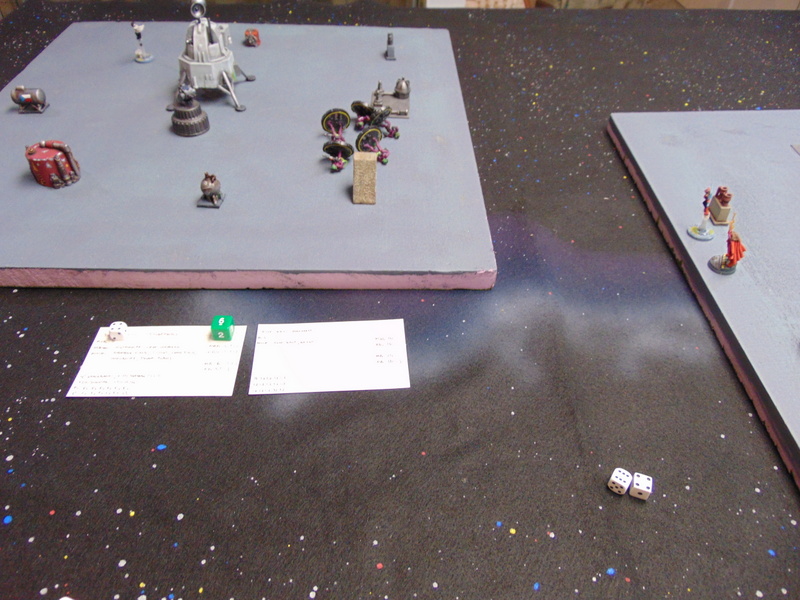
Board 1: End of Round 2
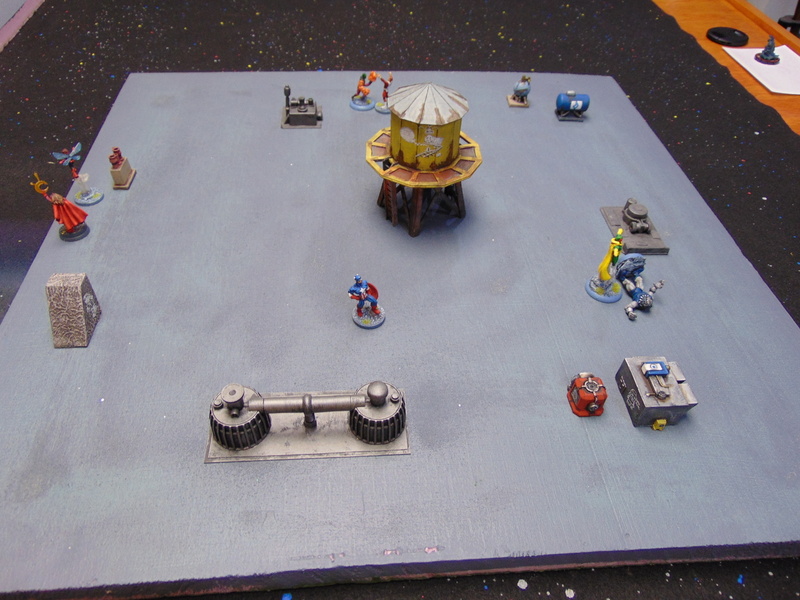
Board 2: End of Round 2
ROUND 3
Captain Marvel fails to sustain her Invisibility, but Super-Skrull keeps his invisibility active.
The Blaster Turret shoots at Captain Marvel, clipping her for 1 damage.

Captain Marvel fires at the spacecraft again. This time she blows it to smithereens. The disruption of the cosmic energy beam causes 1 damage to the Super-Skrull and removes his ability to Regenerate, which is something he hasn’t needed to do yet as he hasn’t taken any damage.
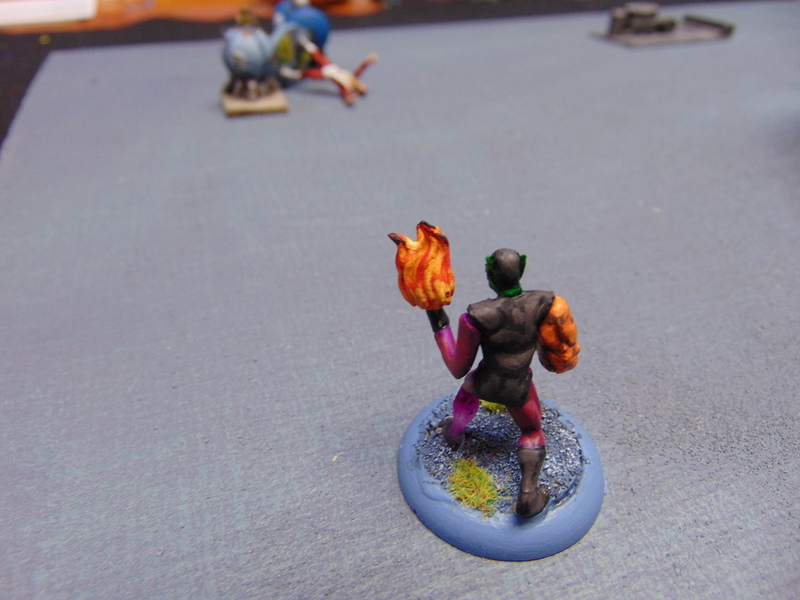
Super-Skrull has had just about enough of Starfox, so he belts him hard, knocking him back another 9″. Starfox is KOed!
Captain America spots Super-Skrull, recharges his Acrobatic Attack and charges! He drops Super-Skrull down to 1 Body with his heroic charge, but falls to Super-Skrull’s Damage Field, which does 3 goals of damage to Cap. Cap is KOed!
If Super-Skrull somehow survives this round, the Blaster Turret will fire again. With this in mind, over on Board #1, Wasp attacks the turret and blasts it to bits.
Scarlet Witch tries to locate the invisible Super-Skrull so she can attack him, but she can’t find him. All she does is move closer to where she thinks he is.
Finally, Vision activates his Density Decrease power, effectively becoming a ghost. He perceives the Super-Skrull and flies directly through him, doing a Ghostly Attack. Super-Skrul takes 1 damage from the attack and fails his KO roll. Super-Skrull is KOed!
Victory to the Avengers!
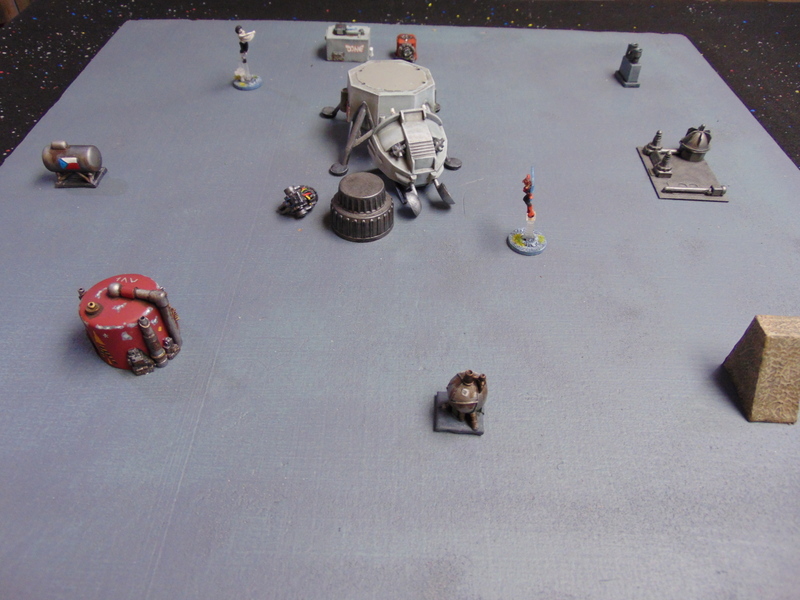
Board #1: End of Game
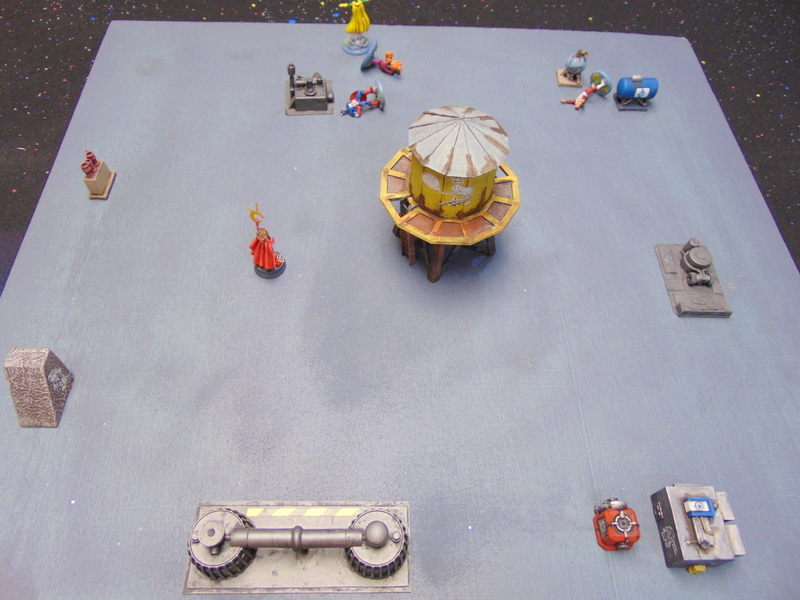
Board #2: End of Game
EPILOGUE
Wow. That was a fast game, indeed. Three total rounds saw three henchmen groups, two heroes and two villains wiped out, three more heroes reduced to half or less health, and one more hero wounded. No one escaped pain! All in the span of about 25 minutes real time!
I changed this scenario in several ways. First, I spread the battle out over two separate rooftops. Second, I felt the Super-Skrull needed a little help, so I increased the number of Skrull soldiers and added Blastaar to his team. I also added the blaster turret as additional security. Other than these additions, the battle was pretty similar to the original publication.
Since Kang isn’t bringing the heroes back this time around, he has no intention of healing their injuries. That means I have to roll on the Fate of the Fallen table for anyone KOed during this scenario: namely Starfox and Captain America. Starfox sustained a rather serious groin injury (who saw that coming?). As such, he is -3″ to his Move and -1D to all his attacks for the next battle. (Groin pain lingers, my friends…)
Despite being blasted by Blastaar and some Skrulls and being burned by Super-Skrull’s flames, Captain America manages to come through with only minor scrapes. He’ll be ready to go next scenario with no ill-effects. That’s because Captain America is Captain America, and not Starfox.
It’s also noteworthy that I rolled very high for most of the game, including all the Recharge rolls I was required to make. That’s why the Super-Skrull and Captain Marvel were invisible for most of the game. That’s not usually how it goes.
Here are my Super Mission Force builds for the Skrull force:
Super-Skrull (Powerhouse): Major: Metamorph, Super-Strength Minor: Damage Field, Flight, Force Field, Invisibility, Power Blasts, Regeneration (only when cosmic beam is active)
Blastaar (Super): Major: Power Blasts Minor: Armor, Flight, Resistance, Super-Strength
Elite Skrull Henchmen: Minor: Armor, Power Blasts
The battle in Midtown Manhattan was bound to draw attention, and it caught the notice of the world’s first super-team, the Fantastic Four! They arrive in their patented Fantasti-car, and after several minutes of introductions and explanations, the Avengers from the future and the Fantastic Four from the past come to an understanding.
“So that’s basically it, Dr. Richards,” says Captain America. It will be several years before they will be on a first name basis, at least by Mr. Fantastic’s timeline. “It seems we were duped, and I blame myself.”
“You can’t think that way, Captain America,” says Reed Richards. “Immortus is generally trustworthy; therefore I suspect it is Kang, his earlier incarnation, that is to blame.”
“Kang!” exclaims Scarlet Witch. “That would explain a lot.”
“Indeed it would,” says Vision. “But, how do we repair the damage to the timeline that we have already caused?”
“Don’t worry”, says Thing. “I’m sure Big Brain has already figured that out.” He unceremoniously drops the unconscious Super-Skrull into the Fantasti-car, while Invisible Girl claps the villain in power-dampening restraints. Similar restraints have already been applied to Blastaar, who glares at the Human Torch while the Torch, only feet away, makes faces at him.
“That’s essentially correct, Ben,” says Mr. Fantastic. “I think I have a plan to set things right.” Thing gives Captain America an “I told you so” look, then walks over to Starfox, who is moaning and clutching a cryo-pack between his legs. “Got ya right in the cubes, huh pal?” says Thing. Starfox nods weakly. “Ya just gotta walk it off. Just walk it off, buddy. S’all ya can do.”
Up next: the final showdown between the Avengers and Kang, the Conqueror!
Perhaps it’s a bit self-aggrandizing (sorry, couldn’t help it), but I managed to complete yet another submission for Forgotten Heroes this month. It just came together on its own, as I had no plans to do another conversion.

Vigilante is a DC character who has undergone several incarnations, and is not to be confused with the Justice League cowboy version. This Vigilante is from the mid-80’s, when America’s fascination with action films was arguably at its peak, and Stallone and Schwarzenegger were in their heyday. Seems like every big movie of the time was about some badass taking the law into his own hands or getting revenge by killing lots of people, usually by shooting them a lot.
Enter Vigilante, a product of the 1980’s if ever there was one. Judge Adrian Chase got fed up with having to release career criminals on technicalities or mistrials, so he donned a black ski suit and strapped on a hand cannon. Then he went after them and shot them. That’s pretty much the plot of the Vigilante series, which ran for 50 issues and wasn’t great. Basically, it’s 50 issues chronicling Adrian Chase’s spiral into madness before he ultimately eats his own gun. For a while, he stops being Vigilante and some other guy whose name I don’t care enough about to look up takes over.
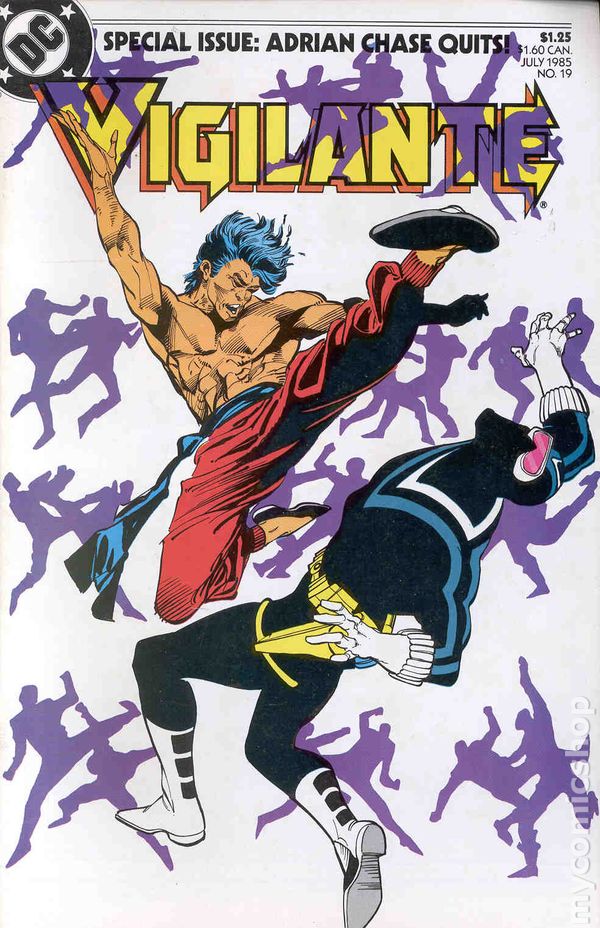
It wasn’t ALL bad, though. My personal favorite issue is this one, Vigilante #19, which is basically just one long fight scene as Vigilante tries to bring in a gang member who is a kung-fu expert. It’s penciled by one of my favorite comic artists of all time, Denys Cowan. In my opinion, no one draws fight scenes like Cowan, a talent he would prove time and time again when he took over penciling The Question. I used to dream of the day when Denys Cowan would draw Shang-Chi or Iron Fist, but to my knowledge, that never happened.
Anyway, why did I convert Vigilante at the 11th hour? Because I could. Remember that Intergang Medic I used when I made my Plant Man conversion? Well, it was just sitting there staring at me from the side of my workspace. Perhaps staring is the wrong word, considering it’s difficult to stare without eyes or a head to stare with. I thought his pose, while nothing exciting, certainly had potential.
First, he needed a head, since I used his for Plant Man. I glued a head from a Crossover Miniature (they thoughtfully provide you with head options on most of their miniatures) and sculpted the visor from green stuff. I removed the Intergang backpack and filled the resulting gap with more green stuff. Then I glued him to a Micro Arts Studio urban base.
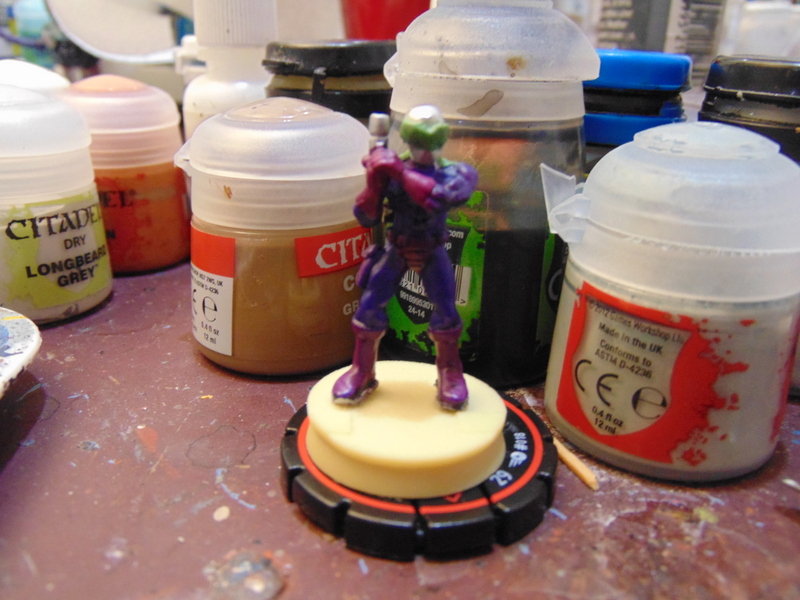
The gun was a small issue. The one that the medic was holding looked like some kind of laser blaster (I’m not familiar with Intergang, so I don’t know what they use for guns). That simply wouldn’t do, as Vigilante uses a .357 Magnum. So I clipped one from a Heroclix Henchman and made the swap. (I know he’s holding an automatic in the picture above, but just trust me. It was usually a .357 revolver.)
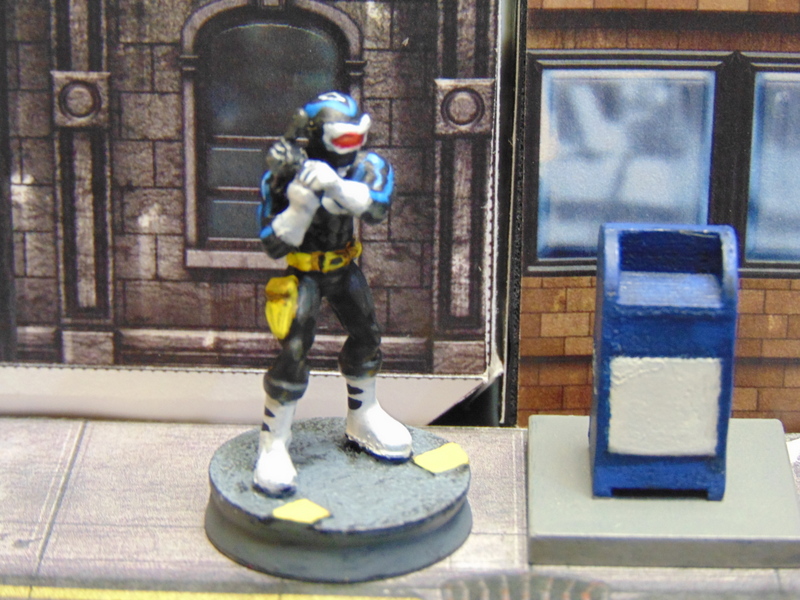
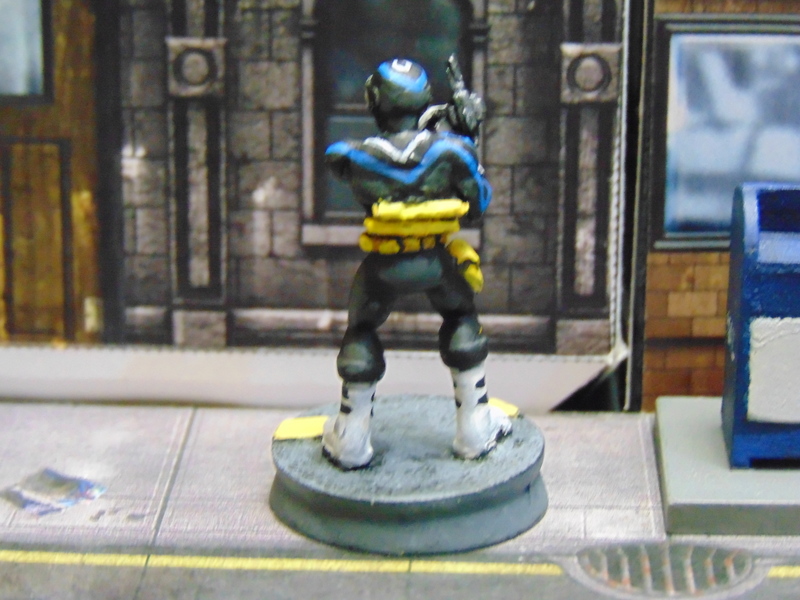
Vigilante also uses a pair of nunchaku for when he gets up close and personal with scumbags who need to be put down hard. I just used some brass rod, cut to size.
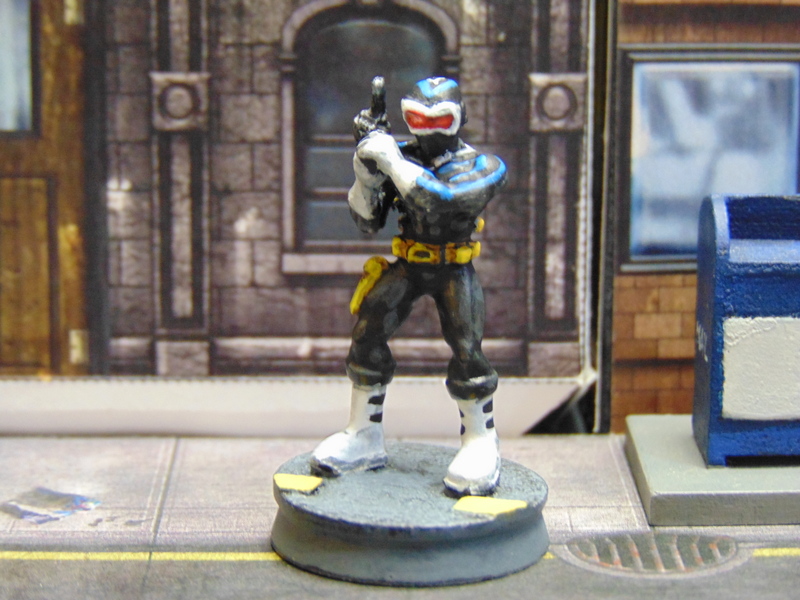
Technically, Adrian Chase was a lefty, so his holster should be on the other side, but I can live with this relatively minor inaccuracy without hurling the miniature across the room.
And that officially brings me to the end of Forgotten Heroes this year. I’m looking forward to seeing what everyone else does!
As Ringo would say, “Peace and Love, Peace and Love…”
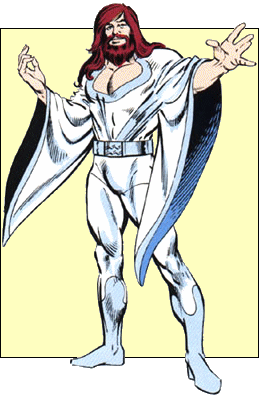
As Forgotten Heroes draws to an end this year, I have saved the truly worst for last. I present to you: The Aquarian!
Sigh. Where to begin?
The Aquarian’s name is Wundarr, and he was born on planet Dakkam. When he was an infant, his father put him in a rocket and launched Wundarr into space because—wait for it—he thought Dakkam was about to blow up. Turns out he was wrong. Oops.
Wundarr drifted through space in suspended animation until he arrived at Earth, where he was bombarded by cosmic rays in the outer atmosphere and got superpowers. (This somewhat plagiaristic origin story may sound familiar to you. Perhaps he should have been named “Suparr” instead. I have to assume it was meant as a parody; either that or DC found the Aquarian so ridiculous they didn’t want to draw attention to the similarities and forever associate their own character with this ball-bag.)
Wundarr grew to maturity in the spaceship, but he still had the mind of an infant when he crashed on Earth. The Thing took him under his wing for a while, then Namorita kind of adopted him before Project: Pegasus grabbed him up and used him to study the Cosmic Cube. Nothing good ever really comes of that, but Wundarr got wicked smart (I’m from Massachusetts) and his powers were increased. He called himself the Aquarian and made it his mission to bring peace and enlightenment to the world. When not doing these things, he tours the country playing the title role in Jesus Christ Superstar.
OK, I made that last part up. (Or did I?)
The Aquarian missed out on being faster than a speeding bullet, but the cosmic rays made him more powerful than a locomotive and able to leap tall buildings in a single bound. This is because he absorbs all kinds of energy and converts it to kinetic force, which he must discharge periodically by doing something physical, lest he explode. This won’t harm him, but the same can’t be said for anyone around him when he goes boom, so he jumps around a lot. He also has a force field that nullifies most superpowers and makes him pretty much invulnerable to anything kinetically powered, like a bullet or a punch. Presumably, you can still give him a hug. He would probably like that.
I first discovered the Aquarian in the unreadable Captain America Annual #7. I have tried to get through this particular issue about ten times in my life, and I don’t think I’ve made it very far. It’s torture.
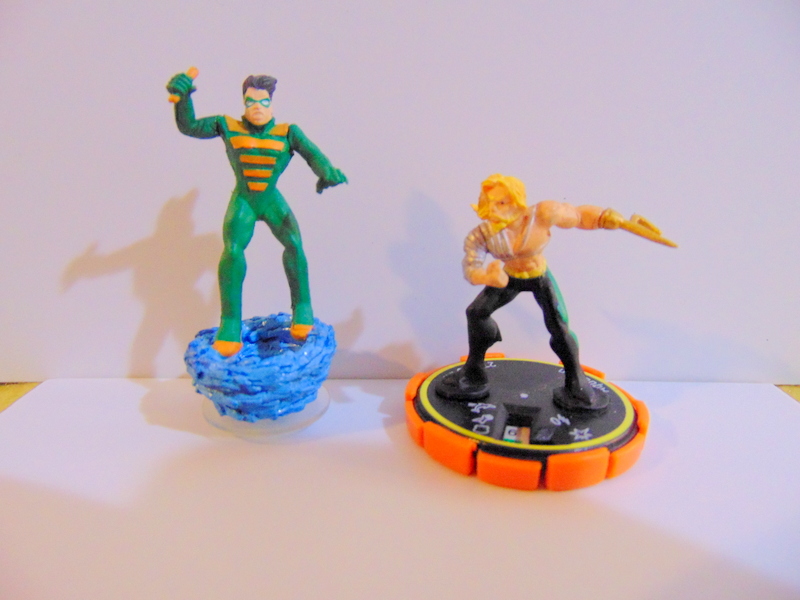
To make this conversion, I used two miniatures, the head of an old Aquaman miniature and the headless body of the Weather Wizard I used making Water Wizard earlier this month.
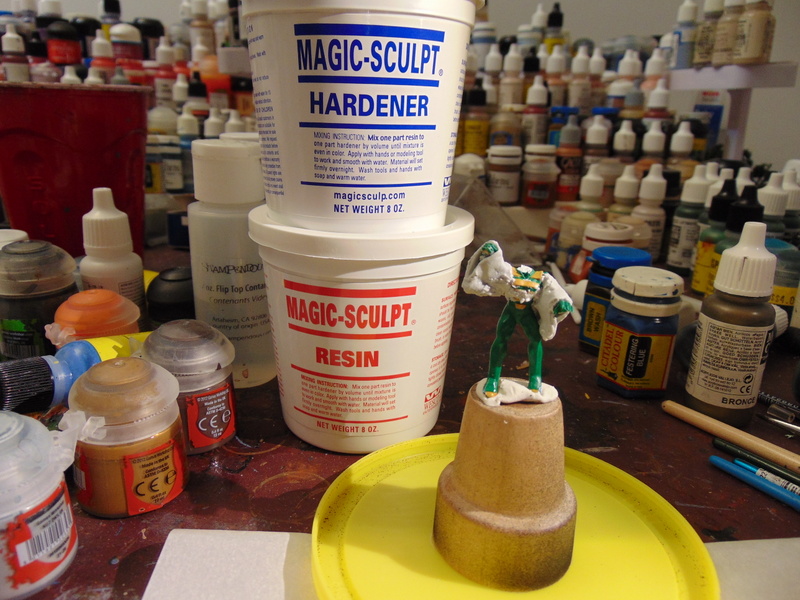
I needed to do a fair bit of sculpting to make the Aquarian’s ridiculous sleeves. As anyone who visits this blog regularly knows, green stuff is not my friend. I decided to try this Magic Sculpt, which is similar in function in that it is a two-part sculpting medium, but it behaves quite differently than green stuff. It’s not as sticky, and it takes a little longer to cure completely. When wet, it gets really soft, which makes holding its shape difficult. It’s also a hell of a lot cheaper. This 1 lb. set cost me less than $20. An 8″ ribbon of green stuff costs $15!
I think my concept was solid, and the miniatures used were pretty good choices, but…
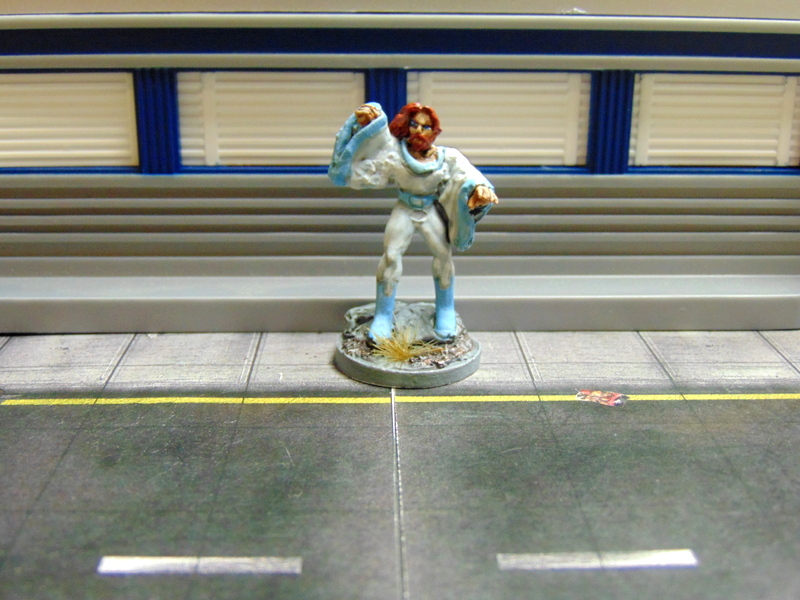
the actual execution is somewhat lacking. Here is the finished model. I’m not thrilled with how he came out. I would have liked to add more texture to the cloth sleeves, but I got annoyed with the Magic Sculpt and decided the hell with it. Hopefully by the time Forgotten Heroes rolls around next year I will be more adept at sculpting.
Nevertheless, I now have a perfectly serviceable Aquarian miniature for supers gaming, should I ever want to use him in a game, which I can’t imagine I would. Ever.
Wait…now I have to, don’t I?
I’m trying to get three submissions in for the Forgotten Heroes challenge this month, and here is number two. If you found Water Wizard to be a bit of a tool, well, congratulations. You’re a great judge of character. But Water Wizard lives life like a boss compared to this guy:
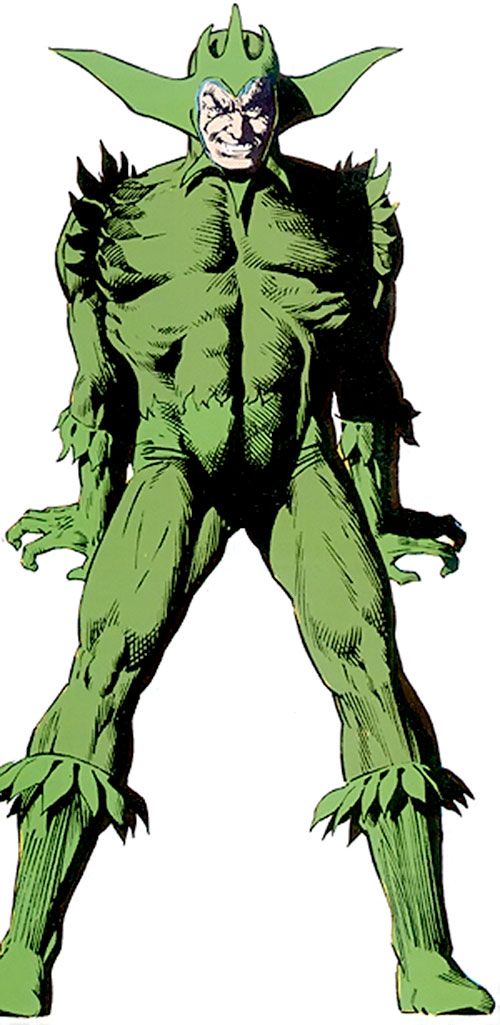 Behold! The Plant Man!
Samuel Smithers was a gardener who wanted to invent a way to talk to plants, so naturally he built himself a ray gun. It didn’t work until one day it was struck by lightning, which somehow charged it with the ability to control and animate plants (I’m not making this up). His boss fired him for working on his ray gun instead of pruning the bushes (which was his job), so Smithers put on a costume, called himself the Plant Man, and vowed revenge. Unfortunately, he met the Human Torch, who quickly put an end to Plant Man’s scheme and destroyed his ray gun.
Months later, he built a better ray gun, which was also presumably struck by lightning and imbued with (better) plant-controlling power. He tried to kill the Human Torch, but failed and went to the slammer, where he was recruited by Count Nefaria; along with the Porcupine, the Eel, and the Scarecrow. (This Scarecrow is not to be confused with the cool Batman villain with the fear gas, and certainly not to be confused with the coolest crow of them all… Carrion Crow. This is Marvel’s Scarecrow. A significantly less-cool crow.)
Any one of these jokers would be prime fodder for Forgotten Heroes, as they’re all remarkably bad at their chosen criminal profession. But I digress.
Plant Man eventually ran afoul of the Avengers and SHIELD, after he took over a SHIELD base with a 100′ tall plant monster and a bunch of plant copies of himself. That’s about where I lost track of him.
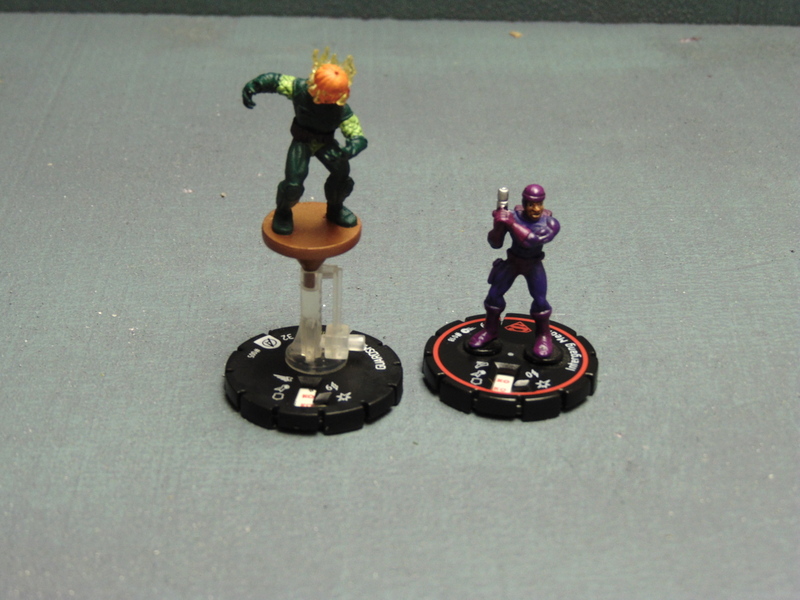
To make this conversion, I used two Heroclix figures: Jack O’Lantern and an Intergang Medic. I needed the Medic’s head on Jack’s body. I also removed Jack from his hover disk and rebased him on some plain old MDF.
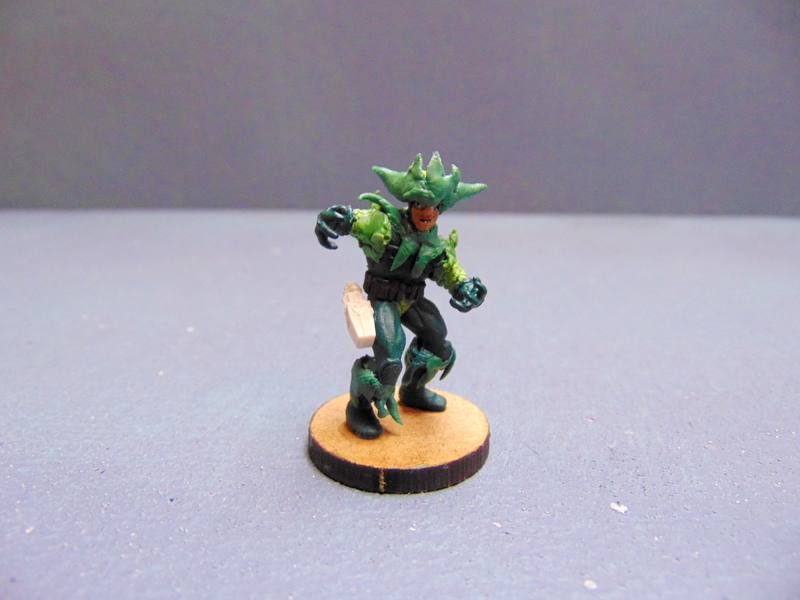
Then I set about adding the green stuff. I said it before and I’ll admit it again, sculpting is not my strong suit. Many thanks to Roger, a.k.a. Dick Garrison, for taking the time to give me some advice on how to work with this hellish substance.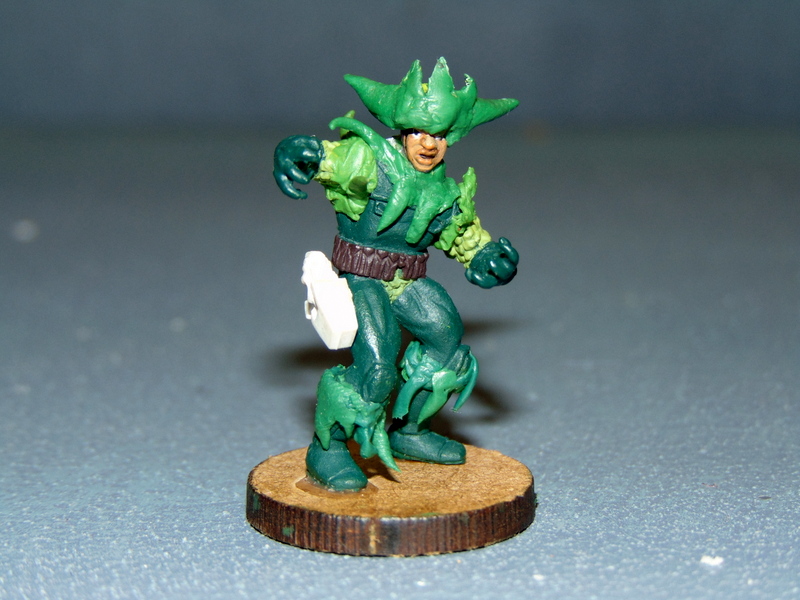
Lucky for me, all I really needed to do was sculpt Plant Man’s ridiculous headdress and some plant fringes around his collar, shoulders and legs. (I forgot his gloves, but whatever.) Since Plant Man’s powers all come from his ray gun, I attached a Rogue Trader-era bolt pistol (minus clip) to his thigh.

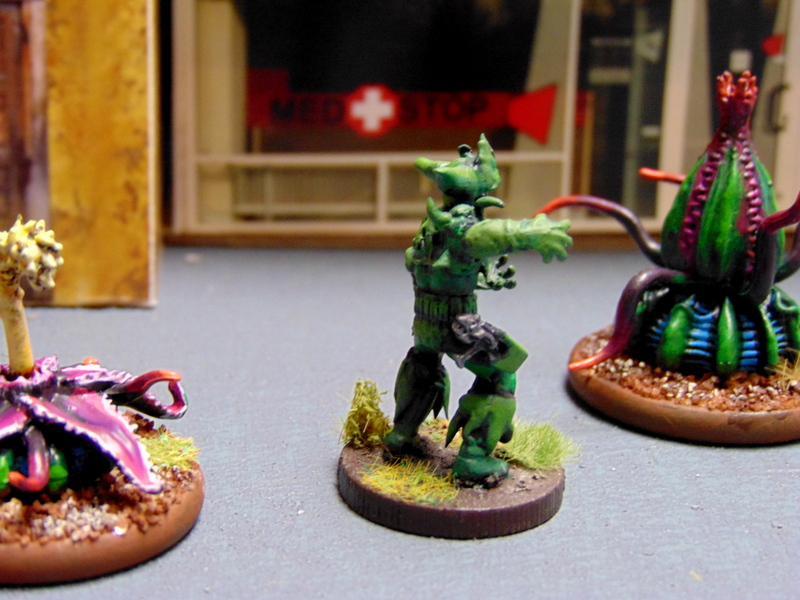
I posed him next to some killer plants, last seen in my Poison Ivy post.
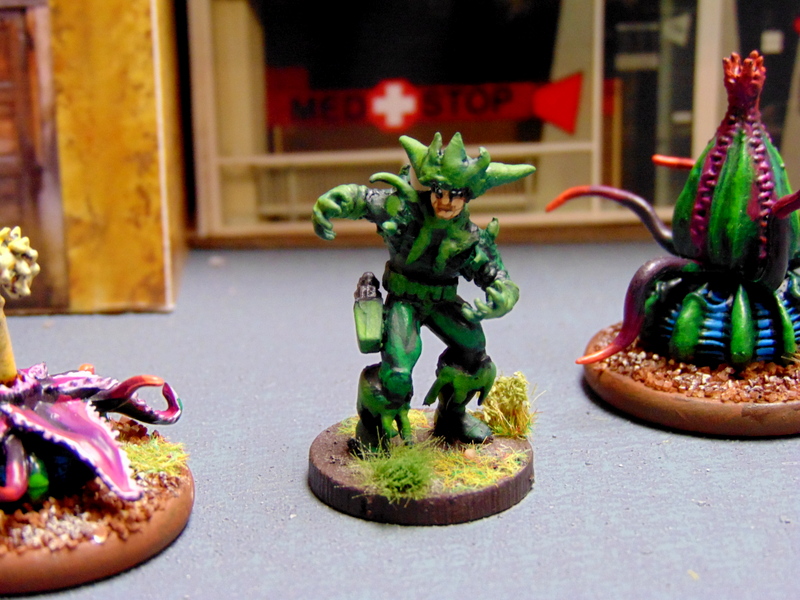
Tremble in fear, for the Plant Man cometh!
I must confess I have an ulterior motive for converting Plant Man. He actually appears as a villain in an old TSR Marvel Super Heroes module, The Last Resort, which I plan on tinkering with for Super Mission Force. Originally, I was just going to replace him with another sucky bad guy, but Forgotten Heroes has given me the excuse to put some effort into making an actual Plant Man miniature!
Hopefully I can get my third submission in by the end of the month, but it will require more precise sculpting with the dreaded green stuff. I’ll do my best!
It’s June, which means it’s time for Forgotten Heroes!
Last year my fellow miniatures enthusiast Carrion Crow invited me to take part in the Forgotten Heroes challenge. I played hard to get at first, but then when I saw how much fun it was going to be, I begged him to let me take part. He graciously agreed. I converted and/or repainted the entire Liberty Legion, along with special guests Spirit of ’76, Patriot, Union Jack and Bucky! This year, I’m hoping to submit three Forgotten Heroes, not a whole team. So, without further ado, here’s the first:
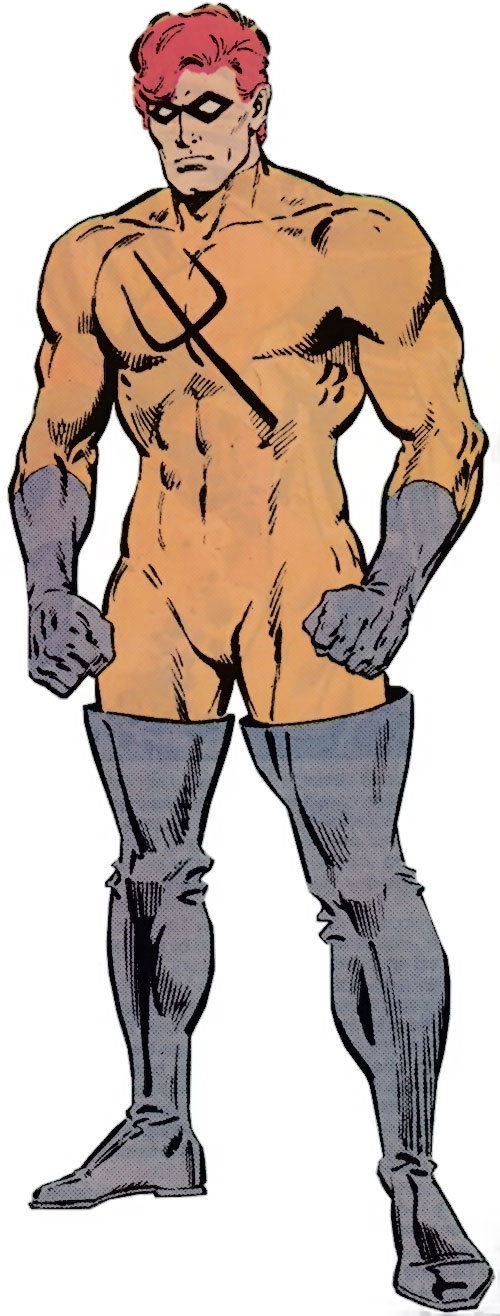
The Water Wizard is a really lame Marvel villain with water powers. In fact, it turns out he can control almost any liquid, not just water. You would think this would make him pretty powerful, but Water Wizard is an idiot. In 1977, he made his debut in the Ghost Rider comic book and promptly got his clock cleaned by Ghost Rider, both in his initial appearance and pretty much every time they met after that.
He actually fought some other Marvel good guys, like Captain America, with predictable results (he lost). He was recruited by criminal financier and Hugh Hefner lookalike, Justin Hammer, but ran away when he had to fight Iron Man.
After a while, Water Wizard changed his name to Aqueduct, which is an even dumber name than Water Wizard, and tried to continue his criminal ambitions. Instead he joined the Thunderbolts and that’s about when I lost track of him.
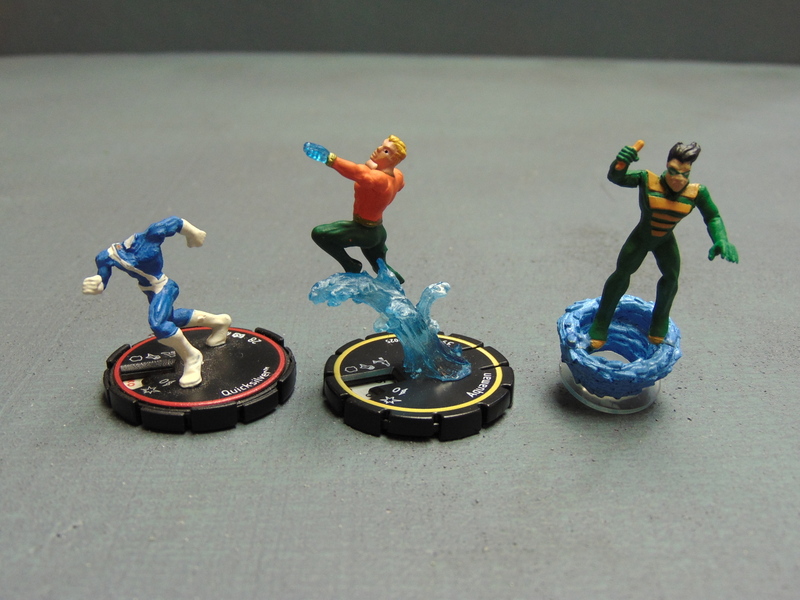
To make this conversion, I used three figures. Because I never throw anything out, I had a headless Quicksilver left over from when I made Jack Frost in my first Forgotten Heroes challenge last year. . He’s been grotesquely hanging around in a corner of my hobby space since then. I thought that the head of the Weather Wizard (similar name, different publisher, equally lame bad guy) would look pretty good on the body. His hair is already blowing around, so it would match pretty well with the running pose. For added effect, I thought I would use this water spume on the Aquaman figure for something…
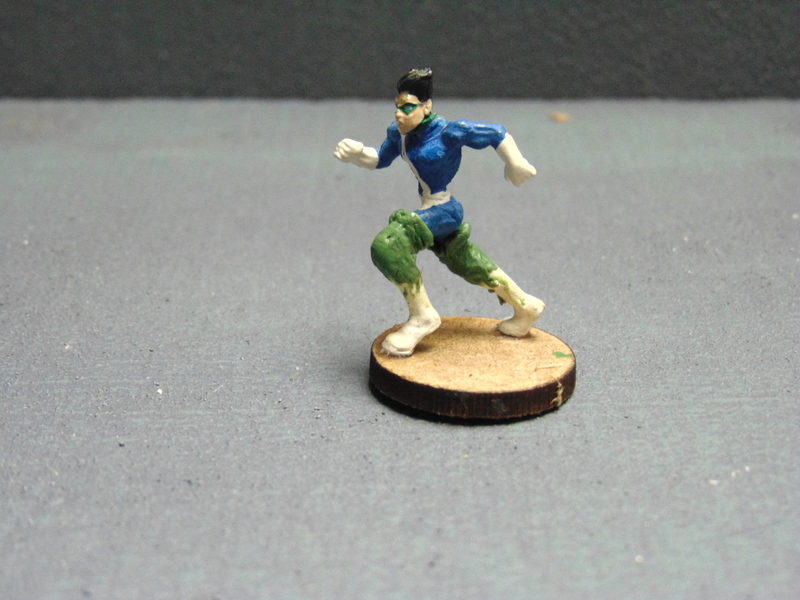
An idea took shape. I re-headed and rebased the miniature, and sculpted his fashionable hip waders out of green stuff. (A side note: I suck at sculpting anything. This is problematic, as my next Forgotten Heroes submissions will require much more sculpting. Thus I have sought the aid and advice of a sculptor extraordinaire to guide my efforts henceforth…)
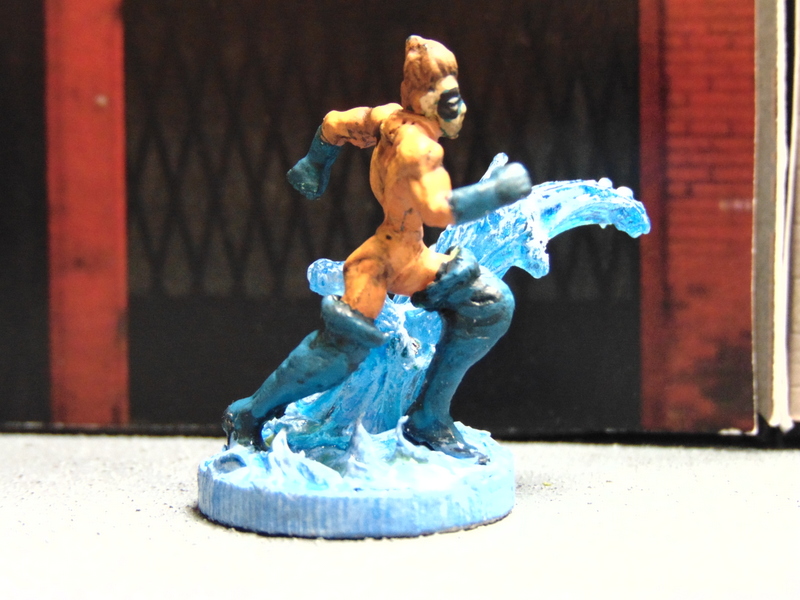
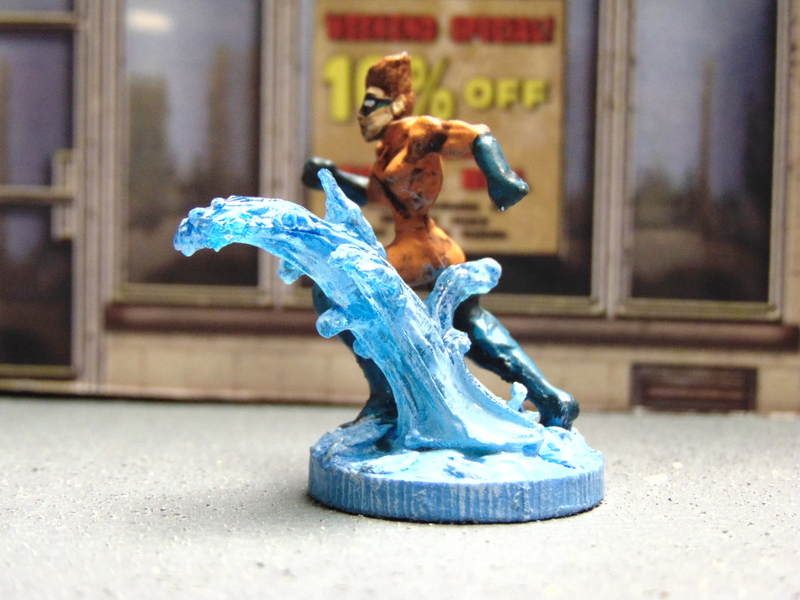
I removed the cumbersome Aquaman model from the water spout and attached it to a base of green stuff sculpted to look like water (I can handle that much). Now it looks like the water is moving with him. Then I painted the model to resemble Water Wizard.
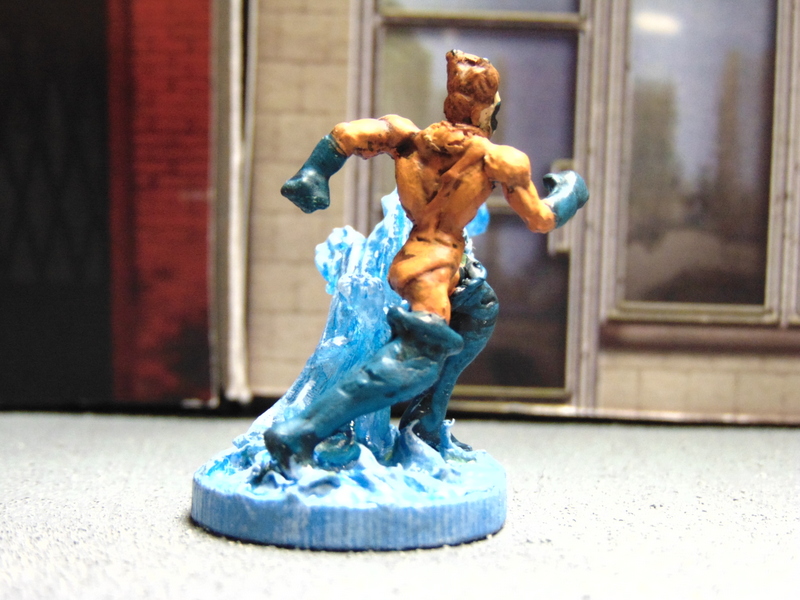
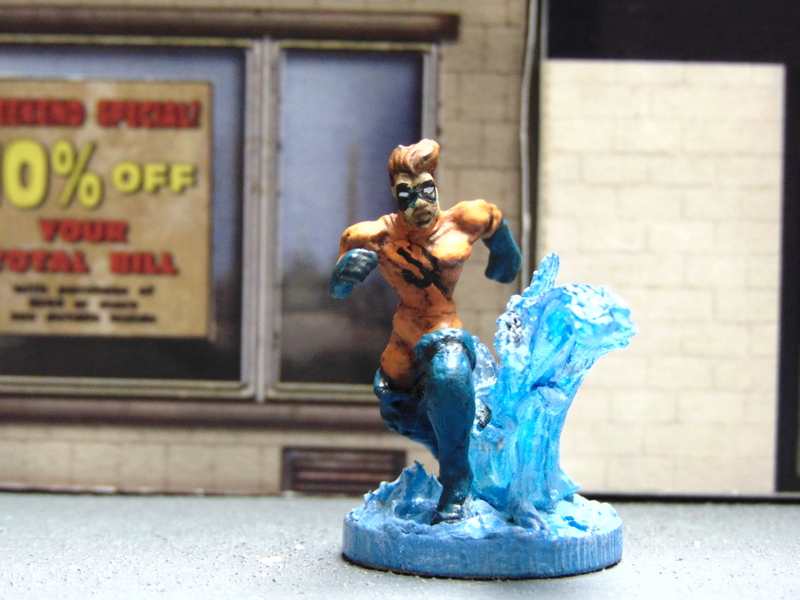
Hi running pose actually looks pretty accurate. I only have to face him away from any hero model since Water Wizard often flees. I don’t have a Daredevil-like sense of touch, so I couldn’t tell if the diagonal slash on Quicksilver’s costume was raised or if it was just a painted on until I painted over it. Turns out it’s actually part of the sculpt, which is unfortunate, as you can still barely see it through my paint. Also, I now have a headless Weather Wizard where my headless Quicksilver used to be.
Forgotten Heroes 2018 submission 1: complete!